Site Menu:
| This is an archived Horseadvice.com Discussion. The parent article and menus are available on the navigation menu below: |
| HorseAdvice.com » Horse Care » Routine Horse Care » Estimating Weight, Height, and Body Condition Scoring » |
| Discussion on Predicting final height in growing youngster | |
| Author | Message |
| Member: Maggienm |
Posted on Sunday, Mar 14, 2004 - 8:46 pm: Dr O I understand that the cannon bone is one of the first bones to stop growing. Is that right? I have been told to measure the connon bone after 6 months and that will translate to the horse height. If the bone is 15" the height will be 15 hands, with 1/4 horses short cannons this might not work for them. |
| Moderator: DrO |
Posted on Monday, Mar 15, 2004 - 10:29 am: Yes the cannon quits growing somewhere between 6 and 18 months of age and somewhere I read that it is 90% of its adult length when the horse is born. I too have seen such recommendations on estimating height but have not seen them validated anywhere. Our article on height estimation, Care for Horses » Routine Care & Procedures » Weight, Condition, and Eventual Height Estimation does give you some verified quidelines for estimating height.DrO |
| Member: Gmwalker |
Posted on Monday, Mar 15, 2004 - 4:49 pm: It's funny that I just got a reminder on this thread. My little mare, and I do mean little, never really grew much more. She's 15.3 hands--just large enough for the AHS studbook. She's had one foal, who looks to have gotten some (not much) height from her dad (16.3 h), and will probably be 16.0 or 16.1 hands when she matures--her cannon bones are just a smidge longer.This mare has the SHORTEST cannon bones I've ever seen. If you tried to estimate height from them, you'd have been off by several hands! Hilary Clayton says that bodes well for soundness in the lower limb, but the mare unfortunately had a pasture injury (we believe she was kicked), and tore the medial collateral ligament in her stifle when she was 3 and is destined for life as a broodmare. She's given me one premium foal thus far, and is a delight to own, though--so I can't complain too loudly. |
| Member: Maggienm |
Posted on Friday, Mar 19, 2004 - 11:24 am: I have been told that very short cannnons predispose a horse to navicular disease. Do you think there is any truth to that? Thanks |
| Moderator: DrO |
Posted on Friday, Mar 19, 2004 - 7:40 pm: No, it makes no sense at all.DrO |
| Member: Gmwalker |
Posted on Friday, Mar 19, 2004 - 9:53 pm: Dr. Hilary Clayton, a vet who specializes in studying biomechanics of movement, did a study of characteristics as related to soundness. She specifically found that short cannon bones were positively related to longterm soundness in the lower limb--which would include the navicular. So I would say that her series of more than 100 horses definitely ruled out there being any truth to what you heard. |
| Member: Christos |
Posted on Saturday, Mar 20, 2004 - 8:32 am: Laurie,The canon bone is the main lever that moves the horse. The shorter it is, the easiest for the horse, and the less wear and tear on adjacent joints, tendons and ligaments. |
| Member: Liliana |
Posted on Thursday, Mar 25, 2004 - 10:51 am: Hello there Terence,How are you, I have not seen any answers to your questions, so here I go; normally to measure a horse one uses hands, originally people used the with of their hand to determine the height of a horse or pony. 1 hand is about 4 inches, any animal up to 14.2hh is considered a Pony, and you measure from the floor to the wither therefore a 14.2 pony would be 56.8inches. You mention a stud foal, I guess what you are trying to say is a colt (male) foal; in my opinion nature is wiser than any of us, my colt is almost 14 months old and he still suckles on occasions, I guess is more for comfort rather than nourishment, he has been allowed to be with his mother and father, so they have been his trainers to a point, they are very well mannered so the colt is the most gentle animal I have ever had, he knows no fear, trusts us 100% hence he is very easy to train, all we need to do is be a little patient when we introduce something new. He is excellent with the farrier; of course he is not shod at all now. Please do not feel embarrassed to ask, none of us are experts from the beginning and I think it is very wise from your part to try and educate yourself rather than just see what happens and make your horse suffer. If there is anything else I can do to help please do not hesitate to write to me All the best Liliana |
| Member: Maggienm |
Posted on Saturday, Feb 19, 2005 - 9:17 am: Help with the math please. Dr. O, you said that a horse at 24 months a horse has reached 96% of final growth then said that means they still have 10% of growth left. Wouldn't it be 4%? I know someone is laughing their head off. math is not my strong suit.So 10% of 16 hands is 16 x 4=64 x 10% =6.4 so a horse that matured at 16 hands would be 14.2 at 24 months? Gay, if you are still out there what did your horse mature at? |
| Member: Christos |
Posted on Saturday, Feb 19, 2005 - 12:55 pm: It is simple, Lori,DrO says that a horse is born, let's say, 60% of the final height. That leaves 40% to go, ie the horse's total growing, from birth to full development, will be 40% of the final height. At 24mo the horse has reached 96% of final height. There's 4% to go. That's 10% of total growing, not 10% of final height. |
| Member: Gmwalker |
Posted on Saturday, Feb 19, 2005 - 4:06 pm: She matured to just a smidge under 16 hands.I've found the "string test" to be pretty accurate in all cases, with the exception of my surviving twin, who shot pretty much off the chart for growth in the first 3 months...and her proportions changed incredibly. The estimate at a few days old suggested 14 hands, but done again looks like she'll be a normal for her warmblood breed of 16.2 or thereabouts...and she's about the same size as the other warmblood weanlings we have born around the same time. |
| Moderator: DrO |
Posted on Saturday, Feb 19, 2005 - 6:04 pm: Christos has it right you are confusing the percent of the final total height with the percent of the amount of total growth. In one you start at a height of 0 and in the other you start with the height at birth. Refigure using the 96 to 98% figure and you will get the approximate height at 24 months.DrO |
| Member: Chrism |
Posted on Monday, Feb 21, 2005 - 2:19 pm: Um, Lori -Don't forget to convert hands to inches. 96% of a 16 hd horse (use 64 inches) is 61.44 inches. 96% of a 15 hd horse (use 60 inches) is 57.6 inches. Just multiply number of inches of expected adult height by .96. HTH. |
| Member: Imogen |
Posted on Thursday, Dec 1, 2005 - 4:10 pm: My head is hurting after reading the article and this thread and others on height estimation.My filly is approximately half Irish draft, half thoroughbred (if you want to be fussy she's 9/16 Irish draft, 4/16 Holsteiner and 3/16 Irish thoroughbred). Both parents are 16 hands 2. She is now 7.5 months and 13 hands ok maybe 13 hands 1 it depends when you measure her. She hasn't really grown since I weaned her at 5 months although she put on about 15 kg according to the weight tape and currently weighs 250 kg although I think some of that is winter fur. I weaned her maybe a little bit early but she was growing so fast and had such long/upright pasterns I was worried she'd get OCD. According to Dr O's article if I understand it right she's likely to end up 16 hands. The other two methods advised in the various threads were measure the elbow to the chestnut and, if I understand it, add that on to find the final height (can't really understand this one, surely the bigger the foal is when you do this the bigger the final height estimation...?) anyway that's 12 inches. ... or is it measure elbow to fetlock and then add that on? ... and also measure mid-knee to mid-fetlock which gives me 12 inches and add that on to the current height which gives me 16 hands again. or maybe just about 16h1 Can anyone unconfuse me? Or am I right in which case she'll likely end up too small for yours truly at 6 ft/11 stone unfortunately! Thanks Imogen |
| Member: Imogen |
Posted on Sunday, Dec 4, 2005 - 9:03 am: Hey mathematicians where did I go wrong? I decided to try all three estimation methods and they all come out decidedly different...First I measured the filly again on a concrete stable floor. When her head is up ie not stooping to get more grub into her mouth from a feed bucket which is how I was measuring her before, she is actually 13 h2. Dr O's method. A 6 month animal is 83 to 86% of final height A 9 month animal is 87 to 90% of final height. So I said ok she is 7.5 months, let's say 86%. 13 h2 is 54 inches. So 54 x 100 / 54 = 62.79 inches or about 15 h3. The canon bone length method (measure mid knee to mid fetlock - add to horse's current height). She is 12 inches from knee to fetlock so final height would be 16 h 2. The elbow to fetlock method - measure elbow to fetlock, add it to the elbow to ground height. Elbow to fetlock (dunno why, I measured this one in centimetres) 72 cm. Elbow to ground 90 cm Total 162 cm which is 16 hands. Or is it just that you can take your pick which one suits your aims? Still confused... I promised to return to this thread in 2.5 years and tell you what she made! Though I have always been told that drafts and draft crosses can continue to grow until they are 5. All the best Imogen |
| Member: Lilo |
Posted on Sunday, Dec 4, 2005 - 9:33 am: Imogen - your result is correct for method 1 - but to get there you have to do this:54 x 100 / 86 = 62.79 inches You probably just have a typo. Lilo |
| Moderator: DrO |
Posted on Sunday, Dec 4, 2005 - 9:58 am: The problem is that none of these techniques are precise to within several inches Imogen so all these answers probably fall within the margin of error. Then again I think your assumption to take the largest size of 6 months would not be how I would do the estimate using our formulas. Instead I would have taken the average of the 2 ranges (appx 85 to 88%)and calculate a minimum and maximum estimate of the final height.DrO |
| Member: Maggienm |
Posted on Sunday, Dec 4, 2005 - 10:23 am: Imogen,My understanding is when you measure from the mid-knee, I use the crease that is present in young horses, let the tape fall to the coronet band. If you measure 15in the final height will be 15 hands, 15 1/4" will be 15.1. When you measure from the elbow to the ergot hold the tape carefully at the elbow and pivot the tape from the ergot up to the withers. The tape should extend higher than the withers. This is the tricky part, you have to 'eyeball' where the final height will be. In the past couple of years I have used both methods on a number of youngsters. Most of these horses still have some growing to do but so far it appears that the knee to coronet measure is the most accurate. Hope this helps. |
| Member: Imogen |
Posted on Sunday, Dec 4, 2005 - 12:12 pm: Thanks allLilo yes, typo, working too many hours, the details are getting lost! Dr O, that makes sense I was just a bit confused why the range in the article goes up to 6 months then 9 months on - does something weird happen between 6 and 9 months that makes the formulas hard to use then? Lori - I'll try the coronet one, given that this foal has ridiculously long pasterns it's definitely going to give me the answer I am hoping for! Thanks all, this site is just the best. Imogen |
| Member: Poncho |
Posted on Wednesday, Nov 15, 2006 - 11:54 am: I have a 18 month old QH filly, I taped her and she was 14.2 at the withers and 15 on the hind. Translate, she was 58 inches, if we go by the 94% she should end up to be 15.2 or 15.3...is that right??? |
| Moderator: DrO |
Posted on Thursday, Nov 16, 2006 - 6:18 am: The math should look like this, with X being the final height:X(.94) = 58 X = 58 / .94 X = 61.7 This translates to a little under 15.2. |
| Member: Imogen |
Posted on Thursday, Nov 16, 2006 - 2:51 pm: It's nearly a year since I last posted on this thread.My filly is now 15h 1.5 and 18 months as I happened to measure her today. Using Dr O's article she is now 94 to 96% of final height X(.94)=61.5 or X = 61.5/94 = 65.4 inches or 16h1.5 at a stretch or X(.96)=61.5 or X=61.5/96 = 64 inches or 16 hands Here's still hoping because 16 hands 1 would be minimum height for me to keep her to ride myself... I'm not giving up just yet since mum and dad are both over 16h2. Maybe I'll have shrunk a bit through osteoporosis by then! She'll definitely carry my weight at 11 stone but I look a bit too tall when I ride her mother... See picture of both in my profile. Another update next year! Imogen |
| Member: Maggienm |
Posted on Friday, Nov 17, 2006 - 10:44 am: Imogen, I hope you get the height you are loking for.I am now in the same boat hoping my filly will get tall enough. You have probably experienced the same thing I have where the size of the barrel affects the 'fit' as much as the height. |
| Member: Imogen |
Posted on Friday, Nov 17, 2006 - 2:49 pm: Yes, I agree, Lori, but actually the size of my filly's barrel gives me some hope she will still grow as she does not look "right" yet (barrel too large for the rest of her, see the pic in the profile). Mind you, she could still just turn out to be both small and ugly with a large barrel of course...Imogen |
| Member: Qh4me |
Posted on Wednesday, Dec 6, 2006 - 2:48 pm: Hi Dr.OYour table is helpful, but I have a 7 month old QH colt that currently stands 13.2 at his withers. Using your table, there is no % listed for 7-8 months. Could I use the high end of the 6th month (86%) and be fairly accurate. If that is the case, that means he could potentially be 16.2??  Mare is 15hh and sire is 16.0 so I was hoping for something in between. But over 16 will be fine too! |
| Moderator: DrO |
Posted on Thursday, Dec 7, 2006 - 7:48 am: Shawna, I suspect there is considerable overlap between the 6th and 7th month ranges so you should also use the low end for a range of probable heights. But when I double check your math I get a little under 15.3 hands.DrO |
| Member: Ella |
Posted on Thursday, Dec 7, 2006 - 10:41 am: So my 18 month yearling that is currently within a half inch of 16h at the withers is going to get to be about 17h.I have raised a giant! (mom and dad were only 16h but there is a grandparent on both sides that is 17h) Ella 
|
| Member: Sjeys |
Posted on Thursday, Dec 7, 2006 - 10:59 am: Along these lines, I had a beginners question. If the height is genetically determined, then why do people insist on feeding rich foods to "speed up" growth. Besides the risks of OCD et.al, are they thinking that they can sell the youngster faster if they are bigger?I guess I'm not understanding why if you are going to get a 16hh horse to end with, why you would push their growth in the early years...aren't you going to end up with what genetics gave you in the first place? I am assuming no malnutrition since that will obviously stunt their growth. |
| Member: Imogen |
Posted on Thursday, Dec 7, 2006 - 4:01 pm: Hi Susan I think a lot of it is to do with showing - for showing youngstock need to be as big as possible as early as possible. Unfortunately many animals that win as foals or yearlings or even two year olds are never heard of again though some are!Imogen |
| Member: Qh4me |
Posted on Monday, Dec 11, 2006 - 10:55 am: Susan,I agree with Imogen. Main reason is todays market rewards big growthy colts in the show ring, and with a higher value at the big sales for show prospects. I know in the Quarter horse world, bigger is better. We start showing as weanlings, and the big babies definitely have the advantage, right up to 2 years old. In order to be competitive, you need a big baby, born as early as possible. If you have ever seen the Quarter Horse Congress pictures or World show pics, the weanlings are huge and look more like yearlings. Here is a picture of a weanling stallion who won the Congress this past year. https://www.oqha.com/congress/congressresults/06results/r1030go1.htm |
| Member: Sjeys |
Posted on Monday, Dec 11, 2006 - 11:44 am: Yikes; that looks like a long yearling. I wish people would realize these "Futurity" shows are FOR and BY breeders...so they can breed, breed, breed and sell, sell, sell. What I wouldn't give to be wealthy and hold a "LONGEVITY" show in the different disciplines. You'd have to be healthy, non-medicated and at least 12 years old to show with a growing purse for the older the horse was...that's what breeding should really be focusing on is the long term.
|
| Member: Mrose |
Posted on Monday, Dec 11, 2006 - 1:00 pm: Susan, I'd be supporting you and showing in those classes! So would quite a few other people I know. |
| Member: Erika |
Posted on Monday, Dec 11, 2006 - 7:14 pm: Great idea Susan! Wish there were more wise people like you. |
| Member: Maggienm |
Posted on Monday, Dec 11, 2006 - 10:34 pm: classes for older horses, great idea. |
| Member: Sswiley |
Posted on Tuesday, Dec 12, 2006 - 10:13 am: I think there is a difference between when a horse grows. My mare, now 7, did all her growing in her first 2 years. I did not grain her either. We were horrified that I would end up with a 17HH horse. I was planning on keeping her and 16 - 16.2 HH if fine for me. She ended up stopping at 16.2 when she was two. Never grew after that. Her half sister and brother both grew well into their 5th year and they ended up smaller. |
| Member: Imogen |
Posted on Wednesday, Dec 13, 2006 - 2:37 am: ShelleyHalf sister and brother - was there any breed difference in the sires that might account for the final size and when the growth occurred? As I'm sure you know although there isn't much research on it (becuase the research is mostly on TBs), and some of the "growth" is probably muscle formation, most people believe TBs grow early (up to 2 yrs), while drafts and some halfbreds keep growing slowly to about 5. I'm all in favour of evidence for the latter for my midget but I'm starting to lose faith! Imogen |
| Member: Sswiley |
Posted on Wednesday, Dec 13, 2006 - 10:24 am: Imogen,They were all pretty much 1/2 TB 1/2 WB. Different sires. Yes, I think the sires growth habits might have influenced them. But most of the time you only know the final height of the sire, not the growth pattern. |
| Member: Imogen |
Posted on Thursday, Dec 14, 2006 - 4:50 am: One of the excellent things about the Irish Horse Board records and statistics is that for most successful sires if the sire's dam had any competition record you can often get the height of both grandparents on that side, and you hope you know something about your mare's parent's height already...Unfortunately my midget had at least one grandparent under 16 hh (sire's dam - I saw her in the field at the stud when she was an old lady and I'd say she was 15h2 or 3). Also old gents leaning on the rails of the showing ring will always tell you "Irish draft sires can always throw a small one..." I think grandparent height maybe an overlooked factor on final height - see Ella's post above. I wonder if anyone has researched the effect of grandparent height? Hard to do except in TBs probably, that may be another reason why most of the research is on TBs. All the best Imogen |
| Member: Ella |
Posted on Thursday, Dec 14, 2006 - 12:54 pm: Dr O., On this size subject.....Does the size make a difference to the health of the horse and their joints in the long run if they are started at 2 years. For example the yearling I have that is looking like she will near 17h is an appendix QH. 3/4 QH and 1/4 TB. All the other QH 2 year olds at the farm I am at will start training at 2 and will be W/T/C by the end of the summer. Should she wait because of her size? I think 2 is young anyway. Even if we start her I will only get her green broke and then turn her out for the winter but with her size should she wait until she is 3 to do anything? Ella
|
| Member: Gmwalker |
Posted on Thursday, Dec 14, 2006 - 1:30 pm: I just returned from the USDF Convention where Dr. Hilary Clayton gave a lecture. She presented some evidence (based on research done in warmbloods) that suggested it was ADVISABLE to start horses in their 2 year-old years, but to start them VERY SLOWLY with a program of progressive loading (meaning gradual increase in duration, intensity and frequency--but only one of these at a time) with the ultimate goal of working W/T/C for 45 minutes 5 or 6 days a week. She suggested starting out at 10 minutes every other or every third day.The reason is that through the 2 year-old year and into the first part of the 3 year-old year, the horse's tendons, ligaments and cartilage retain the ability to show an ADAPTIVE response to exercise that will help them be less prone to injury as adults, but ONLY if they are allowed adequate time to adapt between periods of exercise and if the exercise load is low enough to begin with and increased slowly enough. She does NOT recommend turning them out after they are started, but rather continuing to work them to strengthen their muscles to support them for the work that they will later be asked to do... she calls this a gradual conditioning program. She recommends only walk/trot/canter and simple work for the first 18 months under saddle, because injuries occur as a result of muscle fatigue and improper muscle conditioning, which transfers stress to ligaments and tendons and puts torque on cartilage. It was a fascinating lecture. |
| Moderator: DrO |
Posted on Friday, Dec 15, 2006 - 6:27 am: Gay, we have been publishing this research on Horseadvice for the last few years: race horses with training started later have greater soft tissue break downs however and tissue development in response to age and work. I do disagree with Hillary Clayton about cartilage adaption as it is all but over by 2 years of age.But still the question unanswered is how much is too little, enough, or too much? We still don't have a firm hold on these questions. The other side of the coin is does this early work increase (or decrease?) the chance of later arthritis? It certainly is going to depend on the amount of work vs the natural strength of the horses tissues. Currently I too am of the philosophy that horses can begin very light training as a 2 year old with the purpose of finishing ground manners, getting use to a saddle and weight on the back, and develop a dependable whoa, which is after all the most important gait a horse has under saddle. I strongly disagree with the notion these horses should not receive regular turn out for the very reasons she gives and more. I believe muscle, tendon, and bone need almost continuous stimulation to become strong. It is true tissues require a recovery time following stress to remodel but horses regularly turned out do not spend their time tearing around the pasture. Sunlight and green grass are important nutritional benefits for the horse. Then there is the mental component of continuously stalled horses. Starting slowly and with a 2 to 3 day period of contiguous rest every week and frequent turn out should not only build the musculoskeletal system but provide for a good mental attitude too. DrO |
| Member: Ella |
Posted on Friday, Dec 15, 2006 - 7:57 am: I don't think Gay was saying not to turn out at all. I think she was telling me not to stop work and give an extended turn out period between the 2nd and 3rd year for the young joints to have a rest. That this break is not actually beneficial.It sounds as though It is o.k. to begin a very large 2 year old as long as I don't over do the work. Ella
|
| Member: Gmwalker |
Posted on Friday, Dec 15, 2006 - 10:18 am: Ella has it right. She was saying she doesn't agree with the time off between starting and restarting (except in the case of breeding them young, which she also agrees with). Her youngsters live outside 24/7 for as long as is practical.I have a coming 5 year-old that we started at 3, bred at 3 1/2. She foaled in her 4 year-old year, but was kept in light work until 1 month before, and started back when the foal was 2 months old (light work). She lived outside 24/7 until the foal was weaned, and now is in the barn for space reasons for 18 hours a day, but gets her rotation through the turnout. She's happy, her topline is wonderful, and she thinks her name is "good girl." Her work is wonderful, and we don't do anything much except walk/trot/canter... but her muscling is superb, as is her stamina. And it is this stamina, the ability to work without muscle fatigue, that Dr. Clayton says will protect her joints, tendons and ligaments. |
| Member: Maggienm |
Posted on Friday, Dec 15, 2006 - 1:08 pm: Do you know if the lecture from Dr. Clinton is available online? It seems to make a lot of sense; although like stated there are variables as to how much is too much.It makes sense that a six year old that has never done anything except mow pasture that is put to work, because he is six and can handle it, would have weaker tendons etc. Personally I am not sure the size of the horse relates to strength as far as standing up under saddle. My observation is the bigger they are the longer it takes to get strong. Among the breeding farms in the area they always say it is the big tall ones that they have a hard time keeping sound while they are growing. The only reason I can think of for this is a short 2x4 will bear more weight than a long one. Lori |
| Member: Gmwalker |
Posted on Friday, Dec 15, 2006 - 1:43 pm: USDF does not have a formal transcript of her lectures online, but I took notes and put them online (I do this every year) on my trainers' website. You can see reach them through the table of contents at https://www.germandressage.com/education.htmlI would recommend reading both of Dr. Clayton's lectures in order to get a full understanding of the points that she was trying to make, particularly with regard to protecting your horse's soundness. Once a horse had reached the age of 3 or 4, the tendons, for sure, have reached their maximum strength and can no longer adapt. At that point, the only thing you can do is build muscle stamina so that the muscles protect his tendons, ligaments and joints--and the larger horses take longer to develop the strength because they have more weight to heave around (the fulcrum effect you refer to). I think it also takes them longer to develop the coordination and fine motor control (also the fulcrum effect, because the hoof is swinging around on the end of a much longer "pole" and because it's a lot farther from the brain to the end of the hoof) but once they do, they learn and progress as fast as the smaller horse. I think the biggest mistake that anyone can make is to try to push a horse according to a preset schedule, rather than listening to the horse and working according to the horse's learning pattern and development. What is needed is to build muscle mass and carrying power so that the horse can carry himself with ease and without fatigue--then the least amount of damage over time will be done, regardless of age. |
| Moderator: DrO |
Posted on Friday, Dec 15, 2006 - 6:34 pm: Thanks for the clarification Ella, is this a standard practice in some disciplines or some areas: a year off after starting? I have never seen it practiced around here and we have most disciplines except flat course racing.DrO |
| Member: Mrose |
Posted on Friday, Dec 15, 2006 - 7:57 pm: Around here it is very popular with QH and other folks to start a horse under saddle around age one and a half or two, then turn it out to grow up for another year. Often the progression is: leave them out to run around until they are close to two; bring them in and halter break them then get them started under saddle; turn them out for another year; then bring them in and "get serious" about training them.Needless to say, this isn't the program I adhere to! |
| Member: Dres |
Posted on Friday, Dec 15, 2006 - 8:02 pm: A lot of the breeders here in N.Ca start the Warmbloods at 3 only 3 months is put on them and then they go back out to pasture till a solid 4.. Again light work for that year.. At 5 the hard work with advancement is begun...On the first day God created horses, on the second day he painted them with spots.. |
| Moderator: DrO |
Posted on Saturday, Dec 16, 2006 - 8:47 am: Interesting, I guess the logic was they were really too young to start but folks were anxious to get a bit of training on them before they become very strong in order to make the next step easier. Despite recommendations from experts we still are largely in the dark on this subject but the door is beginning to crack open and let a little light in.DrO |
| Member: Ella |
Posted on Monday, Dec 18, 2006 - 10:30 am: Sorry, I was away for the weekend.What we have done around here (Maine - very cold) is start them at 2 and work them until fall. We have then turned them out for the winter. Sometimes turned out to grow but sometimes just for practical weather related reasons. If there is not indoor arena access then it is not always possible to work. I can find an indoor to keep this filly going if that is what is best for her. The question is "What is best?" Ella
|
| Member: Ella |
Posted on Monday, Dec 18, 2006 - 10:35 am: Sorry, I was away for the weekend.What we have done around here (Maine - very cold) is start them at 2 and work them until fall. We have then turned them out for the winter. Sometimes turned out to grow but sometimes just for practical weather related reasons. If there is not indoor arena access then it is not always possible to work. I can find an indoor to keep this filly going if that is what is best for her. The question is "What is best?" I had always patted myself on the back thinking that I was doing my horses favors by giving them the winter off to heal and rest but maybe I should be kicking myself in the butt. That the time down is actually not good for them but harmful! That they need continued regular work to give the best support to bone and soft tissue. What about in middle aged and older horses? Is a few months off a year good or bad for them? Ella
|
| Member: Ella |
Posted on Monday, Dec 18, 2006 - 10:37 am: Whoops, I tried to add to the original post but I guess both of them ended up being posted. Sorry!Ella
|
| Member: Jgordo03 |
Posted on Monday, Dec 18, 2006 - 2:35 pm: I guess I go about it a little differently. I don’t go by a horses age I waited until they turn two and then have my vet x-ray her Sesamoid bones (I believe is what my vet called them) to see if they have grown together. Until then I limited my QH’s early training to leading, backing up, desensitizing and all around manners, until finally (and I don’t think this is normal) at three and a half her x-rays came back good. Now I have her lunging about an hour a day, and ride her about 30- minutes a day. I add about 10 minutes to the ridding a month. I go easy on the weight bearing exercise since I have heard that horse’s backs don’t fuse completely until they are around six. |
| Member: imogen |
Posted on Thursday, Oct 2, 2008 - 2:16 am: Hello allI thought I would update this thread. Dr O's formula is working so far. Horse is now 3 years 6 months, 16h and half an inch and 500 kg. This is not a good picture (taken at a Le Trec event if anyone has ever done one of those), but judging by her ears, she still has some way to grow and I think will probably make 16h2 eventually. We shall see! Imogen 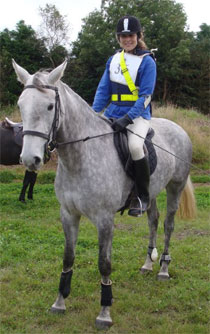
|
| Moderator: DrO |
Posted on Thursday, Oct 2, 2008 - 7:24 am: Hello Imogen,She has fallen right into the range the formula predicts and science says that any further growth will be do to soft tissue: increase muscle and fat on the back. DrO |
| Member: leslie1 |
Posted on Friday, Jan 23, 2009 - 2:51 pm: So I too am adding my filly's estimate and will check back in a few years As she is slow growing breed I will use the lower percentage number. 19 months/15'1 X(.94)=61 64.90 final height 16'1 |
| Member: dsibley |
Posted on Saturday, Jan 24, 2009 - 12:52 pm: Yikes! I have a 20-month-old Shire/paint filly who currently measures 16hh. Her cannon bones are just shy of 18" and she string-tests at 18.2. It will be fun to see where she ends up. Her mother was 18.1, and father is 15.3. |
| Member: imogen |
Posted on Monday, Jan 26, 2009 - 1:56 am: Well this is interesting. I measured my current foal and she is exactly the same size as the previous one (full sister) three years ago at the same age - 7.5 months, 13h2 and 260 kg (the other was 250 but weight tapes are notoriously inaccurate).If you ask me she will be bigger, as her cannon bones are bigger and her whole conformation is more like her TB/Holsteiner mother all though she is a hairy little molly from the Irish draught sire. Let's see! Best wishes Imogen |
| Member: maggienm |
Posted on Monday, Jan 26, 2009 - 12:31 pm: Leslie what breed is your filly?Imogen, hmm, it will be interesting to see how she finishes. Thanks for posting. |
| Member: leslie1 |
Posted on Monday, Jan 26, 2009 - 1:34 pm: Hi LoriShe is an purebred RID.(Irish Draught) This is interesting study, for me, on the estimate of height because the ID is known for having 'short shins' (they are also known for having very thick circumfrence of cannon. My fillys cannons are almost 9 1/2 inches around. And yet...she looks very rangy right now LOL) So anyways I am wondering if the 'cannon' measurement applies to the purebred. or even the halfbreds for the matter. Any ID enthusiast have any info about that? Leslie |
| Member: aannk |
Posted on Monday, Mar 9, 2009 - 3:11 pm: So, if your yearling is taller behind, do you use that height or the withers? Also, anyone who has a voltaire baby, should I use 90 or 92?Alicia |
| Moderator: DrO |
Posted on Wednesday, Mar 11, 2009 - 7:49 am: The chart is based on wither height Alicia.DrO |
| Moderator: DrO |
Posted on Wednesday, Mar 11, 2009 - 7:55 am: The chart is based on wither height Alicia.DrO |
| Member: joannr24 |
Posted on Sunday, Apr 12, 2009 - 10:33 pm: Ok if someone can help me with this I would be forever grateful. I am on the fence about buying a yearling for dressage who has amazing bloodlines. Dad is Contango, Mom is out of Donnerhall/Rubenstein. The mare is just shy of 16 hands and Contango is 17h. This baby was the mare's first baby. Here is my dilemma. He just turned 1 year old on April 1st. He is approximately 13'1" to 13'2". Isn't that awfully small for a warmblood? By the way, he is a Dutch Warmblood. I will buy him if he has a good chance of hitting 16'1 or 16'2 but I fear he may top out around 15'3. Everybody at my barn has a different opinion. He nursed until 6 or 7 months and since then has been fed mare and foal and bermuda hay. He does not look undernourished but he does have a huge belly. I am having the owner run his blood tomorrow to make sure he doesn't have parasites. She says it's a hay belly. It may be because he was in a little pen with two mini's but she just moved him to a huge pasture with the mini's and they've been running around ever since. Obviously we cannot guess heights but does this sound reasonable or unreasonable to the experts out there. I already have three lovely horses and this guy would add one more but his breeding is so good that I hate to pass him up if he has a reasonable shot at hitting the height. |
| Member: joannr24 |
Posted on Monday, Apr 13, 2009 - 12:36 am: Hello again. Disregard my last post. I used Dr. O's chart. He is not going to make it to sixteen. In fact, the most genereous estimates put him at 15 hands. Interesting about how they typically follow the mare's height. |
| Moderator: DrO |
Posted on Monday, Apr 13, 2009 - 7:53 am: Hello joAnn,I get the same results you do. His genetics strongly suggest he should grow taller, so he may have a late and unexpected growth spurt left in him. Those tables are averages and don't figure in the occasional irregular nature of growing. DrO |
| Member: ekaufman |
Posted on Monday, Apr 13, 2009 - 9:15 am: Hi joAnn,Jos is our resident bloodline expert and may comment, but I have seen the C-lines throw the occasional inexplicably small horse, some of excellent quality. From your description, he sounds somewhat unthrifty, which might make me hesitate as well. Too bad. Contango has thrown some remarkable babies! |
| Member: joannr24 |
Posted on Monday, Apr 13, 2009 - 10:51 am: That would be great if Jos would comment. He is an amazing mover and has the tempermant of a golden retriever. The problem is if he is that small he won't really be able to compete with the big guys at the higher levels. I agree with the Contango comment. There is one in our barn who is phenomenal and her mom is 15'3 and she reached 16'1. However, this is a new mare and he was her first baby so it is a guess. People keep telling me that Contango babies are late bloomers but I have trouble seeing this guy gain 3 hands of height at his age. Dr. O have you heard of warmbloods maturing this late? Do you think there is a chance he could hit 16 or is that a long shot? |
| Member: joannr24 |
Posted on Monday, Apr 13, 2009 - 11:00 am: Oh and one more thing. His knees and hocks are HUGE! His hocks are the same size as my 16 hand 5 year old Paint. He is also all legs right now. |
| Member: leslie1 |
Posted on Monday, Apr 13, 2009 - 2:43 pm: HiJust curious if you did the cannon measurement thing as well? L |
| Member: joannr24 |
Posted on Monday, Apr 13, 2009 - 2:59 pm: Yes I did and it said 15'3". I also did the elbow to ergot measure and it said 15'3" also. However, in talking to a nutritionist and the breeder they think he is not being fed right by the owner and that he could potentially be stunted. The owner apparently is very worried about overfeeding and now we are wondering if he has been underfed. She has raised horses for years so I'm not sure what this poor guy's problem is. I told her today that the breeder is concerned about this and if she chooses to disagree I will have to back away from the horse because at this rate he'll be a pony! : - ) |
| Member: juliem |
Posted on Monday, Apr 13, 2009 - 4:09 pm: I took a boarder last fall at a request from my vet,--a yearling Quarter Horse from halter lines, typically over 16 hands and fast maturing. He had been fed more than adequate amounts of hay, but it wasn't the right thing for him. He was clear of parasites. He was no question about it unthrifty with the big belly, long hair coat, and ribby. I started him on equine junior, free choice hay and gradually increased the junior until he was getting one percent of his body weight in four feedings. His belly went down, and right now he is almost 15 hands at the hip having grown at least four inches in six months. I think if youngsters can't get enough nutrients from hay their growth could indeed be slowed. My weanlings have all done well on plenty of hay and vitamins, but this guy needed more and certainly caught up to where he should be. Now, he did come to me at 5 months, but the QH halter lines are usually very fast growers. I know how tough it is to pass up good bloodlines. Would someone explain to me the desire for such size in dressage prospects? My background is QH, cutting and working cow horse lines, and some of the best have to have new shoes on to make 14 hands!! (The other extreme in think!) I really am curious, not being argumentative. Thanks, Julie |
| Member: paardex |
Posted on Monday, Apr 13, 2009 - 4:54 pm: Regarding the bloodlines, Contango and Donnerhall both have thrown almost 'ponies' from time to time. Dutch horses[altough these to are German stallions] mature much earlier [usually] then fi. a Holsteiner. If he doesn't have a growspurt when you throw him out on pasture in spring I wouldn't expect him to do much.My experience tells that the 'rounded' types often stay [to] small for me more important then the height is if there is 'lenght' in the lines of the youngster. Let's say if it looks like a young QH it probably won't go to it's geneticly expected height.[sorry don't see how I can explain what I mean more adequate] If you can find the mares bloodlines I would perhaps be able to tell more. Jos |
| Member: maggienm |
Posted on Monday, Apr 13, 2009 - 5:38 pm: Something I have been told, perhaps this is what Jos is referring to, if the horse looks 'put together', not awkward and gangly, it likely isn't going to grow much more. When they look leggy and are a bit clumsy they still have to grow into themselves.Of course, there are exceptions, a friend of mine had a lovely gelding that always looked balanced, always knew where his feet were, was never awkward, and he grew to a bit over 17h. |
| Member: mitch316 |
Posted on Monday, Apr 13, 2009 - 6:15 pm: I am with Julie here, I am not sure about the size matters either. For cutting and driving horses, short and stocky can work just as well as long and gangly, and tall and stocky seem to be more clumsy. But I am out of my league here. Growing up on a quarter horse farm, we always kind of let nature take its course, because in all reality, for work horses, size come in third to work ethic and personality. For show horses, I could see why you would want yours to stand out by being taller. I can tell you this, all of the guesses, wives tails, and theories in the world are very seldom 100% accurate. Some horses can actually get a growth spurt as late as five years if they were mistreated and malnourished...I say some, but really only have seen one. The Buckskin filly I rescued was severely stunted at 21 months, and now at 24 months she has grown 5 inches and gained 300 pounds. And that is with no supplements, just tender loving care and a well balanced horse diet. No million dollar feeds, no hours of prep before each meal, just horse food fed in with good forage and good quality hay. That is all I have ever used, period. And I think that's why the horses we breed do not have a fraction of the problems all others do. Not knocking all that, but the closer to nature the better, and if you ever get a chance to see some of this stuff "processed", you may rethink it too. Ever wonder how many hormones Purina puts in their food? You'd have to call and ask, because they are not required to put it on the label...yet.Well, on a soap box again. If you do find a way to predict there size that holds up to science and common sense, please post it, as I would be interested too. My Dad, Grandpa, and Great Grandpa have all farmed the same farm, and they gave up on that years ago. But, they will still play guessing games when making a sale, lol. Hope, this does not rub the wrong way, it was meant to be dry humor!! |
| Member: paardex |
Posted on Tuesday, Apr 14, 2009 - 10:12 am: Well I have had very well moving and balanced young horses[especially if they grow gradually what imo often has to do with balanced food and loads of space and exercise with friends] but with what we call 'long lines' long shoulder front croupe etc, not baroque or stocky pony is perhaps a better description[I learned the last few months that there are quite a lot of QH's with long lines though they are hidden under an enormous amount of muscles!]In the Dutch lines the presence of a TB bred for short distances often gave lack of longlines and thus less growing out/up. About the size of a dressage horse: almost all my knowledgeable friends agree that people have gone a bit overboard by buying thos 'elephants' BUT now in the showring they are much more impressive then a small one especially for not to knowledgeable jury. It started though with the need of the above mentioned 'longlines' necessary for the horse especially in the lateral movements. Ofcourse in a way same thing with a showjumper more possibilities to 'fold and unfold' and balance with the longer lines. Everybody agreed though that a 15.3 h horse with long lines is better then a 17 h 'stocky'. Especially as the 'elephants' seem to like to go to the vet even more then the smaller familymembers[especially Ataxia got to be a big problem] Jos PS I tried in my best English to marginally explain one of my soapbox topics! Exceptions in horses stay rule! |
| Member: leslie1 |
Posted on Thursday, Aug 6, 2009 - 10:43 pm: LOL today I was goofing around and I did the knee to coronet 16'1 and thought I would also do the ergot to elbow to wither and got 17hh.quite the discrepency LOL. I may have to redo that. L645 |
is The Horseman's Advisor
Helping Thousands of Equestrians, Farriers, and Veterinarians Every Day
All rights reserved, © 1997 -
