Site Menu:
| This is an archived Horseadvice.com Discussion. The parent article and menus are available on the navigation menu below: |
| HorseAdvice.com » Diseases of Horses » Lameness » Diseases of the Hoof » Wall Cracks and Thin Sensitive Soles » |
| Discussion on Toe crack | |
| Author | Message |
| Member: mysi |
Posted on Sunday, Feb 24, 2008 - 2:25 pm: Last month I got a new mare (Thank's to Cyndy and Hank getting her here ) ) She's barefoot. When she came she had a hairline crack in her RH toe that looked to have a filed "X" at the top which I assume is to keep it from growing. But it had cracked above it. She also had one on her LF that has increased in size too. My farrier came out and trimmed her and said it wasn't a big deal. Both cracks are about 1" high and haven't separated in any way and are not painful to her. After reading the article I would have to guess that it is from very poor hoof care, her previous owner only trimmed if she HAD too. I got her from a friend so I've known this horse since she was 1 and she's 4 now. Her conformation is great, body score great, hooves are great except that. MY footing in my ring is fairly hard, it's all screenings. My questions are... Do I have to shoe her? Is this something I have to wait until it grows out before I keep riding? |
| Member: ekaufman |
Posted on Sunday, Feb 24, 2008 - 4:35 pm: Hi Melissa,Can you post photos of the feet, and of the new horse? Congratulations! Regardless of her current hoof condition, the quality of your footing for riding is quite important to your horses. If you plan to work them regularly and hard, you might want to look into improving your footing. |
| Member: erika |
Posted on Sunday, Feb 24, 2008 - 5:26 pm: Melissa, congrats on the new mare!If you recall, I had a similar problem with a big toe crack that we tried everything on. After a year and a half to two years of careful and frequent trims, it finally grew out. If anything, I think your hard ground, if dry, would be beneficial to the hooves. My biggest problem was mud and soft, moist pasture. As for shoes, I think it depends on how much, and what kind of riding you do. We left our filly barefoot throughout, but she was only ridden lightly. Good luck, Erika |
| Member: scooter |
Posted on Sunday, Feb 24, 2008 - 6:59 pm: Melissa congrats on your new mare. I would imagine if they are superficial cracks they should grow out and be fine as long as you keep the hoof balanced and regular trimming. I wouldn't "pound" her hooves on the very hard ground, but a little walk trot shouldn't hurt. Maybe some kind of hoof dressing would help to keep them less brittle.
|
| Member: hpyhaulr |
Posted on Sunday, Feb 24, 2008 - 8:12 pm: Melissa,So sorry to hear you are having problems with Patches. She is so gorgeous with great Conformation and personality. Have you tried any hoof supplements? We had great success with horseshoers secret we fed that for a couple of months to a horse with a quarter crack, and she did very well, and we did not shoe her. We also used the horseshoers secret hoof treatment. Both are pretty reasonable through horse.com. SOmetimes you can get twofer. Would LOVE to see pix of her again too. And Big Boy MOOSE!!!! |
| Member: mysi |
Posted on Sunday, Feb 24, 2008 - 9:59 pm: First, Cyndy your husband is Walt not Hank. I pressed enter and said "oops", I apologize. I don't even know a Hank! I just started her on Horseshoes secret friday, I must have been reading your mind. I hope it helps. I do paint all my guys feet with Farrier barrier at least 3x week. Moose loves Patches and she loves him which is great. She is a midget next to him even though she's just shy of 16h. She's a great girl, so sweet and willing. I was dying to get back riding after retiring Moose. But it's not the same, I still only look forward to getting on him and walking around.I ride her in the ring twice a week doing flat work for 20-30 minutes, trotting over poles, practicing lead changes. The remainder of work we ride out in my grass field. The footing in my ring is not super hard, but definitely harder than I'm use to. It's screenings and I do drag it frequently to fluff it up, but I'm use to a fluffy sand ring in Florida. I looked into getting sand here and it's non-existant. Is there anything else I could use that is similar? The cracks were there when I got her here but have seemed to grow a little. I will keep her on a 5 week schedule with Moose. He's on 5 wks because at 5 weeks and 1 day he starts to chip. I'll take pics of her feet tomorrow in the day light. I tried tonight but the lights in my barn are strategically placed right above the horses back, therefore the light at the feet is shadowed. But heres pics of Patch and my boy Moose. 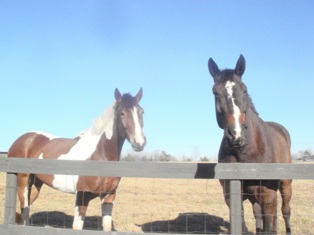 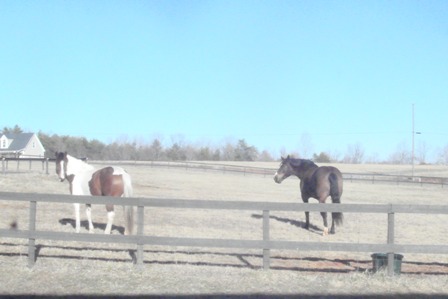
|
| Member: hpyhaulr |
Posted on Sunday, Feb 24, 2008 - 10:23 pm: Melissa,LOL, as long as I remember Walt's name, I suppose he doesn't much care who else forgets it! It's sort of my job to remind them, I guess. Thanks.... and thanks for the pix. They are both real lookers! I know how you miss riding Moose. |
| Moderator: DrO |
Posted on Monday, Feb 25, 2008 - 6:24 am: Hello MelissaWith a file mark where the top of the crack is so you can monitor change, then start with good trimming practices. If that does not work consider less work or shoes. Keep building on protective measures until the crack stops propagating upward. DrO |
| Member: pbauer |
Posted on Monday, Feb 25, 2008 - 6:26 pm: Dear Melissa,Stable Management publication www.stable-management.com (great magazine) there are two products that might be of help. The first product listed under the title: Keep It Together New for farriers is the Nolan Hoof plate, which is used for horses with cracks, thin walls, shelly hooves and played hooves. Made of galvanized steel, the plate wraps around the top of the hoof and is applied using standard farrier tools. The Nolan Hoof Plate is offered in several trimmed angles depending on the need of the horse, including 56, 54, 52, 48, and 45. Manufacturers say that the buildup of pressure with the plate redirects blood flow, promotes new tissue growth and positively affects capillary development. For more information, contact Hoofix Horse Care Products at 1-800-664-6662 or www.hoofplates.com~ The second product listed under the title: Growth Spurt SBS Equine introduces Toe Growth Spray, a copper peptide complex designed to promote hoof growth. Tow Grow is topically applied to the coronet band, according to manufacturers, the copper peptides act as messengers at the cellular level to "switch on" cells that draw the nutrition hooves need from the blood supply for faster healing and growth. For more information, contact SBS Equine Products at 239-354-3361 or check out their website at www.sbsequine.com~ My Best, Tonya |
| Member: mysi |
Posted on Monday, Feb 25, 2008 - 8:56 pm: I got home too late from work to get the pics, I'll try again tom.I'm going to do everything to avoid shoes, considering it's the front and back, I'd hate to put full shoes on a 4 yr old. I'd rather keep the work lighter. But if shoes become a must, I will put them on. |
| Moderator: DrO |
Posted on Tuesday, Feb 26, 2008 - 7:11 am: I do not know of any research that supports the topical application of copper to the skin of the coronet to promote hoof growth Tonya. If might be interesting to test such a product in the copper deficient diet but the correct solution to that problem would be to insure adequate intake of copper, see Nutrition Overview / Minerals and Nutrition for more on this.DrO |
| Member: pbauer |
Posted on Tuesday, Feb 26, 2008 - 3:49 pm: Dear DrO.,
|
| Member: mysi |
Posted on Sunday, Mar 9, 2008 - 7:43 pm: So finally I remembered to take my camera outside to take pics of her feet. Please excuse how dirty they are I cleaned them and forgot to get my camera, and was to lazy to clean them again. It had rained here for 2 days and everything is mud.Front hoof: 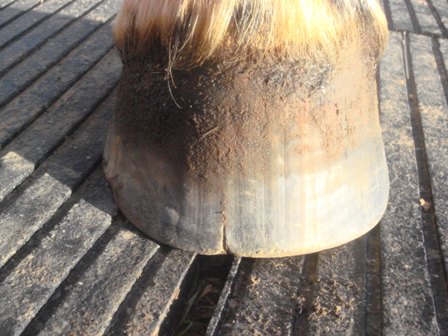 Hind hoof: (the line is from a mark the farrier made ages ago) 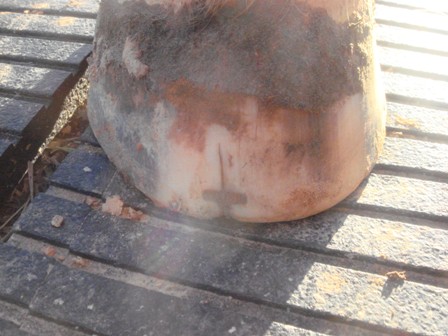 My farrier here that trimmed her said that it was from her toes being so long and when hetakes off the toe it will help. It has, it hasn't grown since then (I don't think). |
| Member: scooter |
Posted on Sunday, Mar 9, 2008 - 9:18 pm: Hi Melissa, I don't think that top one would concern me, as long as you keep her trimmed up with your farrier. I bet that back one will be fine too without shoes as long as the farrier keeps the toe back and the hoof balanced. JMHO |
| Member: mysi |
Posted on Monday, Mar 10, 2008 - 8:29 pm: Thanks Diane, I've been so lucky with Moose and Sweetheart they have never had any hoof issues. I know how important healthy hooves are so I want to be sure I'm doing the right thing!Thanks again!
|
| Member: gailkin |
Posted on Thursday, Mar 13, 2008 - 3:59 pm: Make sure your trimmer keeps the outside of the hoof wall rounded to relieve the pressure on the wall crack Melissa. The other thing I would do is to treat her hooves for fungus which I am realizing is more and more common. The frog/hoof may appear normal, but the fungus grows under the calloused frog and even down into the grooves of the hoof. It can also go up the wall of the hoof faster than the hoof can grow it out. The best treatment I have seen is on Linda Cowles website, www.healthyhoof.com She recommends using White Lightning or Clean Trax as a soak. You actually soak the hoof and cover with plastic sack to allow the stuff to work. You only need to do this once or twice. Then use a tincture of usnea on the frog, sulcus, grooves and white line area. Lastly, she uses Pete Ramey's goop, but I did not find it effective, so I am using Vicks Vaporub. It has been proven to cure toenail fungus in humans, so I slather it on my horses' hooves after the usnea. It will stay on the hoof even with dirt for days. So far I have had good results (1 month) and am happy with the progress. Lots of hoof problems turn out to be underlying fungus issues so treatment won't hurt and may help more than supplements, etc. |
| Member: mandrie |
Posted on Thursday, Mar 13, 2008 - 6:30 pm: what is usnea? |
| Member: gailkin |
Posted on Friday, Mar 14, 2008 - 3:33 pm: Usnea is derived from a tree lichen and apparently it has been used for ages as a fungal fighter. It is sold online or in health food stores as a tincture in alcohol. 1 oz costs about $10. You can use it from the bottle, but a bump from your horse can cost you money, so I like to put it into a dye plastic bottle with long pointy tip sold in hair supply stores or in a pump spray. If using on wall separation between the sole and hoof, I use the DrOpper or dye bottle to get penetration. I use the usnea on the clean hoof and then slather with Vicks. |
| Moderator: DrO |
Posted on Friday, Mar 14, 2008 - 5:11 pm: I must say Gail that in general the horses in my barn and practice have very healthy feet and the only probable fungus (or possibly it is a mixed infection of bacteria and fungus) is WLD as in the article.Cracks without obvious pathology of the horn are unlikely to be secondary to an infection. Fungal infections of the horn generally distort and degenerate the horn to be visually obvious: take your husband's toe nail fungus for instance. I would expect the petroleum in the Vicks to be beneficial in conditions that may promote infection however as it is one of the ingredients we recommend you look for in a horse dressing. If you do have a specific fungal infection to treat we strongly suggest one of the well proven wide spectrum antimicrobial or a specific anti-fungal. DrO |
is The Horseman's Advisor
Helping Thousands of Equestrians, Farriers, and Veterinarians Every Day
All rights reserved, © 1997 -
