Site Menu:
| This is an archived Horseadvice.com Discussion. The parent article and menus are available on the navigation menu below: |
| HorseAdvice.com » Diseases of Horses » Lameness » Diseases of the Hoof » Club Foot » |
| Discussion on Club foot caused by short leg | |
| Author | Message |
|
Posted on Monday, Mar 5, 2001 - 12:49 pm: I have a 10 year old Arab that has a grade 1 club foot on her right front leg. The left front hoof has an under run heal. This mare does not take a right canter lead and tends to cross canter on the other lead. She occasionally goes short on the right front leg. On two occasions she has had soft tissue injuries on the left front.Once a few years ago an inexperienced farrier trimmed her and the club foot went away. He,I, everyone was shocked (the hoof spread, heels opened up and there was no dish in the foot)Unfortunately, he did not know what he did to correct the problem and a few trims later the foot was again clubby. This experience and other research has led me to believe that this mare has a short leg. Short leg on the right front causes the hoof to grow in a cone shape looking for the ground. Long leg with too much weight on the left causes the under run heels and stresses the leg. I have been told that the left rear leg is probably also short, that this often accompanies the short front leg and causes a lot of the cross canter problem. To correct this problem, I am planning to pad the right front and left rear hooves and to use a heal pad on the left front to support the under run heal. Can you comment on horses with a short leg and some of the methods used to diagnose and treat them? How common is this problem, I have read everything from very rare to much more common then you might think. Thank you very much, Betty |
|
|
Posted on Tuesday, Mar 6, 2001 - 6:38 am: Hello Betty,I read the Tony Gonzales thing when it came out a decade ago and I really do not put much credence into the idea that a leg is "shorter" than the other. The writings are based on some pretty subjective observations, some faulty understanding of anatomy, and I just can't find a horse that seems to suffer from this malady. That said, and since I am not there to judge, you may want to try the experiment anyway. Sometimes solutions are found to problems even if the logic is not yet understood. Let us know how your experiment turns out. Measurements of toe length and hoof angles would help quantify the changes and before and after pictures would be super. DrO |
|
|
Posted on Tuesday, Mar 6, 2001 - 7:48 am: Hi DrOThank you for your reply. I have the shoes and pads ordered and I will take pictures and measurements before and during this experiment. I have been in contact with several farriers who had worked with Tony Gonzales and they seem to feel that this might help.(equine studies Q&A forum) https://www.equinestudies.org/disc_toc.htm When standing square and flat this horse does have one knee higher then the other. Her club foot is also questionable because it is more a normal foot with a tall heel. If the other front foot matched, I don't believe anyone would notice anything out of the ordinary. I feel this is worth a try, especially since I do my own shoeing and at any sign of trouble can immediately pull the shoes. I'll let you know how it goes. Betty |
|
|
Posted on Saturday, Mar 10, 2001 - 2:08 am: I also have a moderately club footed gelding. After moving 8 months ago, I had to switch farriers. The first thing the new farrier had me do was to stand on a bench behind the gelding and look at his shoulders. The club footed leg's shoulder had visibly DrOpped down to compensate for the shorter leg. So he put a thick leather pad on the club foot and worked on getting the breakovers on the two feet to match better. Also he left a lot of heel on the shoe to get the club's angle up a bit and the strain off of the tendons involved. Eight months later, the shoulders and the breakovers are more closely aligned and the horse is moving more freely. And most importantly, to me and my behind, more smoothly at the trot. more smoothly at the trot. ~Sharon |
|
|
Posted on Saturday, Mar 10, 2001 - 8:43 am: Hi Sharon I am really glad to hear from someone who has had success with this corrective padding on the club foot. Did you have any trouble with the canter before the pad and did the pad improve the canter? I was also told that the opposite back leg probably needs to be padded.(most but not all cases) Have you had any problems with the back leg? Thanks Betty |
|
|
Posted on Saturday, Mar 10, 2001 - 10:33 am: Betty,Actually this little horse has a great canter. There'd be many many times out on the trail where he'd want to fast trot and I would greatly prefer a slow canter! Also, at the walk, he would plop down the un-clubbed (left front) foot harder. You could tell by his movement while riding him, and listening to his foot falls on pavement. That has improved as well. This horse had no problems with his hind end. He's currently shod in front and barefoot behind. He's got such tough feet I just wish I could leave him bare on all fours. Something I've always wondered to...Why do most clubs seem to appear on the right front on horses across many breeds and disciplines? Maybe that question deserves its own topic! ~Sharon |
|
|
Posted on Saturday, Mar 10, 2001 - 12:21 pm: Having seen two sires which threw 30% club footed foals I am convinced of a strong genetic component, but have seen as many right clubs as left footed clubs.Sharon do you think he has gotten the "short leg" to grow or has he just done a good job of evening up the feet. I find the club footed horses in my practice sound horses. If the owners want them evened up I recommend getting more heel on the "normal foot". Except in a few isolated cases, attempts to lower the hoof angle of a club foot on a MATURE horse usually results in a thin sensitive sole at the toe and/or excessive strain on the DDF tendon. DrO |
|
|
Posted on Saturday, Mar 10, 2001 - 8:51 pm: Hi Sharon, DrOI have no doubt that there is a genetic component to club foot, but there is also a mystery component too. I have extensive research into my horses breeding and there is no evidence of other club footed relatives and none of her sires other get have this problem. That said, I have no plans to breed this horse and I wouldn't even worry about it except that she isn't a sound horse. I have had tendon strain and soft tissue injuries on the nonclub side, the one we are thinking is the long leg, and ongoing problems with the canter(this would be free lunging, lunging ,undersaddle ,and in turn out).This mare has a very rough canter and cross canters every few strides. She also goes short in front on the club side occasionally. (she has been seen by several vets and they have found no other cause for this problem) The point to our padding is to try and get this horse even enough to be sound and move better. Not so much to make the feet even. Several of the farriers that I have been in contact with have also noticed that most of the mature club footed horses they work on have the club on the front right while the vets see about 50/50 in foals. I wonder about this observation. If it is correct, I would wonder if management problems or..... is the cause. Betty |
|
|
Posted on Sunday, Mar 11, 2001 - 1:34 am: Dr.O,I too am a firm believer in genetics contributing to club foot and I can see how management issues can cause it too. I don't know which was the case in my horse, as he had changed hands a number of times before I bought him and his past was somewhat murky. As for my horse's "shorter" leg, no I don't think there's anyway the leg could have grown. Physically impossible as far as I see. Part of his treatment didn't include putting him on the rack and stretching him. I do think the farrier did a great job of evening up the feet more. Yes this horse was and is sound, in the fact that he seemed to be pain free, however his way of going was not as good as it could have been if he had not been born with/have developed the club in the first place. The farrier didn't actually lower his heels that much and as I said, he placed the shoe further back, I think, to compensate for what he did take off and ease breakover. My farrier's main focus seemed to be to get the breakovers on each foot as close to each other as possible, even up his shoulders, and not to create identical feet. Betty, My observation on most clubs being in the right foot also came somewhat from my farrier, from what I've seen with other horses myself, and horses I've read about on this board and over at www.horseshoes.com. Good luck with your mare and keep us updated on how things go! ~Sharon |
|
|
Posted on Sunday, Mar 11, 2001 - 8:05 am: Hello All,Betty the comment about having trouble with the "good leg" is fascinating and suggests a history. Having seen the attempted correction of a club foot result in tendinitis on the leg being corrected: It strikes me that a posssible explanantion is that by keeping this foots hoof angle normal has resulted in excessive strain on the flexor tendons. This could be another indication, other than the cosmetic one stated above, that the heels on this foot should be allowed to grow longer: a standard treatment for DDF strain. The tendinitis could be coincidence but this assumption may prevent correction and prevention of another episode. DrO |
|
|
Posted on Sunday, Mar 11, 2001 - 8:44 am: Thanks DrO, Sharon I will attempt to let the heel grow longer on the club foot. It has never been made to match the other one, but possibly the heel is too short. I will check the breakover also. I don't quite understand why this would cause a problem in the nonclub foot, unless you are referring to her occasionally going short on the club side, " by keeping this foots hoof angle normal has resulted in excessive strain on the flexor tendons. " This might explain why she has always done better in eggbar shoes and on softer ground. This mare has been lame 2Xs on the nonclub front leg. The first time she was diagnosed as having soft tissue injury at a big Equine hospital in S.CA The second time it was a swollen tendon sheaf, luckily they could find no damage to the tendon using ultrasound. This, along with the refusal to use her right lead and uneven shoulders all fall into what I was told to look for in having a short leg in front and most likely in the opposite back leg. Hopefully. the shoeing changes will help. I'll keep you posted. Betty |
|
|
Posted on Monday, Mar 12, 2001 - 6:21 am: Whoa, whoa, whoa! : the heel on the club foot is too short? By definition the heel on a club foot is too long at least relative to the toe of that foot, that is what makes it clubby. Are we sure we are talking the same thing? My definition of a club foot is one whose hoof angle is greater than 60 - 62 degrees and obviously out of line with the pastern.DrO |
|
|
Posted on Monday, Mar 12, 2001 - 7:10 am: Hey DrO The limitations of the written word. The heel on the club foot is too long. What I was trying to write is that I don't think we have trimmed the long heel short enough to cause lameness problems in an attempt to make it match the other foot. Betty |
|
|
Posted on Tuesday, Apr 10, 2001 - 3:44 pm: Follow upMy horse in now in eggbar shoes on the front with a pad under the club foot. The club foot was trimmed so the heal came back to the widest part of the frog and the toe was trimmed back until there is no dish in the toe. No effort was made to match the front feet. The nonclub foot has also been trimmed back until the heal is at the widest point of the frog and the toe has been trimmed short. The back feet are unshod and the toes have been squared to try and keep her from pulling the eggbars by stepping on them. I decided to hold off on padding a back foot until I see what happens with the front pad. The angles when the shoes were put on were 58 degrees on the club foot and 55 degrees on the under run foot.The club foot was 3" the other front was 2 7/8" The shoes have been on about 2 weeks. The horse is moving better, but this could just be the eggbar shoes. The club foot seems to be growing a more normal looking heal.The heal and toe are becoming more angled. (I will measure again when the shoes are reset and see if this is a real change or hopeful thinking) In back I notice she is going wide and outside behind the club foot, right side, and the other rear is going to the inside. This would be the foot that I was told to watch for also being short. I have not seen any change in the shape of the hooves. I don't know if this way of going is due to the pad in front or if I actually need to put a pad on this foot too. Betty |
|
|
Posted on Wednesday, Apr 11, 2001 - 8:44 am: Hello Betty,Do you also have the lengths and angles prior to the trimming? Did the pad have a wedge or was it just a flat pad. What was the thickness or angulation of the pad? The new information you provide on angles and toe length along with statements in your very first post suggest you may have been having more of a trimming problem than an actual anatomical (DDF contracture) one. Still, changes should be done slowly. Thank you for keeping us informed. DrO |
|
|
Posted on Wednesday, Apr 11, 2001 - 1:17 pm: Hi Dr OPrier to trimming the hooves matched at 55 degrees (this was with pads and shoes).I had a 2 degree pad on the under run/right side and the left had the heals shortened and a longer toe, the toe had a bit of a dish. I didn't get the toe lengths, but she hadn't been more the 4 weeks from a trim.. The only real change made was rasping the right/upright hoof back at the toe to remove the slight dish in the front of the hoof ( and leaving the heals a little longer, instead of rasping them very short) and pushing the toe back as far as possible on the left/underrun hoof . Removing the degree pad from the underrun side and adding the rim pad to the tall heal side. The pad is a 3/16 flat rim pad. The trimming may well be part of the problem, but I can tell you that the horse has always had 1 boxy hoof with a taller heal and one flatter foot with an underrun heal. She also has uneven muscling in her shoulders. This has persisted through the years, even when being trimmed by a master farrier. 10 years ago, I wasn't as knowledgeable as I am now. This horse has always had gait problems. At that time, I did a lot of trail riding in the Sierra Nevada Mountains and as long as she was sound, it wasn't an issue. That is until I got involved in Dressage and started learning about ....... So this may not be a club foot, but it is something. I have found that the tall heal/club foot label often closes peoples mind to a discussion of what else it might be. She has always gone better in eggbars shoes. Maybe the problem is in the shoulder and the different front feet are a symptom, not the cause. I realize I added too many changes for this experiment to be conclusive, but if she goes sound and her front feet change shape with the pad, I will assume that limb asymmetry is at least part of the problem. If the hooves stay the same, but she goes sound, I will think the egg bar shoes made the difference and see what happens if I remove the pad. If she continues to go crooked behind and the front shows improvement, I will pad the left hind and see if it helps. I can tell you that her legs have always x-rayed and ultrasounded clean. The lameness is transient and is subtle enough that it is difficult to see if one doesn't have a lot of experience with horses. For a long time, I thought she was rein lame, but if one watches carefully, one can see the shortened stride at liberty. It is just easier to feel then see. I have included a picture ( I hope ). The foot with the high heal has never really looked like a true club foot to me, but?????? In trimming, we have always focused the under run hoof and trying to get the hooves to match. I mentioned in an earlier post that once the hooves did change shape and we didn't know why. (no one ever believes me when I say this, but it really did happen)  Betty |
|
|
Posted on Wednesday, Apr 11, 2001 - 1:36 pm: 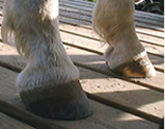 Maybe this time Betty |
|
|
Posted on Wednesday, Apr 18, 2001 - 7:47 am: I don't know Betty, they both look like pretty good feet to me???DrO |
|
|
Posted on Thursday, Apr 12, 2001 - 1:01 pm: Hi Dr. O:I would agree, they DO look like good feet. The more upright one doesn't look like a club foot to me either, but over the years so many vets, farriers.... have told me that a tall heal means a club foot, that I have just given up and started calling it a club foot. The problem is that the feet don't match and have never matched. I wouldn't care, but the horse also has a gait asymmetry, muscle asymmetry in the shoulders, and a history of injuring the front left, the foot with the under run heal. I have focused over the years on trying to correct the under run heal,keeping the feet at the same angle and I have never had any luck, so perhaps focusing attention on the tall side will work. As I mentioned before, maybe the feet are a symptom of another problem else where. I would not recommend breeding a horse with this many problems, but years ago I did. The filly, Xamier, does not have any of her moms problems. She too has a white foot on the left and a black foot on the right front, but they are nicely matched and she has no gait or muscle asymmetries. Like her mom she was born dismature, but unlike mom she never struggled to rise. After imprinting, she was picked up and held to nurse. We did this the first 4 times she wanted to stand and after that she was strong enough to get up and down on her own. I don't know if this is the difference or if I am grabbing straws and making things up, but I have been told that a limb asymmetry can be caused by a early minor injury. To be honest, at this point I do not expect my mare to become an athlete or even learn to canter. If I can get her to the point that she moves sound, doesn't strain the left front, and can do a few limited trail rides with my husband, I will consider the thing a success. Betty |
|
|
Posted on Friday, Apr 13, 2001 - 10:41 am: Hello BettyWell next time they tell you that you can point them to page 98 of Adam's Lameness where the definition is very straight forward: A foot axis of 60 degrees or more. If they are farriers they can look in Butler's Principles of Horseshoeing pg 296 where the same thing is said. Butler does refer to the heel being high in relation to the toe but that is what makes the angle high. He means a long heel not a different angle heel. The most important thing is not that the feet match but that a proper hoof pastern angle is established in each leg when the horse stands square. If the heel is a different angle than the toe it may be difficult to know what the foot axis is and I would use the striations in the hoof wall on the lateral surface be my guide if they are not distorted and if really unsure, take a radiograph. DrO |
|
|
Posted on Friday, Apr 13, 2001 - 1:21 pm: Thanks Dr. OI will take a look at Butler's Principles of Horseshoeing. I will also double check the hoof axis. "striations in the hoof wall on the lateral surface " That would be to check the striations to make sure they line up with the pastern angle? Due to the different feet it may be that the hoof angle is broken forward or broken back and is causing the tendency to injure this leg? I will certainly give it a check and if necessary get the x-rays. It just seems strange that this would cause such an ongoing problem in a horse very lightly used on soft footing. Betty
|
|
|
Posted on Saturday, Apr 14, 2001 - 8:26 am: Yes these striations in the undistorted hoof capsule are a pretty good indicator of the hoof axis. And yes I do not see anything in the conformation of the feet in the one picture that I can see that would make me think it might cause chronic lameness.DrO |
|
|
Posted on Sunday, Apr 15, 2001 - 4:39 pm: (LOL) Dr. O.We are right back to wear we started. The horse has mismatching feet, asymmetries in the shoulder muscles and an ongoing mild gait abnormality. It does sound like trimming the toe on the under run side and the heal on the tall side to try to match feet was a BAD idea and may have been a small part of the problem. Maybe Tony Gonzales was correct in his ideas but only if one has a horse that doesn't have a club foot. Maybe a short leg can cause a high low, gait problem but does not have anything to do with a club foot. As we stand now, my horse is moving better. The stride shortness has disappeared and the tall hoof is starting to spread and have a more normal heal angle. I will carry on, since what we are doing seems to be working. I will post an update in a couple of months when there has been time for any changes to appear. Betty |
|
|
Posted on Sunday, Jul 15, 2001 - 11:34 pm: Hi,I also have a club foot mare. She is a three year old quarter horse who developed her clubbed foot from her feed. We feed her Kwik Feed (and was being fed that as a foal with previous owners) and in the bottom of the bag there were chunks of vitamins which the manufactures didn't break up. She consumed some before they were noticed, and after the extra vitamins she developed the club foot within a few days. I do believe it can also be genetic, but I also think it just depends on the situation, either could cause it. There is no club foot in her lines, and she has great lines . My question, is what is this padding you are talking of ?? And are you saying the up-rightness of the club foot developed to compensate for a shorter leg ?? Thanks. Emily (Tanya's daughter) |
|
|
Posted on Sunday, Jul 22, 2001 - 10:21 am: That's great Betty. Keep us informed. Tanya,there is no well known mechanism for a club foot to be caused by an over ingestion of vitamins like you describe. I think this is unlikely and the time association coincidence. DrO |
|
is The Horseman's Advisor
Helping Thousands of Equestrians, Farriers, and Veterinarians Every Day
All rights reserved, © 1997 -
