Site Menu:
| This is an archived Horseadvice.com Discussion. The parent article and menus are available on the navigation menu below: |
| HorseAdvice.com » Treatments and Medications for Horses » Alternative or Herbal Medicatons » |
| Discussion on Evitek (Chasteberry) | |
| Author | Message |
| New Member: Nancynf |
Posted on Thursday, Aug 31, 2006 - 3:32 pm: We've been given a wonderful large pony, eighteen years old, who has taught many children to ride and has been shown, evented and pony clubbed for years. He came to us with a diagnosis of Cushings, some respiratory problems and a number of medications and supplements. Our vet recommended that the pony be left out 24/7 (with shelter available if he wants to use it). We have followed his advice and that of his previous owner, but we have some questions about one of his supplements, Evitek. Our vet is not convinced of its value but doesn't feel it's harmful. It is quite expensive, however. The horse shows no outward signs of Cushings, no excess hair growth, abnormal fat deposits or compromised feet. The original diagnosis, by a reputable vet some distance from us, was done through blood testing. We have used him in Pony Club for two years, and he is energetic, cheerful and kind. His coat is shiny and he is alert and apparently healthy. He is shod in front during his most active months, and we let him go barefoot for two or three months in the off season. He is trimmed or shod every 6 weeks. My granddaughter is outgrowing him now, and we would like to free lease him to another Pony Clubber with appropriate instructions for his care. We will maintain ownership and supervision indefinitely. Can you tell me what you think about Evitek and whether we should recommend it to his future caretakers. This is a beloved pony, and we would like to be assured that his care is consistent, effective and as affordable as we can make it. |
| Member: Shirl |
Posted on Thursday, Aug 31, 2006 - 3:52 pm: Nancy,It may be that the Evitek is what is keeping him looking so good and in good health if he indeed tested positive Cushings. Evitek is the Herbal form of Pegolide I believe. Just my opinion. Shirl |
| New Member: Nancynf |
Posted on Thursday, Aug 31, 2006 - 5:27 pm: Thanks, Shirl for the input! Your point is well taken and is the reason I asked for information. I find I inadvertently misspelled Evitex as Evitek. I haven't heard of Pegolide, but I know Evitex used to be sold as "Hormonise" and is advertised as "an alternative to Regu-mate". It's a product of Great Britain, where it's apparently been used for years as an herbal supplement. |
| Member: Shirl |
Posted on Thursday, Aug 31, 2006 - 5:39 pm: You are right! And I misspelled it right back. Early Alzheimers I guess, though probably not too early.If the pony is doing well, I'd consider keeping things as they are. Some vets recommend Pergolide and there are pharmacys that are reasonable, just need a prescription from you vet. Not all vets are up on the value, but I know first hand it kept my Cushings horse going for a long time till Laminitis got the better of her. I paid $100 for 3 months supply, dosage was 1.5 mg if my memory serves me correctly. E-mail me privately if you want to discuss details further. Shirl |
| Member: Jojo15 |
Posted on Thursday, Aug 31, 2006 - 7:38 pm: Pergolide? Hormonaise? all sorts of mispellings going on.... grin.Chasteberry is much cheaper than pergolide. or probably the evitex as a horse supplement. Which probably is marked up because its marketed for horses. Get it as just a ground herbal supplement, it might be cheaper. And the other term for it Vitex agnus-castus (chaste tree berry). People use it in place of pergolide and seem to get the same response from it. BUT, just like pergolide its in the dosage that is tricky. And it can be dangerous if given too much. Something that has to do with dopamine effects. I fed it in the beginning, while trying to get my mare to even out. lose some weight, and GET OFF GRAIN... she is now without any supplementation, and just on hay. So it is possible for you to try and get her off this, see how she is with out it and then give to the family that wants her. But i would think 3 months minimum to watch for a change. And then if you see anything taking a turn for the worse you just put her back on it. |
| Moderator: DrO |
Posted on Thursday, Aug 31, 2006 - 11:21 pm: Welcome Nancy,We give our recommendations on the treatment of Cushings, including Chasteberry at Diseases of Horses » Endocrine Disorders » Cushing's SynDrOme and Pituitary Tumors. DrO |
| Member: Xenophon |
Posted on Friday, Sep 1, 2006 - 2:42 pm: Hi Nancy,I've been dealing with Cushing's (and the commonly associated Insulin Resistance) in my 23 year old Irish Sporthorse mare for the past 2 years. An invaluable resource for both medication information, treatment options & a vast knowledge base available through the list Files section (consulting vet to the list is Dr. Eleanor Kellon - a specialist in this area)is the Yahoo Groups Equine Cushing list. You'll find it at https://groups.yahoo.com/group/EquineCushings/ You just have to register (no cost) to join the group to have access. Highly recommended! Chris Luckett |
| New Member: Nancynf |
Posted on Saturday, Sep 2, 2006 - 2:31 pm: Thanks for the reference, Chris. I was fairly overwhelmed by the sheer volume of information. But it was useful, and I'll keep the site for reference. |
| Member: cjlewyn |
Posted on Sunday, Jul 12, 2009 - 6:51 pm: Hi everyone,Just a quick question...my mare is 35, and is doing pretty well for her age. Several vets who have seen her in the last few years have suspected Cushing's. Her coat is heavier than it should be, and she does not shed out well in the summer. She has been tested several times, and the tests have all come back negative. What I'm wondering is...would it be safe just to try the Chasteberry and see if it seems to help her and cause her coat to shed out more, or is it a bad idea to experiment that way? Thanks so much! |
| Moderator: DrO |
Posted on Sunday, Jul 12, 2009 - 9:14 pm: Hello Cindy,We discuss the use of Chasteberry at Diseases of Horses » Endocrine System » Cushing's SynDrOme and Pituitary Tumors. DrO } |
| Member: scooter |
Posted on Monday, Jul 13, 2009 - 7:43 am: Hi Cindy, I can give you my experience with Evitex and chasteberry powder. My arab gelding doesn't shed off completely either, so I tried it for a year on him...he still didn't shed. Other than not shedding he seems pretty healthy so I just clip him every spring...if you go that route buy good clippers made to do the job, otherwise it ends up very ugly and time consuming. Lesson learned
|
| Member: majoda92 |
Posted on Monday, Jul 13, 2009 - 8:25 am: We have a 27 yr.old QH gelding,Jack, who has IR and symptoms of Cushings. He had a really bad winter and lost a lot of weight and energy,and we thought it was the end for him. He was already on pergolide and ground chaste berries. One of my students had heard good things about Evitex, so she offered to supply her old buddy Jack with it. The change in his condition was dramatic to say the least. This is the first summer we didn't have to body clip him. He is much more energetic and spry and seems happier. He also had suffered from chronic diarhhea for the past few years, and even that has completely cleared up. He is now on 1ml pergolide, Evitex and Senior feed which we soak along with beet pulp and a little wheat bran. So far, he has been keeping up with the demands of being a therapeutic lesson horse and beginner lesson and camp horse with no problem! |
| Member: cjlewyn |
Posted on Monday, Jul 13, 2009 - 10:37 am: Thanks very much for the helpful feedback...It's SO great to have access to such a variety of intelligent people! |
| Member: tamarag |
Posted on Monday, Jul 13, 2009 - 2:44 pm: Funny this post caught my attention, only because I have a Basset hound I love dearly with possible Cushings. We have honestly spent $1000's trying to figure out what is wrong with her. She has the symptoms of Cushing, but lab work doesn't show anything other than a little low thyroid.When I started reading about this product Evitex, I kept thinking I had heard it before. I of course googled for it. I realize that my friend that has major degree's in natural care (herbs) had told me about it for my daughter. It is wonderful for that time of month. She has been very blessed to not need anything, so I had a bottle not even opened. I started Flat-dog on it today. I am hoping that I will see a major improvement in her. I will keep you posted. I am using the Vitex not the Evitex. Flat-dog and her son Tucker Two Tone! Wondering when they were going to get to run and play |
| Member: tamarag |
Posted on Monday, Jul 13, 2009 - 2:45 pm: 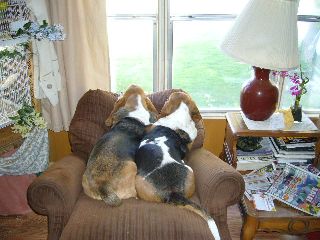
|
| Member: tamarag |
Posted on Monday, Jul 13, 2009 - 2:49 pm: Oh heck I better show this cute picture also.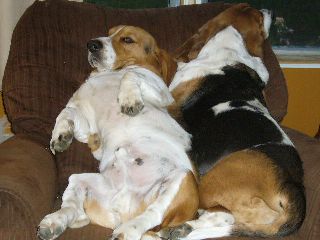
|
| Member: rtrotter |
Posted on Monday, Jul 13, 2009 - 3:24 pm: Tami,Small world! I have a basset hound too. Rescued her pregnant at 10 months old with one pup who wound up dying 24 hours after it was born and $1200 worth of surgery to attempt to correct a strangulated umbilical hernia. Roxie's face looks exactly like Flat-dog and she lays in that exact same position anywhere in the house. Do your bassets' talk to you? Mine has several different sounds she makes when she wants something different and she is a very good alarm clock. Rachelle |
| Member: tamarag |
Posted on Monday, Jul 13, 2009 - 3:36 pm: Oh how sad, that is so young for a Basset to be having pups.Yes mine are both talkers. Plus Tucker Two Tone, loves to howl when he is happy. I wouldn't trade them for the world. Hoping that I can find what ever makes Flat=dog feel better. She is only 6, but I think she feels 100 |
is The Horseman's Advisor
Helping Thousands of Equestrians, Farriers, and Veterinarians Every Day
All rights reserved, © 1997 -
