Site Menu:
| This is an archived Horseadvice.com Discussion. The parent article and menus are available on the navigation menu below: |
| HorseAdvice.com » Training, Behavior, & Conditioning Horses » Behavioral Problems » The Rearing Horse » |
| Discussion on Rearing!! | |
| Author | Message |
| Member: Qh2244 |
Posted on Tuesday, Sep 7, 2004 - 2:33 pm: I just purchased a 4yo standardbred mare to start working with and found out very quickly that she rears anytime anything does not go her way or if she is scared etc.Her history is this: She was at the track briefly as a 2 year old and since then has lived at a family's backyard barn with 2 other horses. They had left her too-small halter on while she was growing, which left a scar on both sides of her jowl. They did remove it eventually. She had not had a halter on since that time up until when I bought her. SHe has had no foot care etc.---she has basically just been a "family pasture ornament" that received treats and brushing. While I know she was probably rough-handled at the track (I know of the people who broke her and their training methods!!), the family that had her did not abuse her. From the info I gathered from the family, she had partial turnout with the other horses and was brought back in at night etc.---without use of a halter (the stall connects to the field) SHe is friendly and lovable if you approach her and doesn't mind being brushed. But she rears at anything! She seems to understand the basic concept of leading, but if asked to do anything a tad bit out of her comfort zone, or if she wants to be opinionated she goes up. This is not a "once in a while thing"----it is EXTREME. She doesn't get mean or strike. I tried using a chain over her nose to help control her while leading, but if you use the shank at all she just gets worked up and goes up even more. Any punishment methods just cause her to quickly end up in a panic state and break out into a sweat. I was thinking of trying some round pen work based off of john lyons and also starting to clicker train her in her stall to respond to pressure and begin teaching her to lead in very small steps. She knew at one time, and actually is very good at it---unless she is the least bit excited and then loses herself quickly. If anyone has any specific suggestions or exercises that would be wonderful. She is a sweet horse, I just think she was "barely broke" at the track and probably man-handled and then sat for 2 years and had the bad halter experience. ANY help would be greatly appreciated. Thanks!!!! |
| Member: Dtranch |
Posted on Tuesday, Sep 7, 2004 - 3:10 pm: Cassandra ...It is my experience with this issue that there may be many reasons for this behaviour, but I have found only one method to eliminate. It may be out of fear, memories of past experience, or she just found out that it works when she wants it to. Regardless of why, we are no strong enough to fight a horse who rears. In fact, the more we pull on her, the more leverage she gets to go even higher or mor violently. What I do, is let her commit to the mistake (rearing in this case) then I make her work hard for a few minutes. I do this by moving her body in each direction as quickly as she can, and also in tight circles. Enough to get her breathing a little heavier. I then immediatley go back to whatever I was doing with her that caused the rear, and try again. If she does not rear this time, a lot of praise and loving, if she does rear, back to the work. I keep up this routine until I get the desired response, then reward with release and praise, and then I quit for the day. I don't want to overdo it or push her into rearing again. I will then start again the next day. This has worked well for me for not only rearing, but for many bad habits in the past. Good luck and hope it helps. I know you will get good info from this site. DT |
| Member: Lorrieg |
Posted on Tuesday, Sep 7, 2004 - 3:22 pm: Hi Cassandra,I would highly recommend that you check out Clinton Andersons (Gaining Respect and Control on the Ground) series. I have had great success with starting a completely unhandled 4yr old Paint mare by following his methods which are a combination of desensitizing and sensitizing, respecting space, yeilding the forehand and hindquarters, all of which are so extremely important in overcoming a variety of behavorial problems. He is extremely easy to follow and uses two different horses to demonstrate (one is a more nervous type, the other a very dull insensitive type). He also includes common mistakes to avoid in his tapes as well. I really think this training series would help you tremendously with your mare I know it helped me to do wonders with my former wild child. Good Luck, Lorrie 
|
| Member: Dtranch |
Posted on Tuesday, Sep 7, 2004 - 3:31 pm: Ditto Lorrie on the ground work. You won't find any better than Clinton Anderson. I use his methods, or a variation of his methods with all my new horses. And, as you point out ... I go back to some basic methods on older horses when needed.DT |
| Member: Lisamg |
Posted on Tuesday, Sep 7, 2004 - 5:28 pm: Cassadra;My husband rides a 13 year old Standardbred mare that was race trained but never raced. You might be right, it might be something in the way they are broke to drive for the track. My husband's mare's response to most any pressure situation is also to rear. She does not rear high, but rears when she wants to go and is being held back, and rears when she doesn't want to go (i.e. is afraid of something). She only seems to do it in high pressure situations and is otherwise a very willing and good riding horse. My husband has ridden her many miles (over 1,000 in distance competition) and she will still rear sometimes just before the start of the ride. I have also been told she rears in harness when asked to stop at traffic lights (i.e. she doesn't want to stop). I always felt that it was her breeding, in other words this mare is a "race horse" bred to be highly reactive .... and that's what she is. Highly reactive. Not just while being ridden either, although I've never seen her rear in hand she tends to be quite quick in her reactions. You might try some of the non-confrontational training suggested, but I suspect you will never totally get her to stop. It sounds like she needs more of life's experiences... but she also needs to trust you first to get that accomplished safely. Good Luck! Lisa |
| Member: Lorrieg |
Posted on Tuesday, Sep 7, 2004 - 6:14 pm: Hey Dennis,Always great to hear from another Clinton fan! I do really like Parelli's as well, mostly because of their step by step program that is easy to follow for anyone, and because of their levels which serve as incentive for those striving for a better relationship with their horse, also because of the certifications that they offer for those interested in becoming professional trainers! I find myself constantly referring to both methods which are very similiar and complimentary to one another, I find that hearing the same thing said in several different ways is very beneficial to learning anything! Clinton is very straightforward and extremely talented, and as you said his methods are easily used on horses of any age. I am looking forward to seeing him in person in Texas in November of this year! Lorrie
|
| Member: Redmare |
Posted on Tuesday, Sep 7, 2004 - 6:55 pm: Hi Cassandra- Lots of good advice already, but here's my bit. First, know that rearing is a sign of extreme fear. In nature, rearing would be followed by a 180 turn and bolt in the opposite direction. Heck, sometimes that happens in the arena while a person is riding! In domestic life, horses can learn to rear to get out of unpleasant situations; however, that's not a reason to react aggressively.You will enjoy clicker training for many reasons. Mainly, it teaches both you and your horse to focus on something other than the problem. Teaching simple, fun exercises will reprogram her to enjoy training and handling. (This post edited by DrO) Spoiling can be as bad as abuse, so you have your work cut out for you. However, with patience and consistency you can make big progress. |
| Member: Qh2244 |
Posted on Wednesday, Sep 8, 2004 - 9:09 am: Thanks for the help everyone. I will start to put some of these ideas into action this weekend! |
| Member: Alden |
Posted on Wednesday, Sep 8, 2004 - 10:11 am: Hello Redmare,I disagree that rearing is just a fear response. Horses at play rear all the time and rearing can also be aggressive. Forward energy begins in the rear of the horse and is transferred forward through the body. Rearing is essentially the result of forward energy with no place to go, but up. With that in mind teaching a horse to disengage the rear end is the first step in fixing Cassandra's horse's problem. The other part of the problem is the horse has been taught that rearing gets her what she wants, what ever that maybe. And that will be more difficult to undue. Both suggestions of ground work following the advice of Clinton Anderson Pat Parelli are both excellent suggestions. I prefer Clinton because I feel he is better at explaining why he does what he does; but they both get results. My addition to these suggestions would be to find a good professional trainer to begin the process, because rearing can be very dangerous for the amateur. Although I can see how a clicker can be used to reward positive behavior, there are several reason I don't use it. First, it is curious that 'natural horse trainers' would use a mechanic device rather than the most natural reward a horse knows, and how a mare rewards or calms a nervous foal, which is a quick rub on the withers or a verbal “good boy”. Second, when I'm teaching new horse people it is about all they can do to keep track of the their feet, hands, ropes and the horse!  So I'd rather keep it simple, besides I'd have to keep track of that little bugger myself. I can't really lose my hands easily so they are always ready to reward. So I'd rather keep it simple, besides I'd have to keep track of that little bugger myself. I can't really lose my hands easily so they are always ready to reward. Third, in my experience food is a poor motivator for horses and I think it would very difficult to use on the trail. I've been on a couple trails this week that had sections with DrOps of several hundred feet, I want the horse thinking about his feet not whats in my pocket.  But, I am curious how the clicker is used to discourage negative behavior? Good day, Alden |
| Member: Dres |
Posted on Wednesday, Sep 8, 2004 - 10:39 am: I had a filly, coming two year old that was terrible when leading her IN from pasture turnout in the winter.. I had to lead her with a lunge line so that I had plenty of rope to let out when she went up.. which was almost the whole walk to the barn.. ( I would comment that I was looking at her belly more then her everyday).. I posted about this problem...I did take her to a professional, and we did some round pen work.. and HE PONIED HER.. that is what made the difference.. when she went up he put his mount into her, then tugged her back.. she became respectful of the halter.. seems she was not halter trained... ( even tho i could lead her).. he then showed me how to unlock her hind end ever few steps at home , to get her mind on me and where her feet were.. she has not been a problem since.. it was a break thru for both of us... good luck.. I HATED bringing her in that season... On the first day God created horses, on the second day he painted the good ones! Ann |
| Member: Dtranch |
Posted on Wednesday, Sep 8, 2004 - 11:30 am: I have found that if you do all the groundwork ... releasing the rear, respecting space, lateral flexes, etc. many of these problems are avoided altogether. Unfortunatley, even knowing this, It seems that I can get ahead of my self and eventually wind up back at the ground work to fix a problem I should have already addressed. Hmmmm .. and they say horses are stupid. By the way Ann, the "really good ones" he just painted the rumps .. right.DT |
| Member: Redmare |
Posted on Wednesday, Sep 8, 2004 - 11:44 am: Cassandra-There was a link to my web site in my post which was removed for "commercialism." Maybe the moderator thought the videos and books for sale were on my site, which they are not. My site had some basic info about clicker training and links to these resources. Yes, I do clicker training in my local area for a living, but I hardly think you folks in other states will be hiring me . So, I guess you'll have to do a web search yourself to find those resources. Alden, you wrote, "Although I can see how a clicker can be used to reward positive behavior, there are several reason I don't use it. First, it is curious that 'natural horse trainers' would use a mechanic device rather than the most natural reward a horse knows." Hmm, I don't know where to start on this comment. Saddle, bridle, halter, rope, stall... all devices unknown in nature. I guess "natural horse trainers" try to communicate with equines in the most natural way possible in the domestic world. That is, we try to develop a relationship with them and get to know them, rather than just tossing on a saddle and riding the bucks out (which I doubt anyone does these days)! "and how a mare rewards or calms a nervous foal, which is a quick rub on the withers or a verbal 'good boy'." Although my handle may suggest otherwise, I am not actually a mare and I am not calming a nervous foal, I am a human teaching an adult, often dangerous equine to accept all sorts of bizarre stuff. "Third, in my experience food is a poor motivator for horses and I think it would very difficult to use on the trail." A poor motivator? Clearly you don't own Fjords  . They will eat your hat if given a chance. The fact that so many people complain of mugging and refuse to hand feed shows how strong a motivator it is. You're right, though, about it being unmotivating on the trail. When the world is your salad, it's hard to get excited about a horse cookie. The clicker is a training tool, used during schooling sessions, not all the time. By the time you hit the trail, you want to have a modicum of control already. . They will eat your hat if given a chance. The fact that so many people complain of mugging and refuse to hand feed shows how strong a motivator it is. You're right, though, about it being unmotivating on the trail. When the world is your salad, it's hard to get excited about a horse cookie. The clicker is a training tool, used during schooling sessions, not all the time. By the time you hit the trail, you want to have a modicum of control already. OK, so back to rearing and how to discourage negative behavior. With positive reinforcement, you don't discourage negative behavior, you teach incompatible positive behavior. There's a little mental exercise you do when you have a problem, where you change your goal from negative to positive. For example, "I want my horse to not rear when I lead her" becomes "I want my horse to walk quietly at my shoulder." That's the behavior you teach, rather than waiting to dole out punishment when the rear happens. Sounds like you're doing the same thing, by disengaging the hindquarters and keeping the feet moving. |
| Member: Dres |
Posted on Wednesday, Sep 8, 2004 - 12:28 pm: RIGHT!!~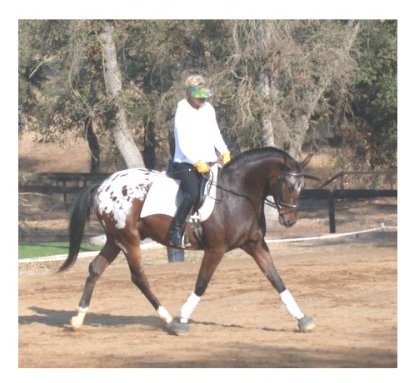
|
| Member: Alden |
Posted on Wednesday, Sep 8, 2004 - 3:05 pm: No, I didn't take you Advisor name as literal and neither do I own Fjords (or even met one for that matter). And if you don't think there is saddle and ride them out trainers any longer you must not get out much. They are still around, too many to be sure. But, while I haven't met a horse that doesn't like food it isn't their highest priority. Mine routinely leave food for a belly or ear scratch.I personally think “Natural horsemanship” to be rather useless term, while I like Clinton Anderson's style very much I have difficulty applying a labeling. My father once said that he thought “Benevolent Horsemanship” would be more appropriate than “Natural”. Maybe so. I don't discount that clicker training could be useful, but it still seems akin to making a cell call to someone standing two feet away. Why not just cut to the chase? It would be interesting comparison to have two horses in training, one with a clicker trainer and one with a 'natural horsemanship' trainer using pressure and release, and see which horse learns the quickest. My money is on pressure and release. Ann, I've been told those spots back there were their brains! Then I've never actually owned one either. But yours is a good looker, for a spotted butt that is.  Good day, Alden |
| Member: Dres |
Posted on Wednesday, Sep 8, 2004 - 4:01 pm: Alden, so you are saying spotted horses HAVE brains..???? hum? interesting concept... hum? interesting concept... Ann |
| Member: Ntucket |
Posted on Wednesday, Sep 8, 2004 - 4:41 pm: Cassandra and Lisa -As an aside, just a little background on how this rearing behavior MAY have developed in your Standardbreds (you probably know all this, but..). When Standardbreds are exercised (jogged) or raced, the tacking up procedure involves hooking the overcheck strap onto the saddle of the harness last, when the horse is actually moving forward and the driver is hopping into the cart, generally never when the horse is standing still. The overcheck is often connected to the same bit as the driving reins and is adjusted to hold the head awkwardly high when standing or walking, but as the horse trots or paces, he brings his head down to bear down on the overcheck to set the head position you see while racing. If there were no overcheck, just the driving reins, the horses may curl down, restricting maximum air flow and would also be more difficult for the driver to control in a racing environment. Depending on the horse and its desire to bring its head lower than optimum headset (for racing), some bits are more severe than others. When introducing a young horse to the overcheck, it should be done very gradually and gently, starting with a loose overcheck and shortening over time. If a horse's exposure is not positive, or a groom attaches it to the saddle of the harness too abruptly, or while the horse is not moving forward, a rearing tendency can be learned. These tractable, kind and trusting Standardbreds probably think that going up is what they are supposed to do when the bit abruptly gets pulled over their withers. Add to this the flight response in this rigging and they have no place else to go but up. Not that any of this helps undo the damage, but it may explain why the behavior is so related to handling of the head. The training tips above that talk to the other parts of the body certainly seem like great advice. Good luck with this frustrating situation! Mary |
| Member: Christos |
Posted on Wednesday, Sep 8, 2004 - 6:18 pm: Now I think I have a few thoughts to add to this discussion.Rearing is simple reluctance to move forward, and I believe it should be treated as just that. Whatever the reason for this reluctance may be, does not matter one bit. The horse must move calmly forward whenever asked. There are, of course, several methods to achieve this. I prefer the lazy, safe one. That is, you ask the horse to lead by gently applying a bit of pressure on the lead line. The very split second that it offers movement towards you, any movement, from stepping forward with just one leg to jumping towards you after bucking, you release the pressure. The very split second it stops moving, you gently reapply pressure on the rope. This is a game of patience. The first step may take one very frustrating full hour. The horse may lie down, buck, rear, or simply close its eyes and seem to fall asleep. It is his job to try every possible trick to relieve that pressure. It is your job to maintain gentle pressure until he finds the correct trick, which is moving towards you. This may sound very time consuming, as the first step may take an hour, the second a few minutes, and then, when the horse will be leading quietly on a relaxed line, you'll need to challenge him by leading him through anything that could possibly be difficult, like a small dark shed, a trailer, a carpet on the ground or over a few ground poles. All together, a couple of hours. Next day you'll need less than half hour to fine polish the exact position you want the horse to be next to you when you lead. All the best, Christos |
| Member: Lorrieg |
Posted on Wednesday, Sep 8, 2004 - 6:54 pm: Another thing you could try in addition to Christos suggestion which is a good one.Start by just disengaging the hindquarters in place, once that is going pretty well on both sides, then disengage and start into a small circle immediately several steps at a time. Before you know it the circle will become bigger and bigger and can then eventually straighten into leading wherever you want. Wish I could take credit, but yet another great Clinton Anderson training method for leading inexperienced or problematic horses. It works great! Good Luck, Lorrie
|
| Member: Mrose |
Posted on Wednesday, Sep 8, 2004 - 7:36 pm: Ann...I didn't know Appy's could look so good! Is your horse a cross? Really nice!!Rearing can be playing, it can be a fear response, and (most often imo) a refusal to go forward. Most of all, rearing can be dangerous whether you are on the ground or, even worse, in the saddle. When I was young I thought it was great to teach my horse to rear; I thought it made me look like Roy Rogers, and it impressed my friends (my parents never saw this stunt, or there'd have been "rear" problems of another kind! I have since seen one man killed, and two others badly injured by rearing horses. When on the horse and it rears, it can easily go up too high and flip over backwards, esp. if the rider is a novice and just "hangs on" without trying to get forward movement going. When on the ground, it's all too easy to get hit in the head with a hoof as the horse is either going up or coming down. A lot of good suggestions posted here; I just wanted to remind everyone that rearing isn't just an annoyance or a "cute trick." btw-I've a friend with Fjords and they are the only horses I've met that like to eat even more than my Arabs do! Cute litttle guys and they move right along on the trail. |
| Member: Miamoo |
Posted on Thursday, Sep 9, 2004 - 8:21 am: Hi all,Christos - the method you spoke about for teaching leading is exactly what I use to teach loading on a trailer too. It works great as long as I am willing in the beginning to take my time. Pressure and release as they step forward. It doesn't matter if they get on the first day as long as I end with a step forward and choose when to quit. Ann - That is one beautiful picture. I have not been an appy fan but yours is gorgeous! Cassandra - Please get some help. Rearing is dangerous as you have heard from others on this post. It will be important to figure out if the rearing is happening from confusion and lack of knowledge on the horses part - fairly easy to fix with any of the Anderson/Lyons/Parelli methods referred to or if it is just a horse with an I don't want to attitude. Not so easy to fix and maybe very dangerous. A horse to get rid of. No horse is worth your health and safety. Just my two cents Ella |
| Member: Lisamg |
Posted on Thursday, Sep 9, 2004 - 5:36 pm: Christos;I disagree with you on rearing being caused by not wanting to move forward. If you read my post...my husband's Standardbred will often "half-rear" in anticipation of moving forward. (i.e. at the start of a distance race). Moving forward is exactly what she wants to do. Unfortuneatley at these times she can't move forward until it's time for the race to start. When she gets this keyed up he tends to stay off her back until it's time to leave. That seems to stop the problem. Doesn't happen everytime, usually on cool mornings in the Fall when she's very fit. However, what you said is still correct, rearing (the really dangerous kind) is also a response of a horse in fear or obstinence who does not want to move forward. I've witnessed this with my husband's mare when overfaced on the trail (it was dark and she was frightened). So you are right for the most part, but rearing can have other causes too. Cassandra: I tend to think your mare is rearing in response to fear and anxiety which is understandable as the mare has led a "sheltered" life. I would assume that now it's a learned behaviour in response to fear. Perhaps the answer is teaching her a differenct response to use. That's one of John Lyons answers to unwanted behaviour. Worked for me. I wouldn't attempt it though without the help of a professional. I also think Ella is absolutely right. If the rearing problem you describe does not improve with one of the previous posts mentioned training methods, I would consider getting rid of the horse. No horse is worth getting hurt over. There are plenty of good horses more worthy of your time. My husband bought an Appy several years ago (no offense Ann) who was a real jughead. Totaly barn sour and had been sold from owner to owner. Unfortuneatley he did not find out about the barn sourness until out on the open range alone with the horse. He was fine going out but when turned toward "home" the horse would tremble turn his head sideways and charge back in the direction of home. When my husband brought him back to Michigan I tried starting over with him. I tried lunging him and he charged me. We sold him at a huge loss. I've often wondered if I could have "fixed" him ... but then we have many "nice" horses now and the feed bill is the same. I just didn't want to risk being hurt by this horse no matter how nice he looked. Just a thought before you get too attached. Lisa |
| Member: Christos |
Posted on Thursday, Sep 9, 2004 - 7:14 pm: Dear Lisa,What your husband's mare does is called a flying start. It is not rearing, it's what she's been trained to do for a living. |
| Member: Goolsby |
Posted on Friday, Sep 10, 2004 - 11:10 am: Hope I am not butting in on Cassandra’s post, but I am having a similar problem with my yearling rescue colt. He doesn’t really rear but stomps, comes up or bucks and runs at me or away from me when leading away from the barn and his comfort zone. He started out leading well (in the corral or around the barn). He also plays with the lead rope. He will shake his head and bite and chew the rope, then will buck or jump or run. Now my question. How should I deal with him playing with the rope? He is focusing on it rather than me. I have been patiently trying to figure out something that will work. I have been doing the pressure and release, but not working with him as much as I should and this weekend my butt headed appy jammed my hand against the trailer so it will be a few more days until I can work him again. I also have another yearling that leads beautifully that I have spent the same amount of time with and used the same methods. |
| Member: Jerre |
Posted on Friday, Sep 10, 2004 - 11:50 am: Colleen, can you do other things to keep your yearling's mind too busy to play with the rope? Ask him to back, disengage the hindquarters and forequarters, back again, yield. If he understands those yields, you can throw them in as you lead him, and he'll have to pay more attention, because you may ask him for something at any step. He sounds like he has a high play drive, so I'd be hesitant to squelch that. But if he's got that much energy, he can "learn" a few more things! Have fun with him, the expressive babies are so entertaining -- as long as he respects your space and you feel safe. |
| Member: Goolsby |
Posted on Friday, Sep 10, 2004 - 2:07 pm: Thanks JerreI will try that (when my hand heals). I have ignored the rope playing thus far and just applied slight pressure until he moved forward, but that is not working well. Our leading sessions have not be very long (time or distance). Other than the leading obstacles, he is respectful and I feel very comfortable around him, but I feel he is going to be a long frustrating road. I am trying to be very patient and take my time. My other colt I call good boy, this one I call mule headed SOB. Colleen |
| Member: Lorrieg |
Posted on Friday, Sep 10, 2004 - 4:13 pm: Great advise Jerre!Those are all techniques that are used on the Clinton Anderson groundwork series that I mentioned on a post earlier, and boy are they ever effective in getting a horses attention and respect! Lorrie
|
| Member: Jerre |
Posted on Friday, Sep 10, 2004 - 4:38 pm: Well, when you do this, your path looks like a drunken sailor's (or those dotted-line cartoons in Family Circus ) But the benefits last beyond leading. ) But the benefits last beyond leading. I'm so pleased that there are so many NH trainers now. When I was (much!) younger, the advice would very often have been to use a chain, jerk his nose and scold. I'm doing the Parelli program at home with my yearling and 5yo, and am mid level-2. I've never had so much fun with horses, or felt so connected. Jerre |
| Member: Lisamg |
Posted on Friday, Sep 10, 2004 - 5:27 pm: Christos;I am familiar with the "flying start" and yes, this Standardbred does that. But that is not what I was talking about. When I said "half-rear" she lifts both feet off the ground but not high enough to be dangerous (kind of like a levade sp?)repeatedly as long as she is held back. The flying start is something difficult to get used to .... even though it's only to a trot (that's what she's bred to do so that's mostly what she does) it's explosive. It really blows people's mind who are not famliar with it. My husband gets great joy by passing others at a trot during a race when they are cantering or galloping. He just loves to watch their jaws DrOp. Lisa |
| Member: Christos |
Posted on Friday, Sep 10, 2004 - 6:33 pm: Lisa,I say this is not rearing in the same sense that a levade is not rearing and a courbette or capriole is not bucking. Accidentally, perhaps, the horse has been seriously encouraged, i.e. trained to do it. May be not directly encouraged to do the particular trick, but certainly bred, fed and often encouraged into racing mentality, which directly leads to it. Now, of course, you'd like that mare to stand still on the start line and blast off on your signal only, but that's specialised race training and I believe beyond the point of this thread. By the way, as her training progresses, you will see that when she stands still on the start line she'll concentrate more, and a less than proficient rider will be caught completely unprepared for the even bigger explosion. Allowing her to act up a bit so she blows some steam and the rider gets in the "action" may be a wiser choice right now. All the best, Christos |
| Member: Redmare |
Posted on Friday, Sep 10, 2004 - 10:27 pm: Cassandra, how's it going? Lots of ideas here, eager to hear how you progress!Colleen, this is a common problem and not just with babies. I've been working with a Morgan the size of a moose who is sweet and playful, but will give you a 1200lb body slam when he gets too far from home and wants to go back. This horse is already clicker savvy, so I use that tool to show him what I want. I try to walk him back & forth (this is key I think, not just walking from A-B) and make circles. I carry a dressage whip to swing in the air to move the parts around, or to hit if necessary (like if he's about to fall on me). I get him to circle one way then the other -- not too many times, as it's for obedience rather than exercise. Jerre, I know all about the drunken sailor. I worked with a semi-wild 2 year old a while ago and I called what we did leading-lunging. Picture it
|
| Member: Qh2244 |
Posted on Monday, Sep 13, 2004 - 1:22 pm: Hi everyone. Sorry it has taken me so long to respond. Crazy weekend.I have come to the conclusion that my mare's rearing problem is due to both anxiety and possibly that she has never learned any other way to "get through" a tough situation. As I mentioned before, her only experiences have been a very brief one at the track with probably rough handling and a life at a barn with minimal handling for 2 years and no routine care. Here is her update: She is VERY nervous when presented with anything new. She will shake, sweat, rear, run in circles etc. I was too afraid to even go in her stall to groom her in fear she'd plow me over if she got scared, so I worked on some simple things from outside the stall. She is now clicker trained to let me put her halter on from outside her stall and to back from a hand on her chest. This has proven to be a great thing, as I was having to "trick" her into letting me put her halter on, which included bribing and chasing her around a stall a bit the first few days. We worked in a roundpen on stopping whenever I turned in to face her and she caught on quickly and would do it so long as she was comfortable in the environment she was in. The next day she was sooo much better to lead out to the field from that simple exercise. She is still nuts at times. If put in a different stall she rears (and walks on her hindlegs---she needs to be a circus horse) and races around, throwing in a few bucks and stomps and anyone new walking into the barn or a car in the driveway (or any other different noise) can send her into a frenzy. I started clicking her whenever she stood still for even a few seconds and this worked wonders. By the end of yesterday I could lead her much better and could actually stand and groom her while hanging on to her lead rope for short periods without her running circles around me or any other "anxiety attacks" --- a HUGE step from me being afraid of getting stepped on as she flew away from whatever it was that was scaring her. The rearing while leading has subsided and she is now saving it for in her stall if she gets nerved up or if you put her under "extreme" (for her) pressure, such as leading over a bit of mud from the arena to the barn. I'm owing it all to the clicker and and the numerous site-seeing trips we've made (spending 10 minutes in every 10-foot section of the barn until she somewhat chilled out!!). We'll see how today goes.... I just recently was exposed to the clicker and use it with my other horse and am now thinking it is a LIFESAVER if you have to deal with a potentially very dangerous horse. It seems to calm them and help get accross what you are asking wonderfully. SOme people I know cornered a yearling at the track with 3 people and numerous boards and used ropes etc. just to get a halter on, ending up (of course) with numerous bumps and bruises and crashes into walls and a terrified youngster. 20 minutes with the clicker and you'd have a horse who accepted and actually liked his halter, as my "crazy" filly showed me. I'm sure the natural horsemanship teachings would result in much of the same, but if you don't have a roundpen and or can't move the horse and can't get next to it at all I'm thinking the clicker is a wonderful thing!! Thanks for all your help. I would love to try the Clinton Anderson or Pat Parelli but we all know those tapes/books are expensive and I have the "poor college student" synDrOme at the moment. If anyone has been wondering why I haven't mentioned trying them out, that is why! I've never seen or dealt with a horse this nervous in 16 years around horses, so if anyone else has had experience with a scared, nerved up horse, I'd love to hear from you! |
| Member: Terrilyn |
Posted on Monday, Sep 13, 2004 - 1:57 pm: Cassandra--Just a quick note regarding your comment above about the training materials being expensive, etc. Yes, they are....but there is also lots of guidance available free online. I think Redmare above has made reference to this site before: https://clickryder.8m.com/7games.html in either this or other posts. But it relates how to team Parelli's Seven Games with clicker training. It seems to be easy to read and offers lots of good suggestions....seems you've come very far already. Adding Parelli's Seven Games to your training tool kit will further enhance the positive things that are happening with you and your horse. |
| Member: Tlcstabl |
Posted on Monday, Sep 13, 2004 - 2:29 pm: Hi Cassandra,I have been away for a while and have just got back to reading my e-mails. As I was reading all the comments about training, I have not noticed anyone say anything about feed. I have come across horses (various ages) in the past that have the same type of reactions as mentioned (especially while in the stall) when they are on sweet feed. It seems that some of the horses do not seem to tolerate molasses very well. With these horses we have changed their diets to crimped oats and have seen drastic changes in their manners within a few days..... Just my 2 cents worth! |
| Member: Dtranch |
Posted on Monday, Sep 13, 2004 - 3:00 pm: Sherry ... Good point.I had someone bring out a 3yo app gelding that they could not get near. He had jumped a round pen, and stall wall and got banged up a little. I did initial ground work and found he was happy to run forever. He really looked liked he wanted to join up, but would not let you within 10 feet of him without running off agian. After a couple of sessions, I asked the owner about her feeding and care routine .. he just seemed hyper. As it turns out, she was feeding sweet feed and pellet supplements exclusively .. this while he was stalled almost 24/7 .. small turnout but not enough to burn off energy. I immediately put him on crimped oats and daily turnout. Within a week, I was able to approach, halter, and work on ground drills. He now carries his head much lower and follows like a puppy. Seems if we look hard enough, we generally find some reason for behaviour situations. DT |
| Member: Qh2244 |
Posted on Tuesday, Sep 14, 2004 - 1:52 pm: Thanks for the link!! Yes, she is on sweet feed along with her hay and is not on full turn out. I'm aware of the complications that can arise out of this, but we've been having a hard time getting hay the past couple years due to all the rain. Putting her on an all hay diet is not an option at the moment. While I'm sure being on sweet feed is not helping her situation she was much improved again yesterday....she seems to be settling more and more each day. I'm thinking that while she is of a very nervous nature I might be able to get the situation "under control" in the very near future. Thanks again everyone!!! |
| Member: Kckohles |
Posted on Wednesday, Oct 20, 2004 - 12:37 pm: I really couldn't read another post about these trainers and gettting respect and not comment.Respect is a convenient excuse to hit your horse with a stick to "to get their respect." I will confess I was there and thought that was a good idea once too, but I have since seen that most "natural" horseman force horses as much as regular trainers they just wait a little longer. It seems even worse to me to hit your horse under the guise of something "natural." And for those of you who will say that those trainers don't "hit" their horses, oh yes they do, they might start soft but then they end up using their sticks and strings. The other thing you might want to look at is disengagement. Yes it is a life saving tool and you want to make sure a colt or any horse you are working with you can access the hindquarters but to use it for training purposes will cripple your horse. I have seen it in a lot of different states with many different horses, horses with either hock problems or problems in their front feet from doing a lot of disengagement. Horses are not meant to turn like that their bodies are not built for it, so doing it a lot cripples them. I can pick out horses that are being trained this way a mile away, their hindquarters look like they belong on another horse because the hindquarters have successfully been disengaged from their bodies. I am so glad to hear that the rearing is disappearing by working on another aspect of the horse. This horse isn't making any "mistakes" it is just doing what it knows and what has worked for it in the past. Rearing isn't a "problem" for this horse, it doesn't work great for us but it shouldn't be approached as something horrible that the horse must stop. I have heard Ray Hunt talk about things like this and this is what I understood him to say. He talked about not trying to fix something like this because that always keeps it close to the surface but instead to focus on putting things on top of it and burying it under a lot of things we would consider good things. Which sounds exactly like what Cassandra is doing. As for respect, having respect for the horse first then the human can EARN respect from their horse not demand it with a stick. I know many might be offended by what I wrote but it might be good to take a look at what you are really doing to horses. Just because someone is making a lot of press and money with a technique doesn't mean it is for the good of horses. |
| Member: Redmare |
Posted on Wednesday, Oct 20, 2004 - 7:16 pm: Right on, Kim!Respect is an overused term in the horse world. Why should an animal "respect" a member of another species? Do they somehow know we pay for their board, provide them with a good life? Many behaviors horses exibit result from fear and confusion. I have yet to see a horse who will rear if she has somewhere else to go. |
| Member: Lorrieg |
Posted on Wednesday, Oct 20, 2004 - 7:35 pm: Kim,I am certainly not offended by your post, you sound like someone who has the welfare of the horse in mind. I constantly work on earning the respect of my horses and not demanding it. What I want is a horse that's glad to see me when I walk up and I am happy to say that I have that. I use my stick and string mostly for stroking and desensitizing when necessary, the most I have ever had to give was light tapping if necessary. As far as disengagement goes I too believe that it should not be overdone and am careful not to do it. I appreciate your concern regarding what is for the good of the horse and always have that in mind. I guess what I am trying to say is that if these techniques are used in moderation and with good common sense I believe they can be very benificial in achieving a mutually respectful and quality relationship between man and horse. Thank you for your obvious love for our equine friends which are for me one of the biggest blessings in my life. Lorrie
|
| Member: Hwood |
Posted on Wednesday, Oct 20, 2004 - 11:01 pm: Cassandra,If you wanted to try a different concentrate feed that isn't a sweet feed, consider a complete pellet . . . like a guinea pig pellet . . . no sugar, yet provides extra protein and fiber. We can get complete pellets from a local feed mill that processes it's pellets from locally grown alfalfa, and we figure a 1lb coffee can of pellets replaces 1 flake of hay (from a 35-40 lb bale). If you wanted to experiement to see if the sugar is part of the problem, the pellets might be a good alternative. |
| Member: Miamoo |
Posted on Thursday, Oct 21, 2004 - 8:39 am: Kim,Respect - I guess it depends on your view of the word. Like many other words it starts out to mean one thing and becomes another. I have 4 horses in my barn. Three over 16 hands and the one that isn't is as wide as a Mack Truck. All over 1000lbs. I would not have them if they did not respect me. It would be dangerous. My 16.1 hand 2 year old is the friendliest girl you could ever imagine. She is so friendly she will walk over to you and then walk on top of you to get a bit closer. She does it with the best of intentions. The same good spirits and intentions that put a foot in the wheel barrow and tip it over when I'm trying to clean her stall. She is two, she wants to play and she needs to understand that I am not a toy or another horse. I don't hit her regularly, but I have slapped her on the neck. I don't yell regularly, but I have used a loud voice to gain her attention. I don't yank on a chain but she will wear one if she decides that going to the grass is more important than listening to me. I have taught her respect. I put my horses out to pasture in the dark (5:30 a.m.) before work. She is the last one out. This morning she can watched all her buddies go, I put her halter on, cliped a line just under her chin and practiced walk/halt/trot/setup showmanship stuff on the 300+ yard trip to the pasture. She was awsome. When I turned her loose she ran for a full 5 minutes flat out - just because she felt good and it was a frosty morning. If I did not have her RESPECT I would not have gotten her to the pasture safely. Please don't underrate it. Some people reading this site are new to horses and just learning skills to keep one. They need to be respected. I think you have seen too many people who have interchanged the word respect with violence. Ella |
| Member: Sunny66 |
Posted on Thursday, Oct 21, 2004 - 10:09 am: I think Kim was right on in pointing out that there are other ways to gain respect other than violence...sure they take more time, but they have better results. My guy got the violent shanking...a couple of times he went down he was so scared. I now have his respect from spending time with him. He understands what he can get away with and what he can't. All I have to do is say "ah ah ah" and he will stop...for the most part anyway.He has really calmed down this last year. He's just as polite and gentlemanly but without the whites of his eyes showing. |
| Member: Dtranch |
Posted on Thursday, Oct 21, 2004 - 11:36 am: I am a "trainer" as well as a devoted owner and rider. I don't have my own show and certainly don't make a lot of press or money. I do not beat or mistreat any horse, but I certainly do demand respect. I am agressive when I need to be, and loving when I need to be. Never confuse being agressiive with a horse as mistreating them. I work with novice owners and riders constantly, and the one common thread seems to be that this horse is their "baby" ... and generaly the horse knows it. The horse pushes them around and generally has their way, and they think it is just being cute .. until they get hurt. I love these animals, but you must realize that they are big, strong, and can be dangerous, even if they don't intend to be. Respect and control is a "MUST" if you are going to be around these animals. Any one can get on a horse and some can even make them go in different directions, but if you are going to be a "horse person", you had better understand this principle. I keep my training sessions short and in no way do anything that would injure the horse, but we do work on respect, and yes, even obeying the handler. I am calm and patient, even with my Appaloosas (that's a joke OK, I own 10 of them). You may be surprised to find that there are some "trainers" who actually love and respect these animals.DT |
| Member: Sunny66 |
Posted on Thursday, Oct 21, 2004 - 11:50 am: "You may be surprised to find that there are some "trainers" who actually love and respect these animals."I have no doubt Dennis....it's finding them in my neck of the woods... that is the hard part....please take no offense!!! You can join Christos if he ever comes to visit California and you both can teach me a LOT! 
|
| Member: Dtranch |
Posted on Thursday, Oct 21, 2004 - 12:13 pm: Aileen ... Have read many of your posts, and I would say that you are doing quite well without us .... Would enjoy the opportunity though. The greatest reward in working with these animals is seeing the positive results, and then sharing with someone else and see them smile with the accomplishment.DT |
| Member: Kckohles |
Posted on Thursday, Oct 21, 2004 - 1:24 pm: Dennis,I do have to disagree that you are getting respect if you are demanding it, because respect cannot be demanded. You can get compliance but if you try to demand respect you will get fear. There is no doubt that horses need a job and direction on how to do it, but I believe most horses are trying to just get along. I don't think horses are back at the barn snickering behind peoples backs at how much they got away with today. There are cetainly times that being firmer is called for but most of the time I am trying to do less not more. I don't see that punishment works with horses, it helps them be untrustworthy and scared but not respectful. I see most horses searching for the place of comfort and the very time they start looking the human gets firmer and pretty soon the horse quits looking and says "just force me, you are going to anyway." I want my horses to think and come with ideas that we can work with not just do whatever I ask them to do, there is a higher level than that. Tom Dorrance talked about yeild, give and turn loose, and from my experience most natural trainers are only at the yeild stage and are satisfied with that. The example he used to describe the difference was fixing a fan up on a ladder and there was a guy helping him. He needed a set of pliers to get the job finished. The yeild would be if he asked the guy to get the pliers for him, the give would be if he said "a fellow could finish this if he had a set of pliers" and the helper went and got the pliers. And the turn loose would be the guy noticing that he needed the pliers and going and getting them. Horses are so capable of doing things out of our realm of thinking it is amazing. I am a trainer as well, and I use to think very similarly to what you are saying I just found it not to be the direction that I wanted to go with my horses anymore. KIM |
| Member: Dtranch |
Posted on Thursday, Oct 21, 2004 - 2:33 pm: Kim ..Again I hear terms like force and punish, neither of which I mentioned or use. I "demand" respect by my consistent method. I understand that my job is to ask the horse for a particular result, then I let him have the space and time to figure out how to get there, and then I reward him for his success. I do not force the action, but lead to it, and I don't punish unwanted response. I would agree that perhaps "demand" is not the proper term. I don't tell my horse to respect me, I earn it from the many hours of ground work and bonding. DT |
| Member: Alden |
Posted on Friday, Oct 22, 2004 - 1:13 am: Kim,In reading you post it seems too me we must be working with two different animals. I use the same principles that my lead mare does. I apply pressure, either with a stick or rope, and I increase the pressure to obtain my desired result. This is exactly what my lead mare does to instill 'respect' in her herd. And she doesn't have any qualms in landing a hoof in a slow to respond gelding's ribs either. I doubt my stick has near the effect as those hooves. Whether it is 'natural' or not, I have my doubts. But then what is natural about horses and humans interacting? The answer to that is easy; nothing. Good day, Alden |
| Member: Imogen |
Posted on Friday, Oct 22, 2004 - 3:06 am: Personally I'm a great believer in posturing since this is also what good lead mares do (a lot more ears than hooves... though hooves will be employed if required which is why the ears work) as long as you don't make the horses unnecessarily upset by melodramatics. Tone of voice is a good aid to a "posture"...Something I don't see mentioned much in our training discussions is the importance of working with the natural instincts for food, company, familiar surroundings etc. Perhaps it's just implicit in what you are all saying. I have a mare that just hates water. If you want to wash her tail, get your stuff ready before you feed her, get it done while she's eating and NO problem whatsoever. Otherwise you will be chasing her around the stable and getting a shower yourself for half an hour. She is 10, I just don't believe you could retrain her out of her water phobia which she had before I got her. Sometimes you just need to go with the flow and forget training theory. Getting back to the original rearing discussion, one thing I'd like to know is whether this is a smart animal that thinks faster than its owner to go to the rearing/avoidance behaviour (so owner needs to get faster and anticipate earlier) or whether there's an element of owner now expecting the bad behaviour and getting into patterns which are actually reinforcing rather than surprising the animal. Best wishes Imogen |
| Member: Kckohles |
Posted on Friday, Oct 22, 2004 - 12:45 pm: Hi Dennis,I believe the definition of punishment is any thing that happens after the undesired action. Such as the rearing, what you recommended was to work the horse for several minutes after the horse came down from the rearing. I thnk that is punishment, all the discouragment is after the fact. I believe if you want to be effective in helping the horse understand what you want from what you don't, you need to take action while the undesirable thing is happening. This is the flip side of using release to teach, you can't release after the thing you wanted, you need to release the moment it starts happening for the horse to be clear. With this case in particular I wouldn't address the rearing directly, like Cassandra is seeing the rearing is disappearing on it's own. But to use another example of what I am talking about let's talk about eating grass. I think I am familiar with what Clinton Anderson says to do (correct me if I am wrong) but he recommends after they eat grass is to put them in action and make them work for a little while, like you suggested witht the rearing. I think that is punishment, the horse associates the discomfort with the rider rather than the grass eating. I just have to stop here for a second and clarify that this is a really interesting discussion for me, and I am not trying to make anyone wrong for the way they are doing things I am just discussing the differences for clarity's sake. I think there is a lot of finger pointing in the horse world of who doesn't know "the right way" and not a lot of opportunity for discussions like this, so thanks to everyone who is participating in this discussion. Back to the grass eating, from my perspective once the horse has their head in the grass, too late, pull them up and go on your way. Way before they even got near the grass they were "telling" you they were going to eat grass, that is when you need to respond by giving other direction. I don't know about you but if I ask someone about let's say eating some cookies at their house and they don't respond and then I eat them, and then they get after me, I am going to be upset at them for not saying they didn't want me to eat them when I asked in the first place! With the grass eating, I understand that some horses are really dedicated to diving for grass so in that case I will use one rein sharply AS their heads go down for grass. So they are doing it to themselves. I don't do it before they start down because then I am doing it to them, it has to be the specific action of head down towards the grass that causes the discomfort. Like I said before if their heads are already down, it's too late just pull them up and go on your way. Hi Imogen, I definitely agree that you need to adjust for every situation there is no one way formula for any situation. If you have found a way to wash your horses tail that works for you that is what I think training is about. Getting along with your horse in a way that works for you, not a way that I as a trainer think you should have it, but the way that you feel comfortable with. I do believe that you could help your mare with this but I think every smart horses owner should ask themselves "do I want to die on this hill?" Which I think means is this the battle that I want to take on? What is amazing about horses is that particular situation can be address in a lot of different places. I have a mare that gets really worried in large groups but the smaller part of that (for the lack of a better way to put it) is when I get her saddled in a high energy place I need to work on getting her to let down and turn loose there, and not wait until I get on and join the group. It is the same issue in the saddling as in the group. I hope that makes sense, it isn't always easy to write these ideas clearly. Hi Alden, I don't believe in the lead mare theory. First your horse knows you are not a horse. Second, the very nature of the relation of the lead mare to the herd is a relationship of conflict, the lead mare is always fighting to maintain that position, and some day one of the other horses will defeat her. The way that I approach it is more from a place that I am not like any horse, I can provide comfort and safety better that any horse could. So there is no conflict pre-existing in our relationship. "I apply pressure, either with a stick or rope, and I increase the pressure to obtain my desired result." Increasing the pressure I think is forcing the horse. The more you increase the pressure the worse your idea becomes. I want my horses to think I have good ideas that hold comfort for them. I have to run so I will have to finish this later, KIM |
| Member: Lisamg |
Posted on Friday, Oct 22, 2004 - 12:56 pm: I apologize for remaining off of the original subject of rearing,... Cassandra I hope things are continuting to improve for you.I agree with both Dennis and Alden, horses in their natural state demand respect of each other. Like Alden said; if punishment was not appropriate at times, then lead mares wouldn't kick and lead stallions/geldings wouldn't chase and bite other horses. Do those of you who think asking for respect only provokes fear really think that the horses that is chastized by the lead horse do not feal fear? Of course, we humans at times (with our superior minds??) over do it. That's called abuse. Don't beat yourselves up though, I've seen some abusive dominant horses too. It's not a perfect world. I do believe though that once a horse understands what you want, he should know that non-compliance to the request will result in a form of punishment. That doesn't mean violence, but physical discomfort is sometimes necessary. Without this a smart horse can quickly become spoiled and dangerous. A horse that is someone's "baby" as Dennis stated often walks all over his "human" because of lack of respect which stems from having no fear of repurcussion from that person. That person in the horse's eyes is below them in the pecking order. You all can attack me now, but I have had experience with a spoiled horse. I spoiled him myself and it took calm (i.e. non angry), consistent discipling to teach him that when he acted badly I would punish him. This horse is the sweatest gelding and totally trusts me now because he has boundries and because I am his herd boss. He will follow me anywhere. But abuse would have ruined him. It's a fine line. I do not claim to be a "trainer" but this is my experience. Lisa |
| Member: Dtranch |
Posted on Friday, Oct 22, 2004 - 2:34 pm: Kim and all ...Here's the deal with me. I teach proactive riding and training. As with the eating grass, you can feel and anticipate this if you are proactive, and make the correction at that precise time. Same holds true for the rearing, and many other unwanted actions. I to agree that many potential problems are avoided and or / fixed, when working on something totally unrelated. Here is where we differ. If I catch my child doing crack, but was not on my game and did not anticipate it before he had actually done it, "I will still deal with it." Absolutely, prevention is better, but if I missed it, I do not want to wait for it to happen again and hope I do a better job of anticipating. A rearing, striking, or biting horse, may only give you one more shot before he hurts you. I agree, patience and understanding are great tools, but when discipline, or call it punishment if you wish is required, I will use it as needed. I have never hurt a horse, and my horses don't hate me, to my knowledge. They come to me, they hang around me and act like they appreciate me being their leader. Imagine that. As we all know, many of these discussions will not change one's opinions or methods, and that is perfect. If it works and it doesn't hurt you or the horse, go for it. DT |
| Member: Liliana |
Posted on Friday, Oct 22, 2004 - 3:10 pm: Hello everybody,Reading Cassandra’s letter I see that the mare has not really been trained to do anything. “She was at the track briefly as a 2 year old. They had left her too-small halter on while she was growing, which left a scar on both sides of her jowl. They did remove it eventually. She had not had a halter on since that time up until when I bought her. SHe has had no foot care etc.---she has basically just been a "family pasture ornament" that received treats and brushing. I feel that the scars left on the mare due to the halter being far too small are not only in her skin, but deep in her perception of the human world, so demanding respect with a stick, in my opinion is just reinforcing the fact that humans are not to be trusted. Someone once said - hitting a horse because it did not do what was expected of him is no different from hitting a kid for not being able to read without first teaching him the alphabet. I believe that we owe it to ourselves and our horses to just take the necessary time to try the horse out before acquiring it. We test drive a car before we buy it don’t we? Neither horse nor humans are born knowing what is expected in the horse-human partnership and it takes many years and a lot of patience to begin to understand them and feel their reactions before they happen. Without meaning to offend anybody, the expression “there are so many nice horses around so dump the “nasty one ” which in turn will result in the animal being sold on from owner to owner, and almost always end up in the knacker's yard, is a bit irresponsible. I urge more people to take the time to find out about the abuse and torment horses have to endure before they finally get to the slaughter house, I would like to think that most people would – after seeing these - take the time and care necessary to make sure that they can handle a horse, before paying their money and making a commitment that will not be fulfilled. I have spent the most part of my adult life bringing difficult to handle horses, dogs, cats, etc. back to the gentle trusting creatures they really are. And the one thing I have found time and time again is that their aggressive/difficult behaviour is due to ignorance in the way they have been handled. Animals have the IQ of a 7 year old human, so handling them as such gives far better results, once they trust you and form a bond with you, your voice will be enough to direct them The only way to get respect is by giving it in the first place. |
| Member: Dtranch |
Posted on Friday, Oct 22, 2004 - 3:20 pm: Cassandra ...I apologize for straying into training philosophies. I would recommend you try various methods and decide for yourself. I only know what works for me. In a previous post, you referred to blowing up when confronted with obstacles, puddles etc. My only thought here is not to try and force her over the obstacle. Continue to send her to the obstacle by applying whatever pressure you choose. Once there, back off and allow her to figure it out on her own. When the she bolts away, simply send her back. Each time she approaches the obstacle and realizes she is not going to die, you will be surprised as she becomes more curious and more confident. Eventually, she will negotiate the obstacle and move on. Strangely enough, she will probably even forget about the rearing. Once we get them to thinking instead of reacting, we are well on our way. Keep us posted and let us know your progress. DT |
| Member: Kckohles |
Posted on Sunday, Oct 24, 2004 - 11:40 am: doing crack vs. eating grass? |
| Member: Dtranch |
Posted on Wednesday, Oct 27, 2004 - 8:46 am: eating grass vs. rearing, kicking, biting ...It seems we agree to disagree |
| Member: Liliana |
Posted on Wednesday, Oct 27, 2004 - 12:56 pm: Hi allIt is true that we can all write our opinions and some advice will be taken and some will not. After all it is a forum not a Lecture. Trying to keep this short. We have 6 horses that were going for dog meat as they had become too neurotic, aggressive, difficult, you name it they were bad news to everybody. Again the problem originated from people blaming the horse, before checking the root of the problem. The Stallion was lame on all four feet, one of the mares had white line infection, being a gentle animal trying to please she would try to carry a rider with bute, which in turn damaged her back, to the point where she could no longer carry a rider, of course she started to rear after a few steps. Some one wrote, “Listen to your horses, they will tell you a lot” and yet people still insist in demanding respect before really listening to the horse. Horses are living beings with different personalities, would you agree?, so really in my opinion it all comes to the way you relate to your horse. The Stallion for example would go for you with all his might, feet, teeth, body etc and the way to give me a chance to tie him up was to give him a huge carrot to keep him busy while y secured him to two posts! Now he is a gentleman and nobody can believe it is the same horse. |
| New Member: Judyh1 |
Posted on Wednesday, Oct 27, 2004 - 3:15 pm: Liliana you are my kind of person. I have read with a gamut of emotions this discussion and can only say a whole lot of people must dis-respect me for I have very mouthy horses - one even gives me head massages if I sit at his feet - but will sail over huge jumps with me at my command. I have talked and listened to my horses and they to me for over 60 years. It has never failed - and like you I have had some real -----s! They know when to play and when to take care of their manners and when to work.Hey all you trainers - go for love and respect not just "respect from fear and domination". It may take a little longer but is much more rewarding!! |
| Member: Liliana |
Posted on Wednesday, Oct 27, 2004 - 6:07 pm: Thank you JudyI just hope that trainers and horse handles realise that! Horses need love and understanding and once they trust you, they will be your best friends! |
| Member: Kckohles |
Posted on Wednesday, Oct 27, 2004 - 6:16 pm: Judy, I like what you have to say, the only thing I disagree with is that it takes any longer. I think that it might seem to take longer but it is really faster. When you earn respect the amount of repetition and "being stuck" at a certain level is so much less and/or doesn't even exist.Dennis, yes we can agree to disagree. The only other thing I would say is that if you see kicking, biting, rearing, tail swishing or chewing the bit with any regularity then maybe it isn't the horses. What is amazing to me is how when I changed my direction how much the horses seemed to change too. When I changed from fixing "problem" horses to seeking to understand horses better the less problems there were! I read a great suggestion from Curt Pate which I will paraphrase, watch any horse video with the sound off and if what the "trainer" is doing doesn't make sense without the words then don't bother with the words. What I will add to that is, what's the horses reaction? Do they swish their tails, pin their ears, stomp their feet, are they sweaty foaming messes at the end or shut down and totally lifeless? A lot of times we listen to what the "trainer" is saying rather than what the horse is saying with their body language, and I don't mean what they are doing physically because some of the top trainers today can get horses to do really flashy things but the horses are hating every minute. Look beyond the horses' outside and look to the inside. |
is The Horseman's Advisor
Helping Thousands of Equestrians, Farriers, and Veterinarians Every Day
All rights reserved, © 1997 -
