Site Menu:
| This is an archived Horseadvice.com Discussion. The parent article and menus are available on the navigation menu below: |
| HorseAdvice.com » Training, Behavior, & Conditioning Horses » Tips and Tricks » 2004 Tips » |
| Discussion on For Horses That Spook From Scary Little Objects | |
| Author | Message |
| Member: Lchapman |
Posted on Thursday, Nov 11, 2004 - 1:27 pm: For those fortunate to live in the country and can have chickens, get them. Eventually, your horses will be accustom to little objects running and flying by. It worked on some ex-racehorses that I have had the pleasure to re-train for their new endeavor. |
| Member: Sean |
Posted on Tuesday, Apr 25, 2006 - 5:37 am: Hi AllI'd like to get fleece lined hobbles for my two year old trotting horse, he keeps changing his gaits and braking into a canter on the road. I have hobbles but they have cut his legs and I really don't want to use them again. Does anyone know where I could order fleece lined hobbles ? Kind regards Sean |
| Member: Erika |
Posted on Tuesday, Apr 25, 2006 - 8:29 am: Sean, you might get more answers if you start this thread under another topic.But, as to your question...I don't know much about hobbles, but you say your horse breaks into a canter on the road. As far as I know, a horse breaks to the next gait when the current one is uncomfortable or requires too much energy to sustain. If it were the latter, simply going slower would work, but I don't think this is what's happening, is it? I have experienced a horse that would break into a canter at a very slow speed when his feet were sore. He would avoid trotting, probably because it was easier to carry more of his weight on his hind end at the canter. Since you drive on the road, is it possible his feet are tender and he is trying to find a more comfortable way of going? Might I suggest that you bute him well before the next drive and see if he doesn't hold his gait better. It may not be a training problem after all. If that is the problem, maybe some boots to reduce concussion might help as well. |
| Member: Dtranch |
Posted on Tuesday, Apr 25, 2006 - 8:35 am: Sean ... didn't know they had hobbles for a "Trotter"Wouldn't hobbles force him not to trot? I thought hobbles were use to "Pace" as opposed to trot. I would think if he is trying to trot with hobbles, he would naturally get sores on his legs. Maybe I'm missing something here. DT |
| Member: Sean |
Posted on Tuesday, Apr 25, 2006 - 9:22 am: Hi yes Dennis he is indeed a "Pacer". He is just two and seams to get confused, changing gaits all the time and then braking, It could indeed be he is uncomforable as he has recently come in from grazing and i'm just working on getting his fitness back, he seams to be good on his way out and braking all the time on the way back in. Will try the bute and shorter runs out to see if that changes. Would I bute him the night before? |
| Member: Annes |
Posted on Tuesday, Apr 25, 2006 - 12:20 pm: Linda, that is interesting about the chickens. I live in the country and there are lots of wild turkeys. One day I saw my ex-racehorse watching a Tom Turkey strutting around with his tail fanned out. Then my horse put his nose to the ground and chased the turkey out of the field. It was really funny to watch. |
| Member: Erika |
Posted on Tuesday, Apr 25, 2006 - 12:51 pm: Yes, Sean, I would bute him the night before as well as the morning of. The idea is to eliminate pain as a factor. Then you can see better if it is a training issue.I do wonder, though, even if it is a training issue, is this how they train pacers--with hobbles? He is just two, could things be just a little too much for him to handle yet? I hope you take it slow and don't rush him into too fast a pace that he simply may not be able to sustain yet. I know little about pacing roadsters, though, so you probably know better than I. Just a thought, in case the bute doesn't make a difference. |
| Member: Terrilyn |
Posted on Tuesday, Apr 25, 2006 - 2:17 pm: Sean--I'm no expert...but I recently adopted a pacing Standardbred. She trots, canters, and paces at liberty...the pace comes as naturally to her as breathing and from what I understand, if breeding as a pacer goes back five generations or more, pacing is probably hardwired into the horse....though your horse can certainly trot, he is naturally going to pace as it is what he is bred for. If you're going to ask for a trot at higher speeds, you're probably going to get a pace...I don't see how you wouldn't. I see that you are referring to him as your trotting horse in the post above, but to Dennis' question you answer that he's a pacer. Is he a Standardbred? If so, he's one or the other...and if a pacer, that's what he's going to do. |
| Member: Terrilyn |
Posted on Tuesday, Apr 25, 2006 - 2:18 pm: Oh, and Linda...I'm getting chickens. I wanted them for eggs, but certainly they'd be a great exercise in de-spooking too!! |
| Member: Erika |
Posted on Tuesday, Apr 25, 2006 - 4:23 pm: Terri,I think Sean acknowledges that the horse is a pacer. His question addresses breaking into a canter. Sean, the more I think about it, most young horses change speed often because they just aren't stabilized. My three year olds will spontaneously canter when I trot them, then it's like they have to be reminded that that isn't what I asked for! But, no, don't know where to get hobbles. |
| Member: Terrilyn |
Posted on Tuesday, Apr 25, 2006 - 5:11 pm: Yes I realize that...but my point was that a pacer is not a trotter, or vice versa; they are distinct. Hobbles are not used on a trotter, as per Dennis' comment above. From the USTA website:"Pacers, which account for about 80 percent of the performers in harness racing and are the faster of the two gaits, are aided in maintaining their gait by plastic loops called hobbles, which keep their legs moving in synchronization." So Sean, please don't put hobbles on your horse if you want him to trot, but DO put them on if you are asking him to maintain a pace instead of breaking into a canter. There were a few terms that needed some adjustment. Just trying to help.  As for breaking into a canter...from a let's see...trot? Pace? I think I would look for some good training resources that address the basics of driving and training your horse in harness. I'm sure that just as in riding, your horse will need balance, muscle development, and time before he becomes adept and consistent. |
| Member: Corinne |
Posted on Tuesday, Apr 25, 2006 - 6:31 pm: Chickens....novel idea.As for pacing. What is that? Is that like the Pace car in car racing? Does the horse get the race going? Also, hobbles are those things that tie their legs together? How do they synchronize movement? I have only ever seen them used to keep a horse from kicking. Sincerely, I only know dressage |
| Member: Stina |
Posted on Tuesday, Apr 25, 2006 - 10:18 pm: While this is not my area of expertise, I did work with Standardbreds in the Equine program at Delaware Valley College of Science and Agriculture (GREAT school!). Pacing is a term to describe the type of gate and it is when parallel sets of legs move instead of diagonal. So, RR and RF move as a unit and LR and LF move as unit. The unique hobbles used in this case are to keep the parallel legs moving in unison. Other uses of the more common hobbles, are to prevent pawing and to keep horses to closer to home when camping. |
| Member: Corinne |
Posted on Tuesday, Apr 25, 2006 - 11:26 pm: Thanks Stina. I assumed it was a type of gait but after reading a few of the posts I was getting confused as it seemed to describe a type of horse as well.Guess I haven't seen many horses who don't move their legs in diagnonal pairs. Are there any web sites where I can watch these horse in action? Sounds fun.....I heard they are easy to sit as well. Can they move in parallel sets at the walk and trot? |
| Member: Sean |
Posted on Wednesday, Apr 26, 2006 - 4:52 am: HiThank you all for your advice, I really appriecate it, The time difference hasn't allowed me to reply before now. He is indeed a pacer, Erika I think what you are saying is correct. He is braking and changes his gates mostly on his way back from our drive, so i presume its a combination of rushing home and tiredness as I had mentioned he is just back in from a spell off grazing. His a well developed two year old but between myself and my girlfried we keep 8 very healthy happy horses but just one road pacer. I took him as a rescue horse, you wouldn't belive the horse we took back then was the same horse I currently have, If we didnt take him last year I would say he was only one day away from dieing, I have a special bond with him and want to ensure he is trainned correctly without stress to him, although in saying that don't get me wrong he is stallon that needs firm direction and bites which i'm trying to stop, If anyone has some good advice on this also. At first I taught sometimes the biting was a young thing of saying hello but his a bit of a bully and stabled in a stallion yard so I now think its a Stallion thing,, I wouldn't over work him and i don't like to use the hobbles that I see a lot of Irish horse man using as the leather ones intially cut the back legs which i won't put my horse through. This is why I wanted to try fleece lined ones to prevent the cuts from rubbing. I'll first try him with the bute and slowing his pace on the way back in to see if this prevents him from braking. I'll also half the journey time to see if this helps. Thanks a lot the advise is always great. |
| Member: Kthorse |
Posted on Wednesday, Apr 26, 2006 - 6:23 am: If he is just being mouthy I would rub his muzzle and around that area till he wants to keep his head away from you. Stallions are more mouthy than other horses. But if its a fair dinkum bite you have to catch him in the act with a giant wollop at the same time if you can. You have to frighten him. If you dont get the timing right or dont frighten him it will become a game of cat and mouse and get worse. Not around the head though or you will make him head shy. I have heard people use a water spray bottle in the face. I have never done it that way though.Good luck with the pacer. Katrina |
| Member: Erika |
Posted on Wednesday, Apr 26, 2006 - 6:41 am: Sean, you sound like a very kind and reasonable horseman. I'm sure you'll bring this colt along fine. Good luck! |
| Member: Ajudson1 |
Posted on Wednesday, Apr 26, 2006 - 8:09 am: Corrine,I used to ride a horse that would pace a few strides going down hills. Very unique, wonder if anyone else has ever experienced that? you can try going down some hills at a faster clip and see if you get any "pacer" moves from your horse. O wait, aren't you healing yet? oops, maybe not a good suggestion for you!! 
|
| Member: Corinne |
Posted on Wednesday, Apr 26, 2006 - 9:29 am: Hey Angie...will give you a foot update on my healing from surgery post so we don't hijack this post. thanks for asking |
| Member: Terrilyn |
Posted on Wednesday, Apr 26, 2006 - 10:09 am: Corrine--The ability to pace is the norm, not the exception, for many gaited horses such as the Tennessee Walker; many of the American breeds share a common ancestry. The pace (or a pacey gait), however, is usually considered undesirable. For perhaps more info on this than you ever wanted, visit: https://www.gaitedhorses.net/Articles/Pace/Pace.shtml As for there being two different horses. If you are talking about Standardbreds then yes--they come in one of two "flavors," trotter or pacer. Many more are bred as pacers than trotters. The designation refers to the gait in which they race. A pace is faster than a trot (both are two-beat gaits), and a fast pace is NOT COMFORTABLE to ride. (Although the website above shows an Icelandic executing a "flying pace" which looks kind of cool!) A Standardbred's conformation is a contributing factor to pacing talent...they are generally built downhill, have powerful hindquarters, and have backs that tend to be a little longer; for these reasons they can get long and low to the ground. Pacers cover a mile in the 1:50s in a harness race. It is truly amazing to watch. Sean, the online cataloger Big Dee's carries harness supplies for pacing horses, to include hopples and hangers. Here's the link: https://www.bigdweb.com/Hopples_Hangers_and_Parts_C635.cfm Happy Wednesday, everyone.
|
| Member: Lilo |
Posted on Wednesday, Apr 26, 2006 - 10:16 am: About pacing: A lot of Tennessee Walking Horses pace, and some of the other gaited breeds do it also. It is not considered desirable, and a true pace is not that comfortable for the rider. There is something called a "stepping pace", that is more comfortable for the rider. I have the opposite problem with my "gaited" Rocky Mountain Horse - he is on the trotty side.Some of the gaited horse websites have descriptions of the different gaits, e.g. www.gaitedhorses.net. Lilo |
| Member: Warwick |
Posted on Wednesday, Apr 26, 2006 - 11:45 am: Hi SeanSince you live in Ireland as does Imogen Bertin, who is another HA member, I wonder if you might try contacting her as she might have seen some of the hobbles you are looking for in the tack shops in her area as opposed to ordering from the US which would likely incur high shipping costs and perhaps duty as well. Might be worth a try. Sue |
| Member: Alden |
Posted on Wednesday, Apr 26, 2006 - 7:23 pm: I didn't find the horses cared one bit about our chickens. The chickens would do their thing right around the horses feet. I even toss a bird up on the horses every once in a while and the chicken is much more upset than the horse. But I do like the eggs. And for those who haven't tried them the duck and goose eggs are good too I think some of us loose sight of the de-spooking process. It's not that I expect the horse to not spook at a particular object. I expect a horse to trust me about any particular object. Once the horse trusts you with strange objects it doesn't matter what you have and it does transfer to the saddle over time. So I don't think objects in the pasture/paddock do much for de-spooking because there isn't any association with me and safety. The horse needs to learn I won't let those scarey things hurt him so there's no need to spook. Good day, Alden (HTG) |
| Member: Djws |
Posted on Thursday, Apr 27, 2006 - 3:30 pm: Sean-I have never seen fleece lined hobbles. At the tracks in our area (trotters and pacers), I see the trainers applying Vaseline to the pacer's hobbles and to the section of skin where the hobble is likely to rub. It seems to cause less friction. Having CLEAN hobbles is essential. We insist that our trainer clean the hobbles after each use. Hobble burns generally do not continue as the skin becomes tough in that area. I hate to see rub burns on any horse at the track but, it happens. 2 year old pacers are still babies! Have patience with him. Also, loosening the hobbles may help. Pacing IS bred into them and it's a beautiful gait. Many trainers are known to never allow a pacer to canter. This is my dilemma with my retired pacer..he walks, trots and PACES! We are working on a canter as, they can be retrained after racing. A fast pace is NOT comfortable to sit as Terri states. An added note: many of the drivers and trainers at the tracks will have a horse checked for EPM when their horses break a lot. Unfortunately where I live (Ohio), too many horses are diagnosed with this disease. As for the biting. I went through a bout of this behavior with our 2 year old colt who also is very studdy. It was suggested to me that having a stiff brush at my disposal could be a great tool. When you see the bite coming, hold out the brush and let him get ahold of the stiff brush bristles, not you! It doesn't hurt them BUT, they don't like it. I believe that our reflex after being bitten is to strike back BUT, I don't think that frightening a horse helps. Our Standardbred colt tired quickly of this habit after the brush game. It is hard to anticipate their every move in time to get the brush into position but, it worked for us on this particular colt. Also, I never fed him treats of any kind unless they went directly into his bucket. I have seen a few of these guys get "nippy" from being hand fed. I wish you the best! |
| Member: Mrose |
Posted on Thursday, Apr 27, 2006 - 5:11 pm: I've seen fleece lined hobbles in some of the catalogs. They are the regular western hobbles, but you'd just need to add extra chain links, I'd guess. I don't work with Standard Breds, but many years ago used to hang around Del Mar when the trotters/pacers were in town as my dad had friends who were trainers.On the biting, one things that works with colts is to spit on their nose when they try to bite. They hate it, and after a couple of tries, I've never had them bite again. (Missed everyone....have been away at shows.) |
| Member: Sean |
Posted on Friday, Apr 28, 2006 - 5:30 am: thanks for the advice and information sara, I will certanily look up in catalogs for the fleece lined hobbles if the slowing down and reducing time out doesn't work.will try the spitting on his noise as his becoming bigger and stronger and difficult for my girlfriend to handle. He has recently serviced his first mares and has made him more of a bossy lad,,,, |
| Member: Mrose |
Posted on Friday, Apr 28, 2006 - 11:23 am: Oh, yeah! There's nothing like a young stud colt who's just started breeding! Hot stuff!!Something I've found very usefull when handling such "boys" is a big, plastic baseball bat like those sold for little boys to play ball. They look fiercesome, and make a load noise when the horse is bopped with it, but don't really hurt much. After a couple of bops with it, most young studs will behave, at least as long as you carry it. Also, we always use a "special" halter with a stud chain when breeding, and a "regular" halter for everything else. They quickly learn the difference between the two and when they are going out to breed, and when they are going out for other things, and it greatly affects the way the behave. |
| New Member: mizbetty |
Posted on Sunday, Jun 3, 2007 - 1:17 am: Is there a desireable headset for a Mo. fox trotter?-My Mare carries her head very high and I was told that a headset training tie down might be of value, |
| Member: martina |
Posted on Sunday, Jun 3, 2007 - 10:20 am: Hi Betty. You should start your own thread for this topic... because I'm sure you're likely to get many more responses that way from people with gaited horses. But no, a MFT should not carry their head high. It sounds like she is still green perhaps, or was never schooled to break at the poll or in vertical flexion. Don't use a tie-down to try to "break the habit" because she's likely to develop another habit to counteract the effect of the tie-down. I tried to upload a picture of my MFT showing his headset, but the image was rejected (too large). Anyway, there are lots of great videos from the various equine clinicians who can show you how to develop this headset. But it takes time, patience, and practice. Good luck! |
| Moderator: DrO |
Posted on Sunday, Jun 3, 2007 - 11:26 am: Hello Betty,Tina is correct, by keeping discussions separate, topics are easier to find and follow. Consider copying your post, creating a new discussion with a descriptive title, then paste this in your discussion. You will get more and more timely replies. DrO |
| Member: martina |
Posted on Monday, Jun 4, 2007 - 6:25 pm: Betty, I was finally able to get my photo to a size that would be acceptable to post. Here it is: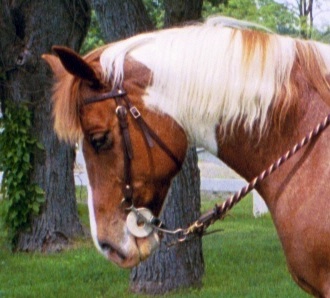 Although this photo was taken while standing, this is a good headset for a MFT when traveling as well. Of course, head shake is acceptable! If the nose is in the air and the head is held high, it hollows the back. |
| Member: alden |
Posted on Tuesday, Jun 5, 2007 - 11:22 am: Betty,What is your horse's age and training level? What kind of bit are you using? What is your riding experience? I can give you several training tips to correct your horse's head carriage but I need more information. Tina's horse looks great and she's correct that MFT will have signification head bob at the trot, amount of bobbing depends on breeding, training, and suppleness. I have four MFT and none travel with a high head. Good day, Alden |
is The Horseman's Advisor
Helping Thousands of Equestrians, Farriers, and Veterinarians Every Day
All rights reserved, © 1997 -
