Site Menu:
| This is an archived Horseadvice.com Discussion. The parent article and menus are available on the navigation menu below: |
| HorseAdvice.com » Training & Conditioning Horses » The Gaits of Horses » |
| Discussion on What makes a bouncy trot? | |
| Author | Message |
| Member: gwen |
Posted on Sunday, Oct 28, 2007 - 8:39 pm: So my new tb continues to exceed all of my expectations. He is a wonderful horse. Under saddle, we have reached a fun milestone. He has gone from hating any bit contact, to reaching into the reins. I am NOT complaining, but had a really hard time keeping my body steady today when trotting. He has a natural tendency to be bouncy in the trot, and today it was just huge. It feels neat, compared to the jog of my qh! It was really hard though, to keep his rhythm consistent. He has been pretty pokey up until today (I am wondering if the "cool calories" I just started have affected him). This part is kind of just a vent. HOWEVER, I was curious about what piece of their conformation makes them soo bouncy. I am confident that SOMEONE on this website will know the answer. THANKS!! |
| Member: dtranch |
Posted on Monday, Oct 29, 2007 - 8:25 am: Gwen .. Make sure you are getting him collected and working off the rear at the trot. When they reach into the bit, sometimes they are getting too much on the fore. I work a lot of backing exercises to get them collected. Try to lightly pull in the reins and feel the weight shift to rear before asking for the trot transition. You should feel a smoother trot immediately, but will have to practice at it to maintain.DT |
| Member: terrilyn |
Posted on Monday, Oct 29, 2007 - 8:51 am: Long legs, bigger stride, just a "different ride" than a QH. I am dealing with the same learning process myself.... I notice that it takes quite a bit more physical work to ride this horse than a more compact QH. I'm taking lessons from a hunter instructor, who laughs every time I go to slow my big guy down (I get so exhausted physically) to take a breath. A working hunter trot is worlds away from a western pleasure jog. You're working alright... |
| Member: sunny66 |
Posted on Monday, Oct 29, 2007 - 10:31 am: I struggle with this too. I'm told it's all me ... LOL... In addition to Dennis' comments, I've also been told to do transitions within the gait. So a slow trot, ask for a bigger trot, slow trot, bigger trot... all the while keeping your core centered with a relaxed back to absorb the impact -- unless of course you're posting which then you just post slower and faster -- to help get his hind end underneath you... easy to say, not so easy to do The goal is to feel his hind hooves in your hands ... I've felt it once and it's a great feeling... once you've felt this you'll also feel that he will give you a place to sit! If I'm misleading, I hope someone will correct me The goal is to feel his hind hooves in your hands ... I've felt it once and it's a great feeling... once you've felt this you'll also feel that he will give you a place to sit! If I'm misleading, I hope someone will correct me I'm very glad you're so happy with your new boy
|
| Member: gwen |
Posted on Monday, Oct 29, 2007 - 12:21 pm: Hmmmm. That makes sense. I do wonder if he is getting strung out. He was REAAALLLY forward again today. I was trying so hard to sit up with the downward press and getting heavy in my elbows to ask him to slow. A few things weren't great:*he would slow nicely for me, but then would resume same super speed *he ended up with his head in the air and not reaching out and down I ended up just grabbing mane and letting him cruise, and somehow created a nice forward gait that was pretty manageable! Any thoughts on the drawbacks of my half-halts would be appreciated! |
| Member: aannk |
Posted on Monday, Oct 29, 2007 - 12:35 pm: Gwen,Half halts are not done with the rein. They are done with body position. You should post slower than he is going. You need to set the pace. It requires strong core body muscles. IT is also akward feeling. It will work, but will take time. Good luck, Alicia |
| Member: gwen |
Posted on Monday, Oct 29, 2007 - 1:13 pm: I thought Alicia, that it was a combination of all aides creating a half-halt...The slow posting piece I absolutely get-I just can't make my body do it!! 
|
| Member: aannk |
Posted on Monday, Oct 29, 2007 - 1:38 pm: Gwen,From your post, it appeared to me you were just using your reins. If I can remember right, when I half halt (well when I do it the way my instructor tells me to) at the trot to create a slower pace, I do the following in order of importance and in time order. 1) Check to make sure I am not leaning forward 2) Make sure my lower leg is not gripping 3) Balance myself a little more with my upper thighs 4) Let the horse "bump" me on each side of the post, in other words, when you are supposed to go up, you kinda wait until the saddle hits your bum, then you kinda hold yourself up a little longer than the horse wants you to, you are right, this is VERY hard. I have been trying to do this consistantly for about 5 years now. 5) Ask the horse to go forward, yes forward, into a consistant rein contact When they are running around with their heads up in the air, I find the only thing that really works is what I mentioned. When they are lugging on the bit, however, you need leg first. Alicia |
| Member: dres |
Posted on Monday, Oct 29, 2007 - 1:41 pm: ''What makes a bouncy trot'' well confirmation can make for one, the length of the pasterns/ short or long ?Some horses just have to much suspension for some riders and it makes for a difficult union .. That being said don't try to sit his trot more then a few strides at a time.. once you feel out of the rhythm go back to posting and regain your balance and the horse's.. I tell my grand kids to sit 5 strides post 5 strides / sit 5 strides post 5 strides.. sometimes not thinking about it but thinking about the count will relax your seat and back as well.. * its worth a try * Getting your horses to be honestly in front of you leg and lifted thru his back is key in sitting a comfortable trot.. have fun.. This isn't learned quickly.. On the first day God created horses, on the second day he painted them with spots. |
| Member: ekaufman |
Posted on Monday, Oct 29, 2007 - 2:05 pm: Horses have different ways of going. Level of fitness and training (horse and rider) also make a big difference.One great trick to learn to post with body control are the following exercises-- 1) Post the walk. Yup-- it's hard because the horse isn't helping (mine find it funny), but it will force the issue of your own body control, and help you develop the strength not to plop into the saddle. 2) At the trot, mix it up: post 2 up and 1 down; 3 up and 1 down, etc.. Same deal only it works your timing as well as control. A week or two of this, and a normal posting trot is very easy, and you will have the body control to slow or speed your posting to cue the horse. |
| Member: vickiann |
Posted on Monday, Oct 29, 2007 - 5:17 pm: A bouncy trot can be a beautiful thing. Experiment with speed control to see what works for a given situation. If a horse has a long, forward, natural stride, he will be bouncy if you shorten his stride. As stated previously, the horse's condition is important to controlling the stride and smoothing it out. Usually, you can find a speed that helps to make the way of going smoother. |
| Member: mrose |
Posted on Monday, Oct 29, 2007 - 6:09 pm: I prefer "bouncy" as it gives you a boost when you post and the posting just becomes automatic with no work involved. I have to work to post on a really smooth horse (maybe that's just me, tho') As someone else pointed out earlier, it's a big switch from TB to QH. TBs are as a rule much bigger movers. It's difficult enough, imo, to switch horses within a breed, and takes a bit to get used to a different way of moving. From breed to breed it take that much more to get used to the differences. Hah! You should have seen all of us trying to adjust to Ilona's gaited horses in New Mexico!
|
| Member: gwen |
Posted on Monday, Oct 29, 2007 - 6:42 pm: AWESOME ideas everyone. Thanks so much. |
| Member: canter |
Posted on Monday, Oct 29, 2007 - 7:59 pm: Gwen, everyone has given you great info. I'll say again that a big trot is much easier to ride when the horse is round and connected. When that happens and you get that big, lovely trot...you will feel like his feet are not even touching the ground and you both have sprouted wings! You will love it. Enjoy! |
| Member: ekaufman |
Posted on Monday, Oct 29, 2007 - 8:04 pm: Be careful Sara about letting the horse boost you on the trot-- if you think about how posting works, that approach makes you late on your rise.... |
| Member: mrose |
Posted on Monday, Oct 29, 2007 - 10:58 pm: Perhaps "boost" isn't the right word. I just find it much easier to post on a "bouncy" or stronger trotting horse - it feels more natural to me. |
| Member: maggienm |
Posted on Monday, Oct 29, 2007 - 11:06 pm: It could be the difference in the type of horses you are used to riding.Compared to the easy jog of msot qh a powerful tb would feel very different. However, I just happened to read about the trot in a book by Ingrid Klimke. She talked about how a stiff or poorly muscled back can cause a rough trot. Of course, the book took a page or so to say this. The condensed version is use circles to slow the trot. Use serpentines and ground poles to build strength and suppleness. Every time the trot gets rough, heavy on the front or feels like the front legs are pounding go back to circles. After several weeks raise the poles to low caveletti. Another thing that will cause a rough trot is nervousness in the horse. This is not necessarily that the horse is high strung, he just might not understand what is required of him so in his eagerness to please he pounds away. This was actually the case with my mare, when I got her she was sooo rough, a great bouncy trot that would churn butter. |
| Member: gwen |
Posted on Tuesday, Oct 30, 2007 - 7:57 am: Good points Lori. I think nervousness may have something to do with it. However, when he does begin to reach through his back, the trot changes its rhythm (I think that is what I mean) but still takes me so far. I can't believe how sore I am. My ankle, which has screws in it from an accident ten years ago, is barely movable right now. This horse makes me feel so old! It is definitely invigorating compared to my qh. |
| Member: vickiann |
Posted on Tuesday, Oct 30, 2007 - 10:57 am: To me stiff and bouncy are two totally different things, and have owned horses with each way of going. What Fran says is exactly true for when you take the bouncy to collection. My bouncy Arab glides and flies for me. It is heaven and we truly become as one. And he IS easy to post on. His normal stride is huge -- should have been a race horse. Lori is right on about the conditioning and strengthening. This is very important. Without a good level of fitness, it is hard for a horse to smooth out at either a faster or slower speed than his/her normal way of going. Gwen, it sounds like this horse will make you a better rider. The bouncier (OR rougher) the ride, the more you must relax and go with rather than against the horse's motion. |
| Member: sunny66 |
Posted on Tuesday, Oct 30, 2007 - 11:01 am: Ouch Gwen! I wonder if lunging him a bit would help at all? Maybe a longer walk warm up? I have no idea, just thoughts...Elizabeth, could you go a little more in depth in posting the walk? I'd like to do this but I can't quite figure the muscles to use... I think our thighs are supposed to be open at all times to give us the secure seat, so would it be just the core? I just don't know enough, please enlighten me! |
| Member: mrose |
Posted on Tuesday, Oct 30, 2007 - 11:34 am: Gwen, I feel your pain!...did your ortho surgeon ever suggest that you have the screws taken out of your ankle? I've complained to my surgeon about my ankle swelling and really hurting after riding, esp. after posting a lot, and he told me I should have the screws taken out. (I have a plate and seven screws.) I'm trying to decide if I want to do this or not. |
| Member: maggienm |
Posted on Tuesday, Oct 30, 2007 - 11:41 am: Elizabeth, good ideas for developing the post. I have posted the walk, mainly to train myself how to post at the trot correctly.Have you ever heard of posting the canter? Charles de Kunfy offers this about half halts, The seat should continue to follow as you are not asking for a full halt. The torso and arm resist the following action briefly. To teach the horse this may have to be exagerated a couple of times then minimized to give the horse an oportunity to respond to the lighter aid. The rein is a guide and should never be used alone without other aids. |
| Member: mrose |
Posted on Tuesday, Oct 30, 2007 - 11:42 am: Elizabeth - great ideas for exercises! I'm going to try the sitting two, posting one etc. (Can you actually walk after you've done these exercises?) Re: loose thighs - I was taught to stretch my thighs down, which tightens them against the saddle, and to keep my lower legs relaxed; to balance my seat like a beach ball balancing which moves with the horse and is separate from what the legs do. I can see with jumping you'd want more leg grip (I assume; I don't jump although I've spent a lot of time around people that do.) But for flat work is the above correct or does it depend entirely on the style of riding? |
| Member: aannk |
Posted on Tuesday, Oct 30, 2007 - 12:51 pm: You should allow your thigh to drape down, not force them down. Lower leg should also drape around the horse, not hang loose. You don't need any more leg grip jumping, if you do grip, your leg will slide back. You just have to allow your joints to bend and aborb impact. That is why I ride with the flexible stirrups, made a big difference in the impact on my ankles.Your legs basically just stabilize your position on the horse, and of course aid the horse when necessary. They should not actively press unless they are being used as an aid. Alicia |
| Member: canter |
Posted on Tuesday, Oct 30, 2007 - 12:53 pm: Sara, you do want to stretch your thighs down, but without tightening or squeezing - try to stretch them down from the hip without adding tension to them (so easy to say...so hard to do!). I've been told to think of it as pointing your knee down and I've been told to think of your legs as wet blankets, draped over the horse, in contact with the horse, but without pinching anywhere.Sometimes, those images work better for me to remember to ride correctly. I have a tendancy to squeeze too much with my upper leg and it pushes me out of the saddle. Also, my mare is pretty sensitive and when I squeeze too much with upper leg, she slows down, so I give her a nudge with the lower leg - totally sending the poor thing mixed signals! |
| Member: ekaufman |
Posted on Tuesday, Oct 30, 2007 - 1:59 pm: Hey all,Don't sit two-- rise two and sit one. The rising phase of the trot is the one to work on (since the "sit" phase isn't a true sit anyhow). I would worry that sitting two/rising one would make the horse sore and disrupt the trot rhythm. Yes, I have posted the canter. It's a great exercise for developing the medium canter on less than forward horses, or ones that have trouble maintaining a rhythm. You guys can probably tell that I rode with a sadistic trainer :-) Posting the walk is just like posting the trot, only the horse isn't helping you generate impulsion, and obviously the gait pattern makes everything harder. But it can help develop strength and organization for the faster gaits. It also can allow you to PUT YOUR HANDS ON YOUR THIGHS and make 100% sure that you are not balancing on the reins to get out of the saddle. Make sure that you don't grip with your knee or lock your ankle-- your weight is going into the ball of your foot. And yup-- you might be just slightly tired. Who needs to walk when we have horses to ride! |
| Member: terrilyn |
Posted on Tuesday, Oct 30, 2007 - 2:32 pm: For imagery on every aspect of your seat, there's no finer resource than Sally Swift's "Centered Riding." Most people read steamy romances while on vacation. Not me. I sat at the ocean's edge with an old dog-eared copy of that classic and tried to memorize it... |
| Member: gwen |
Posted on Tuesday, Oct 30, 2007 - 6:27 pm: This place is such a wealth knowledge! Interesting about taking the screws out. I might look into that! I actually had to put an ace bandage on today because my ankle was so sore. I have the jointed stirrups, and I have never been this affected before-even when I was jumping.I do have to strengthen, and at the same time make fluid, my body. Great exercise ideas everyone. Elizabeth, the posting exercises sound great. I will also dig out and dust off my Sally Swift book. I actually feel good about my riding, as compared to how I was riding with my qh. I was so crooked and (I know this will probably make you all say "jackpot") stiff on my qh. I feel like the "muscle memory" from my college riding days is coming back to me. He is going to be a blast to work with. My trainer already says how fun he is because he is so kind and smart. |
| Member: mrose |
Posted on Tuesday, Oct 30, 2007 - 7:48 pm: Gwen, my surgeon said that most if not all of the pain in my ankle comes from the screws and that once the ankle is healed, in my case it's been over a year, the screws are no longer needed. So, do check with your ortho guy. I'm trying to find the time to be out of commission for a few days so I can have mine out. My ankle kills me now.Terri, I love Sally Swifts books and videos! I evidently need to review them as it's been a few years since reading/watching. Mostly, I need to ride more than I do. I have excellent balance, but zip endurance in the legs. After a few long classes my knees (both repaired) and ankle are screaming, along with my leg muscles. Trail riding is no problem as I either ride with a long stirrup or no stirrups. Fran and Elizabeth - maybe you two could come out with Dennis and give me lessons while he works with the horses! Ahhhh...if only I could ride like I did when I was young (and had nothing else that had to be done!
|
| Member: canter |
Posted on Wednesday, Oct 31, 2007 - 7:28 am:  Sara, I'm the last person qualified to give anyone lessons. I have tons of knowledge in my head but have a very hard time putting it to practical use for myself, never mind anyone else! (But of course, that doesn't prevent me from trying to help here on HA). If only I could take everything I've read, everything my trainer has told me, everything I've learned from clinics and everything I've observed from much better riders...and actually do it. Sigh, but that would take the challenge out of riding well, wouldn't it...and where's the fun in that? Sara, I'm the last person qualified to give anyone lessons. I have tons of knowledge in my head but have a very hard time putting it to practical use for myself, never mind anyone else! (But of course, that doesn't prevent me from trying to help here on HA). If only I could take everything I've read, everything my trainer has told me, everything I've learned from clinics and everything I've observed from much better riders...and actually do it. Sigh, but that would take the challenge out of riding well, wouldn't it...and where's the fun in that?
|
| Member: terrilyn |
Posted on Wednesday, Oct 31, 2007 - 8:50 am: If any of you are in VA, Wendy Murdoch is giving a clinic in Williamsburg on December 1! This is such a great opportunity and will address exactly the issues discussed here. I can only be there for one day and have signed up for a semi-private session. I am PSYCHED. Her book, Simplify Your Riding, has been a tremendous help and takes Sally Swift's principles one step further. Hoping I come away from there with an improved understanding of balance, seat, the synergy between horse and rider...I understand her teaching is phenomenal. |
| Member: mrose |
Posted on Wednesday, Oct 31, 2007 - 10:01 am: Fran, you and me both! We'd be in the Olympics!
|
| Member: sunny66 |
Posted on Wednesday, Oct 31, 2007 - 10:24 am: Thank you Gwen for this thread, and thank you Elizabeth for the information on posting the walk and to everyone else for making me think and visualize better
|
| Member: maggienm |
Posted on Wednesday, Oct 31, 2007 - 11:13 am: I am trying the posting exercises mentioned.How and why would you post the canter? I am trying to improve my two point position so I'm thinking these exercises will help. |
| Member: gwen |
Posted on Wednesday, Oct 31, 2007 - 12:22 pm: Have you guys seen the "igallop" from Brookstone? I wonder if that would make me a stronger rider, as the company claims... I am going to grab that book by Wendy Murdock. That sounds great! |
| Member: dres |
Posted on Wednesday, Oct 31, 2007 - 12:48 pm: Posting the canter will help improve your balance and give the horse freedom to improve as well...I will post the canter on my newly started young horses for bit.. It also helps a novice rider get the feel of the articulation of the head in the canter as well.. It can help in leg position too ..On the first day God created horses, on the second day he painted them with spots.. |
| Member: frances |
Posted on Thursday, Nov 1, 2007 - 8:23 am: Ann, do you think posting the canter is more beneficial than cantering in forward position, in terms of freeing up the horse's back, etc? |
| Member: ekaufman |
Posted on Thursday, Nov 1, 2007 - 2:08 pm: Posting the canter is more effective at developing rhythm in a horse that may need that help. I use it for that, and also to help more advanced horses learn the difference between medium, extended, collected canter. The posting works like a metronome.Also, on a big-moving horse, it is really really fun! |
| Member: lilo |
Posted on Thursday, Nov 1, 2007 - 4:49 pm: I am just having such a hard time visualizing "posting the canter". I would have to watch someone do it (or see a video).This is an interesting discussion. Lilo |
| Member: frances |
Posted on Friday, Nov 2, 2007 - 10:56 am: I agree, Lilo. Anyone want to have herself videoed posting the canter for our edification?!
|
| Member: ekaufman |
Posted on Friday, Nov 2, 2007 - 3:43 pm: I ride alone (except the horse) but will try to get this done next time I have a visitor. But you can also just give it a try-- rise on the inside hind lifting (is this how you do it Ann?), and expect it to be a big swing. Fun! It's easy to tell when you have it right. |
| Member: frances |
Posted on Saturday, Nov 3, 2007 - 10:39 am: Thanks Elizabeth - looking forward to it! |
| Member: adriaa |
Posted on Saturday, Nov 3, 2007 - 10:08 pm: Aha, the igallop. I sat on one at the mall last year, the next day or so my back was soooo sore. I kept wondering why. Then I realized, the igallop. I don't know if what it did was good or just made my lower back ache.On the bouncy TB trot, my TB has a nice stride, but when she is nervous and way too forward her trot is not just bouncy but hard. When she is relaxed and using her hind it's really nice, not flat but a nice bounce. |
| Member: gwen |
Posted on Sunday, Nov 4, 2007 - 1:26 pm: https://www.brookstone.com/store/product.asp?product_code=531707&search_type=sear ch&search_words=igallop&prodtemp=t2&cm_re=Result*R1C1*THere is the link for the igallop. heehee My guy was really hollow on the lunge line yesterday, and today was super speedy and hollow. Definitely bouncy because he is tense. It is soooo hard to ride it! I did some walk-trot transitions, and they were really good. However, as soon as I asked for the trot-he would try to zoom around. This is not something I am used. |
| Member: gwen |
Posted on Sunday, Nov 4, 2007 - 4:48 pm: Here are some pictures of me riding my tb. I thought that maybe someone could spot something in my position that is creating a problem with my boy's trot. Thanks!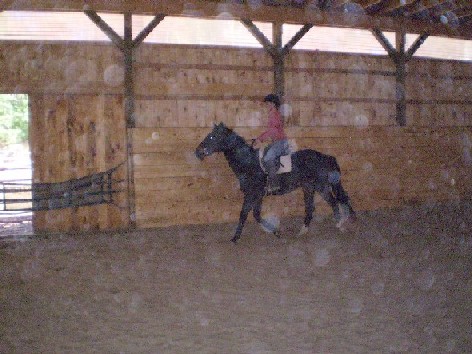 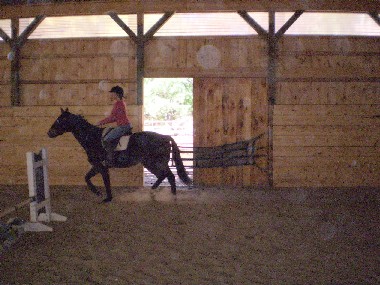
|
| Member: adriaa |
Posted on Sunday, Nov 4, 2007 - 7:03 pm: My TB gal is a sensitive, nervous type, if she's nervous it's a forward, hollow, head in the air trot. I took me a while to realize I had to be SUPER, SUPER relaxed to get her to be relaxed and stretch down. Don't know if you are tense when riding him and it translates through, TB's are sensitive. I even switched to a side pull for a while, she went great in it and was really relaxed, it also forced me to relax, I found I could do a nice relaxed trot on the buckle! It was training for me. I know you said he got pretty forward if you just let him go, but if he's like my TB if you get heavy it gets worse. I've been working with a new trainer and she has inspired great confidence in myself. It does look like your hands are a bit high and a shortish rein.I am certainly not an expert here, but he just sounds a lot like Rosie. RELAX, RELAX, I know it's hard, he gets tense, you get tense, he gets tenser, you get tenser... It was a stretch for me to totally release, let go and go on the buckle trot. But, now we are cantering, not charging around! Good luck |
| Member: gwen |
Posted on Sunday, Nov 4, 2007 - 7:15 pm: Thanks, Adria! He is really interesting because he is non-reactive in terms of being spooky. In fact, today when I was riding him he stepped on a cone. It got stuck on his foot, and aside from the clumping sound, I would have never known it happened! I stopped him, and he stood there while I yanked it off. However, I think he is being sensitive under saddle, as you have said.It is funny that you talk about sort of "letting go" because at the end of the ride I did just that (I tried it the other day too, and it settled him). I grabbed mane and went with it, and he settled in. I just was thinking that I needed to establish an appropriate rhythm for him to know what is expected. Like I said, he is awesome with downward transitions, but when we go back to the trot, he gets like a train-faster,faster,faster. As I have mentioned, this is a NEW WORLD compared to my pokey qh! It is wierd though, how he has changed soo much in the past week. It is like night and day with him. |
| Member: ekaufman |
Posted on Sunday, Nov 4, 2007 - 7:37 pm: Hi Gwen,You guys are a nice pair. I see two main things that would interfere with his gaits. The first is that he's traveling inverted in his neck, which will cause his back to stay DrOpped and tense in all gaits, and harder to ride. The second is that your leg is pretty far in front of you for flatwork, which can cause problems in timing and in landing hard for posting. That could be the saddle, overly-short stirrups, or just that you need to open your hip angle and bring your leg back to where it can support you. Be sure when you post that you can do it with your hands on your thighs, and that you are not unconsciously leaning on the reins as you rise. I could be completely wrong, of course-- hard to call it from still photos. WIll be curious what others think. |
| Member: ajudson1 |
Posted on Sunday, Nov 4, 2007 - 8:47 pm: Talk about interesting info here!! Wooo-eee! Geesh guys, I only started trying to post at the trot a few years ago myself, and figure I look like I am doing the chicken dance. And now ya all got me wondering about posting at the walk and canter too? Oh dear....my poor horses, they will be wondering what the heck I am drinking if I try that!Now, seriously, after reading this and seeing the pictures, my little bit of advice, for what it's worth, is RELAX. Sometimes when we try so hard to do the right thing, we are trying to control our bodies with our minds, instead of just letting our bodies go. My oldest mare, an Arab with a huge trot, taught me that. If I sit on her like someone said above, my legs draped like big wet towels, or as I say, OPEN, she's a dream to ride. Try to make it all work according to what I know hands/legs/back; she tenses up. Of course, I'll never win any dressage competitions, but don't care. I have to ride her (after warming her up) like above at a sitting trot, then I ask for more and post; otherwise she also has a stuck gas pedal. This is a great subject! |
| Member: gwen |
Posted on Monday, Nov 5, 2007 - 6:54 am: Thanks Elizabeth and Angie.Elizabeth, his hollow back/neck is new and I don't know what originated it. Two weeks ago, I had an unbelievable ride on him. He was stretching through his back and into my hands, with a beautiful rhythm. I have no idea what changed the plan. I will pay attention to my legs. I was trying to avoid bumping him with my legs, because I thought that maybe I that was asking him for forward. Thanks for the feedback! Angie, I definitely think you are right about my resisting. I thought that I would try keeping my core steady and strong so that his enormous stride doesn't just toss my around like a ragdoll, but clearly that ain't workin'! 
|
| Member: canter |
Posted on Monday, Nov 5, 2007 - 8:13 am: Gwen, these pix are tough for an analysis, but one thing I do see here is very high hands with elbows extended out away from your body. I'm wondering if you have locked your elbows rather than keep an elastic feel from elbows, down through your lower arms, through your hands, down the reins into the bit. Let your elbows fall to your sides, resting gently against your rib cage. Pretend there is weight in the tips of those elbows so that your shoulders don't hunch up or forward. And keep those elbows "fluid". Let them breathe as you and your horse move so that they give but still provide a firm, consistent contact without pulling.Gwen, give yourself time to learn how to ride this bigger gaited horse. It's very hard and can be quite intimidating. Everyone else said it, but try your best to relax. Sing, if you have to. Do you have someone qualified to give you some lunge line lessons on your TB? I highly recommend it. It will give you a chance to get used to his stride without worrying about where he is going or what your hands are doing. When I purchased Sparkles, I took a lot of lunge line lessons. I had the exact problems you are having now. Those lessons helped me tremendously, and when I gained a bit of confidence, I did a lot of riding without stirrups, which also helped me get used to a big stride. |
| Member: gwen |
Posted on Monday, Nov 5, 2007 - 12:11 pm: Fran, that is a super idea. I felt somewhat vindicated today when my trainer got on him. She got on and said, "Wow, this is harder than it looked." He makes it so hard to just keep my body under control, never mind rating him and everything else! NOT making excuses, just trying to break it down! We talked about continuing with w-t transitions for now. I will propose the lunge line ride! |
| Member: terrilyn |
Posted on Monday, Nov 5, 2007 - 12:14 pm: When I "forget" the proper position for my lower leg, my instructor has me two-point until my muscles give out. It always helps me get my leg nicely back into position.Also, the location of your pelvis has A LOT to do with how your rounds underneath you. If your seat is such that your pelvic bone is jutting straight down into your horse's back, he will hollow to get away from it. |
| Member: gwen |
Posted on Monday, Nov 5, 2007 - 12:41 pm: Does anyone have an idea of why he has changed such in literally-one day? I am not exagerrating when I say that on a Saturday I was having a phenomenal ride, riding almost effortlessly, with him starting to use his topline, using a consistent rhythm, etc., to Sunday superspeedy, hollow man? It was a really weird change with no known change in my riding. Now of course, I am having a hard time maintaining my position, but it was as if we were cruising along and he changed the rules on me! |
| Member: ekaufman |
Posted on Monday, Nov 5, 2007 - 1:07 pm: Hi Gwen,Does he have a tail at one end, four hooves, and ears in front? He's a horse! He may be adapting himself to your riding, or your tack, or a combination of those. I have found that the first few rides on a new horse often show me more about the last rider than me. In my experience, it can take a year to get fully in synch with a new horse, especially if that horse is different from your usual ride. Your guy sounds like great teacher. If you are serious about developing your riding, he will show you every place that you can benefit from changes, strengthening, etc.. A wonderful thing about horses is that, for the most part, they will adapt themselves to the sport and the level of effort we want to put in. Some people love to challenge their riding, and work hard every stride to improve and "move up." Others like to go out and about, or move cattle, or just have a grand time. Most horses will go along cheerfully with those choices. SO my point is, don't beat yourself up if, for a while, you go backward. You will not be able to wave a "perfect wand" over yourself or your horse, just change things slowly and one at a time, if you want to do that. And he will be fine-- his expression looks quite happy in those photos, and he's not muttering about you under his horse breath. But my guess is that, if you want that long relaxed neck and back, you are going to have to work hard to get it back. Focus on your own correctness and relaxation, and he will come around. Good luck! |
| Member: canter |
Posted on Monday, Nov 5, 2007 - 1:50 pm: Elizabeth said it perfectly - he's wondering about you as much as you're wondering about him. And remember, you may feel the same everyday, but you're really not. You're body might be slightly stressed from an angry conversation, unloading groceries, raking the yard. We don't take out that stress on our horses, but it can certainly effect what your muscles are doing and how tense they are. For example, for years, I've learned not to ride right after using a leaf blower to clean up my yard. The darn thing was so heavy that my right shoulder muscles would tense up and burn. Took at least 24 hours for the knots to relax. It affected the way I rode and how Sparkles went. Of course, it's not always realistic to only ride when we've had a good day and are feeling great, but just be aware of how that can affect your horse, particularly a sensitive TB.I've learned that it's normal and OK to take 2 strides forward and 1 stride back (and sometimes 3 strides back...)in my riding. Ultimately, everything progresses. Not always as fast as i would like, that's OK. (and I've also learned to buy a lighter leaf blower !)
|
| Member: gwen |
Posted on Monday, Nov 5, 2007 - 6:11 pm: HA, Elizabeth and Fran, you guys are so funny! I sometimes feel like I am the only one who faces setbacks in training. I look around my barn and think, "Oh, everyone else is just cruising along making great headway, and here I am ruining my wonderful little horse." |
| Member: ekaufman |
Posted on Monday, Nov 5, 2007 - 9:05 pm: Remember Gwen that there is no "headway" without, well, the other way. You know what the opposite of a head is, right? Yeah, that way. They go together. As you and your horse become a team, your struggles may become less obvious. Or not-- my upper level mare objects to certain kinds of new movements by BOLTING bucking across the arena. Then she'll do it, but grunts loudly all the while. And then she decides it's all okey dokey, and we look normal again. So if we were in an arena together, you could say-- thank goodness we don't look like them! |
| Member: canter |
Posted on Tuesday, Nov 6, 2007 - 7:40 am: Last lecture, I promise . Gwen, don't measure your progress by what everyone else is doing in the barn. If your barn is like most barns, it's filled with kids and teenagers who take to horses like ducks take to water. You could drive yourself insane thinking "that little girl who started just 2 months ago is already cantering and I'm still working on trot" or something like that. Remember that you want to ride correctly...that little girl just wants to canter. There's a world of difference. . Gwen, don't measure your progress by what everyone else is doing in the barn. If your barn is like most barns, it's filled with kids and teenagers who take to horses like ducks take to water. You could drive yourself insane thinking "that little girl who started just 2 months ago is already cantering and I'm still working on trot" or something like that. Remember that you want to ride correctly...that little girl just wants to canter. There's a world of difference. Set goals for yourself - make them small, but something you have to work hard for. I guarantee that you will find more satsifaction in reaching those goals than almost anything. When I hit those goals, I walk around for the rest of the day with a s**t - eating grin on my face. ...And I promise you, if I haven't ruined Sparkles by now (after 4+ years), you won't ruin your wonderful guy. |
| Member: canter |
Posted on Tuesday, Nov 6, 2007 - 7:41 am: Ach, Gwen! I just checked your profile - you're a teacher. I better do a better job next time double checking my spelling!! |
| Member: hpyhaulr |
Posted on Tuesday, Nov 6, 2007 - 10:07 am: Gwen,Ok let's grade on the curve here. Come on-a-my- house. I will make you look like olympic material. FIrst of all the thought of riding a horse with out a handle on its saddle would flatline me. Second, I too have meager goals. Mostly to stay vertical and preferably on top of the horse. When I bought Tuffy, the seller made me sign a statement that I understood that Tuffy was a horse who was only aappropriate for an intermediate rider and not a beginner (which she clearly knew I was after a couple of turns around her ring with Tuffy). After I brought Tuffy home, I did not get on her back for almost 2 years. I spent that time feeding grooming, talking to her and basically apologizing in advance for what I was going to do when given the opportunity. Once I knew she trusted me completely (walking around behind me at my shoulder wherever we went) I started lessons on her. It is a threat to the triple digit IQ when you get up on a beast who knows more about what you should do than you do. TUffy has taught me humility and I have proudly torn up my Mensa membership card. As I go on, the playing field is equalizing, and I am confident she appreciates that perhaps even more than I do. I can almost hear her groan when she sees the saddle coming out "Oh Lord, the dummy is at it again." Bottom line is the joy of learning. Celebrate that and the rest will come. |
| Member: gwen |
Posted on Tuesday, Nov 6, 2007 - 5:39 pm: You guys crack me up! I will be more patient. It just feels kind of weird thinking, "I have been riding horses for FOREVER, and I can't even trot on my own horse!" Eeesh. If I can remove that sentence from my brain, I will be all set. Lesson in the morning-wish me luck!Fran, you are too much! "Ach, Gwen! I just checked your profile - you're a teacher. I better do a better job next time double checking my spelling!!" As a third grade special education teacher, I do cringe sometimes when I read posts with spelling/grammatical errors. That is what most of my day focuses on! But then I remember that spelling and grammar really aren't major priorities to MOST people! We all have our strengths and weaknesses, right???  } }
|
is The Horseman's Advisor
Helping Thousands of Equestrians, Farriers, and Veterinarians Every Day
All rights reserved, © 1997 -
