Site Menu:
| This is an archived Horseadvice.com Discussion. The parent article and menus are available on the navigation menu below: |
| HorseAdvice.com » Training & Conditioning Horses » Behavioral Problems » Suppressing Heat and Estral Behavior in Mares » |
| Discussion on 11 year old mare in heat most of the time | |
| Author | Message |
| Member: pfdusty |
Posted on Thursday, Apr 17, 2008 - 1:36 pm: I took in a Paso Fino mare 21 months ago. She was severely emaciated and had a 2 year old filly on her side.After both had physically recovered, we separated the two (the filly always has shown severe aggression issues towards people). The mom has been with me the whole time and I also determined that she must have been beaten significantly (she has the scars to prove it, and the corners of her mouth are also somewhat cut (but healed). She has severe mental issues and raising the voice is enough to send her into the corner of her stall, trying to dig her way out and shaking. She does OK with me and trusts me to a certain extend but not completely. I do NOT trust her at all. Ever since we separated the pair, the mare is in heat pretty much up to 4-5 weeks at a time, out of heat for maybe 1 week and sometimes even less. When she is in heat she is significantly aggressive, pins her ears all the time, winks etc. Our Vet tried to do an ultrasound and while she was tranquilized with 2 different meds (could barely stand) she still fired with both hind feet just about getting the Vet. We decided to let it go and with the meds pushed her out of the heat cycle (I believe it was regumate). She came out of her cycle within 24 hrs but went back in 3 days later. This horse does have a very fine line between being scared and going into panic mode or aggression and being pushy. When she is in heat she is so much worse. I have read the article and am wondering if an ovariectomy would be the appropriate thing to do. The heat cycles with her behavior put a damper on training and we would like to retrain her and find her a new home, but not until she is "normal". FYI, her daughter had been with a trainer for 30 days, has been ridden and the trainer said she is unpredictable, never does things the same way twice. She now is about 4 years old, very feral (for a lack of better terms), can't be approached, will attack even when she can choose to walk away and fire with both hind legs while running backwards. And we are seriously considering putting her to sleep (she is absolutely gorgeous and well put together, it's such a shame). Would an ovariectomy be a good alternative for the mom? How much does this procedure approx. cost? |
| Moderator: DrO |
Posted on Friday, Apr 18, 2008 - 6:41 am: Hello Moni,If your goal is to give this mare every chance and estrus seems to be related to increased aggression, it seems logical to me. I do question the finding of estrus related aggression based on your description since the cycles are not of normal length and occasionally you will see nervous and/or aggressive winking in mares. The cost can vary tremendously and will depend on the hospital where you have it done and the procedure they use. There is a training technique that has worked well in my hands with "very bad actors". Basically it consists of tying the horse to a wall with a fairly short rope (2-3 ft) and having them stand there for 23 and 1/2 hours a day. They are then turned out in a paddock for 1/2 hour a day with hay and water. This is done every day for 7 days. I find by the 4th or 5th day I have become their best friend and after a week this change is permanent and training can normally proceed from there. To create the tie rope we drilled a whole in the wall at about poll height (when the horse is standing at rest) the diameter of the heavy bull snap at the end of the lead rope. Then we placed the rope through the hole and then placed a knot on the other side of the wall to hold it in place. This created a nearly injury proof situation. While the horse is on the wall he is completely ignored no matter what histrionics he creates. This is important. I know this technique is not everyone's cup of tea but the results can be nothing short of miraculous and if the only other choice is destruction it seems a humane alternative to me. DrO |
| New Member: darlenh1 |
Posted on Friday, Apr 18, 2008 - 11:37 am: Dr. Oglesby,The problem is hormonal and behavioral. You must take care of the physical before the mental (behavioral) aspects can be cared for. I was a teacher of troubled children as well as those students with learning difficulties for 30 years and am now retired. Even before considering mental concerns, any physical causes needed to be addressed first and cared for first. Now I know horses are not children, but the principle is still the same, physical before behavioral. One thing I found out in my many years working with my former students is that I still had much to learn from others about teaching young people even to the day I retired. I have been around horses and other animals even longer than I taught school, and I am still learning from others. This is why I subscribed to horseadvice.com. Even in the short amount of time I have been a member, I have learned much. There are standards which hold true even with new and old techniques. Your idea of tying the horse for an extended amount of time is an old technique. Tried and true, but it is far from right. How can you make the car run better without tuning and repairing the engine. Physical before behavioral. Tie the horse because he jumped a fence. Tie the horse because he misbehaved during round pen training. Tie the horse to get his thinking, in general, in the right place. Unlike kids, the horse doesn't have the faintest clue why it is standing tied to an object, and even though kids have been told why they are isolated, after a while, the purpose is lost to the child as their minds have wondered to other things than the inappropriate behavior which got them there in the first place. There are two things you are accomplishing when tying a horse for that amount of time. The first and only concept they have learned through this old way of training is how to stand still while tied for a certain amount of time. Nothing else, and I mean nothing else as the purpose of the tying is lost on the horse. Behavior modification comes with immediate positive or negative feedback over time until the positive behavior is achieved or the negative behavior has diminished or changed for the better. Not prolonging a technique which is neither immediate or effective. No doctor, the only reason he has become docile is not because he is your best friend, it is because his spirit is less for the experience. He just doesn't give a hoot any longer. Physical first, then mental. You, yourself, have lost out with the horses you have treated this way. This is an old tried but true method, and it works in the minds of some, but it is not my cup of tea. |
| Member: paardex |
Posted on Friday, Apr 18, 2008 - 11:53 am: Edward Imo you overlooked one [and perhaps the most important] thing in Dr.O's message:If the only other choice is destruction this seems like a humane method. And you overlook the horses in this posts seem to be VERY dangerous to people which limits your possibilities[again imo]Furthermore my reaction is not because I think the dear Dr needs defending [he would perfectly be able to handle that himself and certainly won't need me] but because I see such a method suggested as a last resort in a dangerous situation. I would not be able to exercise it myself but if no other possibilities were present would certainly not object to somebody else doing it for me Jos |
| Member: pfdusty |
Posted on Friday, Apr 18, 2008 - 12:07 pm: Thank you very much Dr. O,since our Vet can only do "so much" without a stock to put the mom in, it is possibly the best option to find out where to get that procedure done. It crossed my mind before that maybe there is a tumor or something (a wild guess, I know). In regards to her daughter, I agree that it is an old method, but honestly, at this point we are at the end of our rope and I guess we can try this if nothing else works. I am aware that some horses just can't be helped and it breaks my heart. |
| Member: darlenh1 |
Posted on Friday, Apr 18, 2008 - 5:56 pm: Jos,You are right. There was no mention of the danger Moni feels when she is around this horse, nor was there an echo to the abuse and neglect perpetrated on her horse by the former owner to which Moni referred. The response ignored the frustration and possible hopelessness Moni must be feeling. My contribution to the forum up to now has been to address Dr. Oglesby's suggestion. Moni in her Friday, April 18, 2008-12:07 P.M. response brought up a point for all of us to consider in this discussion. She is looking at the physical concerns her horse may have which may be affecting her horse's behavior, as she referenced the possibility of a tumor, and, in her initial inquiry to this forum, the concern regarding her mare's cycles. There may be concerns with other maladies affecting the horse's body systems. Maladies caused by abuse and neglect toward the horse during its formative years. Moni refers to emaciation which can and does have adverse effects to body systems during the time the systems are maturing and even after they have matured. The horse, according to Moni, came to her with physical scars in addition to the emotional scars that have been caused by the abuse from the former owner. It truly sounds like Moni is unwilling to give up on this horse. Moni, It appears you are looking at the whole horse. A tumor may be the problem. Maybe it is a wild guess, but it is certainly one to be explored by your vet and you. A tumor affecting a body organ may be the cause of her behaviors. The endocrine system may be involved as may all or some of the other body systems due to the abuse and neglect. Always question that which affects those close to us. Not always, but sometimes, we choose to go to another doctor, because we question our doctor's diagnosis or inability to properly address our illnesses; perhaps, you may wish to do this for your horse. In my gut, heart, experience, and looking to and weighing the research of experts, I try, not always, to find what may be the physical reasons behind behaviors, and maybe there are no physical concerns causing your horse's behaviors. You and those around you who you trust are obviously looking at your horse and making conjectures regarding her physical and emotional concerns. You may be at the end of your rope, but you are still questioning and looking for those people who offer possibilities which will have positive effects on your mare. You are to be applauded. |
| Member: paardex |
Posted on Saturday, Apr 19, 2008 - 4:39 am: Edward, Perhaps I overreacted, if so please put it on lack of sleep I am waiting for a foal . . I just want to stress that this board always advises the need to look into the horses problems use gentle and natural ways to gain/restore confidence etc. There are however situations without another option[due to circumstances, people must fi be able to afford certain methods and due to certain horses] when you need to choose between life or death in such a situation an otherwise not recommended method might be chosen, I won't judge. Also I have known a few horses BORN with characterdefaults that made people try methods who seem harsh, in these cases I never saw any results though from whatever method. One of these horses was aptly called 'Fatal Attraction' I knew him [and his family] from his birth and followed his carreer and NOBODY was able to make contact or teach him firmly and as he was very beautiful and very talented believe me all pros and different methods in Holland were tried. With a rescue you can never know they certainly will be abused but perhaps some of them are 'mad'[for lack of a better word] too. With mad I mean they will rather die then bond or obey, they just can't. With the daughter of the horse to having great difficulties I wonder if resolving any physical problems even if possible will help. Moni you know them you and it is your decision to make I wish you wisdom and please don't get hurt that will mean that perhaps you will not be able to help ANY horse again. Jos |
| Member: darlenh1 |
Posted on Saturday, Apr 19, 2008 - 8:28 am: Jos,Thank you for sharing your experiences and insight into each. I appreciated your reply and will take your response into consideration for my own edification. Edward |
| Moderator: DrO |
Posted on Saturday, Apr 19, 2008 - 9:39 am: Edward, I agree that all physical concerns should be addressed before the behavioral ones are and I think my post reflects that. And using the behavioral examples you provide you badly underestimate what I consider (to use my own quote) "the only other choice is destruction".You suggest the technique could not work but I know 3 excellent riding companions that had this technique applied that went from dangerous to be around, to cooperative individuals who enjoy human company. These are horses that come running up to you in the field looking forward to interaction with you. DrO |
| Member: ekaufman |
Posted on Saturday, Apr 19, 2008 - 9:44 am: Just to second Jos,The more different horses I handle, the less I judge when good experienced people make unusual training choices. True enough there are more ignorant people than dangerously crazy horses, but those horses do very rarely happen. Some are made that way (and sometimes by inexperienced people bullying them with bags), and a rare few are born that way. Most of us never meet a born-wrong horse, many of us never meet one that has crossed the line where "normal" training doesn't work. Once you meet a horse like that, it broadens your view a bit. I've owned one horse that was born mad. Like Jos's horse she was a beauty, and had been through many good people when I thought I could save her, because I had some rare insight that all these other good folks had missed. We are all know-it-alls until a horse shows us different. Folks may remember from another thread that I made the near-criminal mistake of allowing some folks to pasture-retire this mare instead of euthanizing her myself. She nearly killed someone this summer, and was put down (and then fed to the local lions at wildlife rescue-- poetic). I eventually tried the Rockies version of Dr. O's approach on this mare, and it made her almost safe for me to handle. I didn't like it, but there was no "game" or cuddling or chasing around a small space that would reach this particular horse. Honestly I think she was mentally unbalanced, not a villain. But truly and unpredictably aggressive, nevertheless. If you ain't lived it, don't judge it. |
| Moderator: DrO |
Posted on Saturday, Apr 19, 2008 - 10:25 am: Elizabeth would you describe the Rockie's version? Though we were dealing without history in 2 of the 3 cases I describe, I think all the horses we were dealing with were poorly handled resulting in the result. Yours may have been a bit different but I am interested in how your technique differed from the way I describe above.DrO |
| Member: ajudson1 |
Posted on Saturday, Apr 19, 2008 - 11:11 am: Following this with interest to see how it all turns out.Elizabeth, I couldn't agree more with your statement "there are more ignorant people than crazy horses." I knew of a beautiful Arab stallion who was kept tied similar to the method DrO describes above. He was MADE to be aggressive with his solitary confinement. He was only taken out to race, supposively. This same idiot "horse lover" kept his prize filly tied the same way. Last time I saw her, as a 2 year old, she couldn't even stand although by this time the authorities had been to this farm numerous times with threats, and she was in the pasture with the other 30-40 horses. (these are beautiful Arabs with Bask breeding...heart breaking) I thought I'd put this out there just in case with this specific mare the tying causes more trauma instead of helping. I know the above cases were different but I can't help but wonder if perhaps confinement in a small pen with high sides wouldn't be safer? And one person giving food and water making this mare solely dependent on her? Then spend as much time as possible being there, say sitting on the wall of the pen, totally ignoring this horse, but yet being present? |
| New Member: sejensen |
Posted on Saturday, Apr 19, 2008 - 11:15 am: I have to say that: 1)I agree strongly with Edward's initial post regarding Dr. O's response and (2) I guess one's view of humane depends upon on you interpret the word.I am sorry that the original poster is is this situation but Dr. O's suggestion for dealing with the problem frankly shocked me. How is depriving a horse of necessities for 23 odd hours for a week humane? The horse doesn't understand it. The humane response for an animal that is that dangerous and unfixable by any trainer using conventional methods or by veterinary intervention is to put it to sleep. I would say the same for a vicious dog as well. Again, the horse doesn't understand that it is about to die. It is going to go down and it will not hurt anyone nor be in the position to be hurt by anyone itself again. Unless you are a professional dealing with an incredibly talented horse (we had a Standardbred stallion in our area whose temperament was so vile he needed two professional handlers at all times. This was balanced by the incredibly talented offspring he produced) why would you keep a dangerous horse around?. When was says that keeping the horse alive is humane, you have to ask, "Humane for whom?" The owners or the horse? In this case I think advocating this type of method is just trying to keep the horse alive so the owner feels better. Yes, the owners are likely going to feel guilt and grief over a decision to destroy the horse, but it sounds like they have done their best for the mare. Sometimes horses can't be fixed. |
| Member: scooter |
Posted on Saturday, Apr 19, 2008 - 11:39 am: HMMM Don't like these type of discussions, because everyone has their own point of view, but here I go anyway . . Of course we know the horse don't understand what the problem is or he's going to be put to sleep, however I think the point is as a LAST DITCH effort it may be worth a try. If it don't work then have them euthanized. A week of discomfort isn't going to hurt him in anyway, and may help. I have seen this method work also and the horse was no worse for wear, when done, except he learned to control himself. Some of these horses just need to learn to control themselves and people will not harm them. This method as a LAST DITCH effort could do the trick. Sometimes horses can't be fixed is very true, but then again if they can, what the heck it's worth a whirl. I think I would rather put up with a week of discomfort than be euthanized. |
| Member: paardex |
Posted on Saturday, Apr 19, 2008 - 12:04 pm: Sejensen, I am shocked that while you want to let's call it euthanize dangerous very hard or not to fix horses[with which point of view I personally don't have any problems] you agree with BREEDING with a stallion with such a character!!Jos |
| New Member: sejensen |
Posted on Saturday, Apr 19, 2008 - 1:04 pm: Sejensen, I am shocked that while you want to let's call it euthanize dangerous very hard or not to fix horses[with which point of view I personally don't have any problems] you agree with BREEDING with a stallion with such a character!!Jos Wasn't my horse -- he was just famous in our area. I am simply saying that he had a utility -- he produced fast horses and the dollar is what makes the wheels of the racing business turn. Do I agree with it? No. But it is a case where keeping a dangerous animal around can be seen to make sense from a financial point of view. Plus because of his prepotency for producing speed, he was unlikely to end up in a kill pen at a slaughter house. And, indeed, he did live out his days in a lovely barn with reasonable turnout. The point is, I don't think amateur riders or horse owners should place themselves in the same sort of position -- no-one's life or health is worth it. And I question the quality of life that a dangerous horse itself will experience. So many of these horses end up being shipped for slaughter. Here in Canada, slaughter is still legal and every week the pens of a local livestock market are filled with horses. Many of these are unmanageable and untrainable. It is a gruesome end and no animal deserves it. If they don't go with the meat men, they may end up with some "trainer" who will use methods advised earlier in this post and then be sold on to some unsuspecting amateur. Maybe it works out -- but sometimes it doesn't. Once the horse is sold on to an amateur who may make some innocent error in judgement while handling the horse, there can be horrible consequences for the owner/rider. And the horse once again ends up being sold off to be "trained" using harsh methods or shipped off to the stockyards. I have no problem with people retraining horse who are "reachable"/teachable. We just have to realize that sometimes horses can't be fixed and even if they can be, they may not be suitable for the average owner. |
| Member: ekaufman |
Posted on Saturday, Apr 19, 2008 - 1:17 pm: Ok, well, at the risk of further raising the volume on this discussion, I'm going to answer Dr. O's question and describe what I did with my dangerous mare. I should point out four things first:1) this was really a homegrown approach, not anything common to the Rockies; 2) we had exhausted medical examinations on this mare (my vet-- no shrinking violet-- had recommended euthanasia) 3) she had been evicted by multiple good trainers (better than me) 4) I was alone with a small child, and was not about to die for the comfort of one pretty yellow mare My basic concept was to make my presence the only good thing in this mare's day, and to make being with me the only release she had. I also wanted complete control over her, and an ability to punish aggression instantly. I also needed to be sure I could work her without ever putting myself in a position of vulnerability, because her thing of choice was to try to shatter her handler's head or body with only about a half second's warning. Note this was not a fearful horse-- I never once saw her spook or show fear. She was bred for the bull ring and, if anything, lacked a normal flight reflex. On another patient horse, I designed a rigging that included a halter bridle, a rope harness, and kicking hobbles. I had "handles" (like training tags for dogs) all over this contraption. It was designed to allow me to control many parts of the horse at once, and to saddle and bridle her without bending down or having to put my arm around her head. I got the rigging on the YB (Yellow Horse). There was no safe way to do this. I put her on the far side of the property, away from every other animal, in a 4x6 dirt pen. Every few hours (I was telecommuting, and committed), I went out and worked her. The point wasn't fitness, it was attention to me and submission. The moment I got that from her, I returned her to her pen and offered her water (hand-held bucket) and grass hay, by the hand full. If her expression changed or her demeanor changed, I left immediately. Rinse/Repeat. I varied the work, including riding her. She never saw another horse the whole time. Every time she came after me in work, I corrected her HARD and returned her to her "cell." No grass hay, no water. This went on until she looked "done" to me-- it was nine days. And you know what-- she did learn. She learned how to wait for a person. She learned how to depend on a person, and she learned that life sucks when you try to injure people. She lost her confidence in the innate superiority of herself versus people, and learned that bad behavior would always be punished, but not good behavior. The right thing was easier than the wrong thing. It didn't work completely, because (I believe) she was organically deranged. So I ended up with a horse that would still unpredictably come after people, with no pattern to the circumstances and very little warning. Her expression would change and she was trying to kill you. Not sure why I got the improvement with the training-- might have been chance, or it might have been that she could have been managed like that forever safely, which was not an option. |
| Member: dres |
Posted on Saturday, Apr 19, 2008 - 1:30 pm: Just a quick response to Dr. O's last ditch idea.. I had a mare that wouldn't stand tied... we put her on the WALL for 6 hours a day.. She would try to wiggle / pull out of it.. After only 3 days at the wall.. she became more patient and never once since then pulled when being tied... That worked for what we were needing at the time..On the fist day God created hoses, on the second day he painted them with spots.. |
| Member: scooter |
Posted on Saturday, Apr 19, 2008 - 1:53 pm: Ann when Hank went to the trainers he did the same thing to him, tied for 8 hrs. a day because he would paw the whole time he was tied . . I went up every day to watch his training, I went up one day and asked where Hank was, he said tied over there with the saddle on. He said Hank had dug a hole so deep they had to fill it with the bobcat the day before. Now I felt really bad for Hank, but that pawing was a horrible habit. I bit my tongue a figured the trainer knew best....he did, to this day Hank does not paw when tied. I had tried everything to break him of the habit "nicely" but it didn't work. |
| Member: paardex |
Posted on Saturday, Apr 19, 2008 - 2:42 pm: Okay Sejensen, Point taken I even agree with the fact that imo euthanasia can be more humane then certain training methods[But I keep saying breeding with a horse with a real bad character is shocking because it increases the number of horses needing euthanasation]BUT I will never form a firm opinion about whatever method of training [like always shocking or always good] if I don't know the horse really well. What would be cruel and not worth the result for one horse can be acceptable for another, it depends on what is behind the behaviour and only the person working with the horse[given they are good professionals] can make that decision. That's why object to being shocked by a method given not as an advice to do but as an option in certain cases.Jos |
| New Member: sejensen |
Posted on Saturday, Apr 19, 2008 - 5:40 pm: Okay Sejensen, Point taken I even agree with the fact that imo euthanasia can be more humane then certain training methods[But I keep saying breeding with a horse with a real bad character is shocking because it increases the number of horses needing euthanasation]BUT I will never form a firm opinion about whatever method of training [like always shocking or always good] if I don't know the horse really well. What would be cruel and not worth the result for one horse can be acceptable for another, it depends on what is behind the behaviour and only the person working with the horse[given they are good professionals] can make that decision. That's why object to being shocked by a method given not as an advice to do but as an option in certain cases.Jos We aren't just talking about advice given by Joe Blow or Jane Doe for free over the Internet. We are talking about paid advice(through subscription fees)given by a Doctor of Veterinary Medicine. Unfortunately, because a veterinarian has given this piece of advice, I suspect it will carry more weight with many people and be more likely to be viewed as a reasonable course of action not just some "option". I have nothing further to say on the matter except that I will be requesting a pro-rated refund for the subscription to this service. It would be very difficult for me to view advice from this source as legitimate. Again, I am very sorry for the original poster. It is a horrible situation to be in and it really does sound like you are trying your best for this horse. Stay safe. |
| Member: scooter |
Posted on Saturday, Apr 19, 2008 - 6:14 pm: UGH I knew this would turn ugly. The only thing I can say is all the people on this forum are smarter than that. The ones that have been here long enough know Dr.O. does not give that kind of advice lightly. AND it was an attempt to give the op an option OTHER than euthanasia PERIOD! Read his response again.TO QUOTE....if the only other choice is destruction it seems a humane alternative to me. |
| Member: paardex |
Posted on Saturday, Apr 19, 2008 - 6:37 pm: Sorry guys know I shouldn't have reacted not worth the time.Again that's what you get when I am kept out of my bed! Jos |
| Moderator: DrO |
Posted on Saturday, Apr 19, 2008 - 6:53 pm: Let see if we can take the points in order but let us do this at a normal speaking volume.Angie, you are absolutely right, each situation is different and neither of the situations you describe relate to the situation I describe in my post. I would like to include I have never heard of physical or mental harm coming to horses treated in the manner I describe above but I do think it important that the horse be handled by a experienced horse person who has a eye on the horses health. sejensen to address your stated main point, we do agree that difficult horses should be handled by someone with enough experience that they are not likely to get hurt. To answer your question of, "what is humane and how could this qualify?" I would suggest the most humane treatment would be what is done with the horse's best interest at heart. The choice between destruction and this seven day fix would greatly favor the seven day fix in my opinion when using this criterion. I have not seen horses treated this way appear to be "suffering" from any external appearance or from its vital signs. They generally drink six to ten gallons of water so are not likely to become hydrated. I understand that they cannot take in a full days meal so are likely to be hungry for most of the day everyday. Since a lot of this discussion is anthropomorphic, if I were a horse I would choose the wall. If sejensen you choose destruction who am I to disagree and we will have to differ here. But to come to this conclusion it strikes me you will have to choose to ignore my above observations of "no apparent distress and dependable horses as the eventual outcome in 3 of 3 cases". I have no doubt it will not work with some but there is still your option waiting for those unfortunate ones. These horses are not likely to be beginners horses at least not at first. This is really the first step to getting these guys trainable. I do own one of these equines though, a mule, that I still own and that my 10 year old daughter rode. Opps...Dana corrected me, she was 11 when this photo was taken. 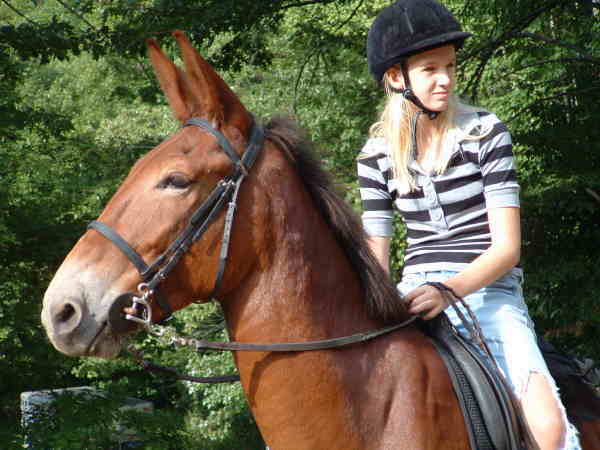 He is currently for sale but there is not much to say about him as the last 2 years he has been a very steady ride. That is very interesting Elizabeth and you highlight exactly one of the key reasons I believe this works: the horse does not feel punished but learns to rely and trust on the human to come and provide the essentials of life. I base this on the observation that by day 3 or 4 they are looking forward to see you and even though you come back into the round pen to put them back on the wall they come willingly and don't look at the wall as a threat as you latch them up. DrO |
| Member: cgby1 |
Posted on Saturday, Apr 19, 2008 - 9:27 pm: Hi All,Just thought that I would relate a story told to me many years ago, by an old cowboy on a stud colt he trained. He said that the colt was real arrogant and paid no attention to him. Then he kicked the cowboy. The cowboy gave him an attitude adjustment. He roped the horse and put him on the ground, tied him up like a calf and then covered him with a dark tarp. He covered the edges with dirt and left him to think for a little while. He told me that after he uncovered him and let him up that the stud never took his eyes off of him again or gave him any more trouble. I don't advocate doing this or even know if it works, especially for the mares that are being described here. It was over quickly but that horse was put in a vulnerable position so I can see how it would make him change his attitude, at least toward that cowboy. I am presently working with a big chestnut mare that I got for free. I brought her home Feb 29th, you can see her in "New to Dressage second year". So far, I am happy to say that her problems are small compared to what Moni is going through. Cynthia |
| Member: zarr |
Posted on Saturday, Apr 19, 2008 - 10:09 pm: Moni, when I helped at my friends barn there were 2 troubled mares both dangerous for everyone. One from fear and abuse one because she was in heat ALL the time. Finally they were both "fixed" and the change for one was amazing. She had cysts on her ovaries and once they were gone she became an excellent ride. It seemed to help the other mare for awhile until she grabbed one of the kids by his shoulder and threw him for several feet and then went after him, he had just fed her. So her owners gave up it was really dangerous and yet so sad! Perhaps your mare would benefit Lady certainly did! Cindy |
| Member: darlenh1 |
Posted on Sunday, Apr 20, 2008 - 1:14 am: Dr. Oglesby and fellow contributing members,Sadly, we have only heard from Moni twice, and both of her posts were at the very beginning of this forum. We don't know if Moni is being helped by or is even considering all or any part of our discussion. For all we know, Moni may have given up on us all and is seeking suggestions somewhere else. We all are truly concerned for Moni and her horses; however, the only history of the nature and needs of the two horses, we know of, is through Moni's initial post. Her second post seemed to reflect frustration, sadness, and confusion. We all have only a woefully small snapshot of her complex problem. For a problem as serious as the one she describes, Moni may wish to continue to seek help from equine professionals and veterinarians in her area who have a history with or will have a history with her and her horses. |
| Member: pfdusty |
Posted on Sunday, Apr 20, 2008 - 2:46 am: Hello again, a Thank You to all who have posted here and sorry for the late reply. I did keep up with all the postings but didn’t have the time to respond till now.I am going to try to fill in some info on the two girls in question. The mom’s name is Dallas and she is wearing a red halter in the old pictures. We named he daughter Tequila (with a kick) and she is wearing the blue halter. I do not have current pictures of Tequila but she is as pretty as he mom. Here is the link to their slide show (hope it works): [URL=https://s260.photobucket.com/albums/ii18/DTHR/Past%20Cases/Dallas%20and%20Tequila /?action=view¤t=dd66604a.pbw][IMG]https://i260.photobucket.com/albums/ii18/DTHR/Past%20Cases/Dallas%20and%20Tequila /th_DallasCounty016.jpg[/IMG][/URL] When they first arrived, they were quarantined together and both were lead into that area. The Vet arrived within 24 hrs to draw coggins etc. Dallas was standoffish but let us handle her. Tequila turned her butt to the Vet and ran (fast) backwards towards the Vet before we could even get her on a lead rope. So we put that on hold until they both settled in (or so we thought). I cleaned their quarantine area daily and it always seemed as if Tequila is protecting her mom, placing herself between mom and me. I only entered with a whip (just in case) but she never went out of her way to attack me as she had done with the Vet. I started feeding Tequila her grain over the fence and she accepted me petting her head while she got the grain as a reward. I never took the halter off. Dallas started to improve and enjoyed being petted while Tequila stood close by watching us like a hawk. Two weeks later we moved them into separate stalls. Dallas was happy to have Tequila out of the way but Tequila didn’t like it. They were turned out together and I always hand walked them into the field and back to their stalls in the evening. They both knew if they wanted to go outside they had to come “through” me and the same if they wanted to get their grain and hay. During that time Dallas was never in heat (how could she being in such poor physical condition). I could touch Tequila on the neck and chest even got as far as brushing her back. She was always tight and ready to blow. But it seemed as if she tried to be good. Once they both were physically in good condition (Tequila still wouldn’t let the Vet near and all we did was deworm her with a powder not to mention the farrier) we decided to separate the two. Dallas stayed with me and Tequila went to a foster home (we took both to the foster home and Dallas came back with me the same day). Dallas started going into heat about 2 months later. As I mentioned in the beginning post, it seems as if the longest for her to be out of heat is 3-7 days then being in heat anywhere between 4-6 weeks. I can handle her, and we are slowly introducing more people and about 4 weeks ago I was holding her while 2 others groomed her, including picking all 4 feet. I can give Dallas a shot while the lead rope is hanging over my shoulder. The only time she tried to intentionally kick was while she was in heat and the farrier wanted to trim her rear hoofs. He corrected her with a short smack (I expected her to go into panic mode) but she just took it and stood still. Second time was when the Vet wanted to do the ultrasounds and with 2 tranquilizers in her system, she double barreled backwards, barely missing the Vet. When I want to catch her in the pasture, she will choose to walk away and if I insist, she will threaten to kick me. Once it’s dinner time, she comes up to me and I put the halter on and we go in (no problem). She has bonded with me but on her terms not mine. I can work her on a longe line and she will work as long as it is positive voice, I have to ignore the bad and praise the good. She will chew and lick her lips just about the whole time. Again, when she is in heat it’s a different ball game. I can still handle her but she is unpredictable. Tequila: Once at her new foster home she had a pasture to herself. She has jumped a stall wall once (didn’t get hurt). She wouldn’t let anyone near her for months. Finally they managed to get her into the round pen and with the help of a trainer, they loaded her into the trailer by making the pen smaller and smaller. She was with the trainer for 5 weeks and as I mentioned he did ride her but said she is unpredictable and never does the same thing twice. He also mentioned that she is aggressive and NOT scared of people. She went back to the foster home where she has a large paddock and gets fed in the “stall portion of the paddock, which is open. She can come and go as she pleases. One day the fosters went in to clean the stall area and even though she had the choice to move away, she chose to paw the ground, rear and attack. Nobody was hurt but it showed her aggression had developed into a new level. To this day, her feet can not be touched and the only way to catch her is through the round pen and taking the panels out. It seems as if after being at the trainer she hates us people even more. Bottom line: I believe I can change Dallas if I can get her heat cycle under control and she is a mix between dominant and terrified. But with Tequila we are at the end. She is beautiful and floats when she runs. She is put together very nice and the trainer said she rides and feels very athletic. But what if someone would fall off? Would she try to kill them? Is living in a field, while never being able to get touched a good life? Is it fair to Tequila to never get vaccinated or her feet trimmed? Both are naturally gaited. I do not know what else to say. I feel guilty in many ways. I feel bad for what all happened to the 2 before we got involved. I can only imagine and am not sure I want to. We have contacted many people and did not have any success finding an affordable solution. We can not afford to pay hundreds or thousands of dollars to a trainer with uncertain outcome. By now you probably think we are crazy for doing all this, but we want to make sure have tried everything humanely possible to rehab them, especially Tequila. We don’t want any “could haves, would haves, should haves ” after it is too late. |
| Member: paardex |
Posted on Sunday, Apr 20, 2008 - 5:04 am: Moni, First of all I think you should stop feeling bad according to this post you did everything in a way any normal experienced horseperson would have done just met two horses who need more then that and for that you are now asking help and advice.Hearing your story of Dallas: I've had a few horses resembling the picture you draw. I own one at the moment with the characteristics you describe I call her 'dominant very intelligent high strung she panics easily and then you'd better get out of the way'. A very good professional studfarm confirmed my idea and when dealing with her carefull she poses no problems at all and is a very talented horse. They DID however stress they agreed with me it was NOT and would never be an amateurs horse[by lack of other description] they deemed as I do the risk of an accident to big.BUT she has a normal cycle and is now waiting for a foal [from a stallion with a VERY good character and after a lot of deliberation on my part] and even being pregnant made her already a lot easier. I did have some mares with the heatcycle you describe and they were a a pain in the..... when in heat. I would try to get her to a good clinic or studfarm [In Europe University clinics are good and less expensive] but at a good studfarm normally they are used to difficult mares to[some react strange to calming products but better to others? is what I am told ] and find out what is wrong with her. Perhaps she is just multifollicular? You never know. If it turns out she needs very expensive treatment you can reconsider but don't expect the worst immediately. On the training of Tequilla others will be better in advising you how to deal or advise the people where she is now, but it does sound as if retraining is still a possibility although she does not sound like 'the right horse at the right place'. I've seen more stories like this with happy endings on this board. Good luck Jos PS I do not think you are more crazy then the rest of us horselovers 
|
| Member: scooter |
Posted on Sunday, Apr 20, 2008 - 7:17 am: Moni how long was the mare on regu mate? Sometimes it takes a month of being on it to get them regulated. I had a mare boarded here that was much as you describe your mare. I insisted the boarder put the mare on regumate or move her. When she was in heat, which seemed to be constantly she was unpredictable and witchty. So bad I decided I would never own a mare again! Just in case I got one like her and I'm not kidding.After a mo. on the regumate, she turned into a sweet horse(for her)and was very manageable. Tho I know Regu-mate isn't cheap, maybe if you could try it for a few mos. it may give you and idea if is indeed her cycles giving her the attitude. It is very important not to miss any dosages so you do have to be available to give it. All the mares I have known on it eat it willingly in their feed. The boarded horse here was able to go off of it for a couple mos. in the winter, but had to start it back up around FEB. the other people just kept their mares on it year round as didn't want to risk the behavior returning. Good Luck |
| Member: paardex |
Posted on Sunday, Apr 20, 2008 - 8:03 am: One of my mares [multifollicular during spring]was put on regumate because she went with stallions to shows[in one van] and all of them forgot about their work but she became very studdish and difficult to handle on regumate. Thought I'd mention this Jos |
| Member: scooter |
Posted on Sunday, Apr 20, 2008 - 8:20 am: Funny you should mention that Jos, the mare that was boarded here was just the opposite, when in heat she would ride my MARE! I had never seen a mare ride another mare in all my days before that mare.That behavior stopped also with the Regu-mate. I guess it just goes to show medicines affect individuals differently. Might be worth a try if it doesn't work it easy enough to remove from the diet 
|
| Member: ajudson1 |
Posted on Sunday, Apr 20, 2008 - 10:50 am: DrO;You are correct in saying that my post didn't relate to the situation you described. The "rope through the wall" brought back some emotional memories and I apologize for getting off track. Moni, Now that I've read your more in depth second posting, I am thinking differently in what to do with this mare. Your story doesn't sound so far out there now as I experienced the same sort of thing with a malnourished filly we got 5 years ago. Although she is not a severe as Dallas with her aggression, we did see a big change once she got some groceries in her, and yes, she gets very witchy as she goes through her cycle. I agree with the others that you need to work on the hormonal things first, and look for physical issues. And safely continue training when you can do so. The filly sounds like she needs an attitude adjustment is all! We're all a little bit crazy when it comes to our horse relationships, welcome to the club!! LOL! |
| Member: sunny66 |
Posted on Sunday, Apr 20, 2008 - 11:08 am: This sounds like a VERY tough situation and I commend you, Moni, for all that you've done for this filly!!! I have no suggestions, but questions:If her feet haven't been done (am I correct in that her feet have never been done since you've had her?) She's most likely in pain from that. Pain is surely to escalate aggressiveness I think. so, for example, if she won't let a farrier near her, how would you fix this? Tranqs don't work with her I understand? Wouldn't something need to be done to make her understand that she needs to trust "someone" in order for her to feel better? Has anyone ever "laid her down"? Could a vet "put her out" then have a farrier do her feet while she's laying down?... then have the vet do what he/she needs to do while the mare is out? |
| Member: kathleen |
Posted on Sunday, Apr 20, 2008 - 11:19 am: Moni,This is just a thought and you may think it is way out there, but you might try contacting some of the big "natural horsemanship" gurus and see if they or one of their certified trainers would like to take on a project, maybe to prove that their technique works. They are very gentle and don't hurt the horse, so you won't have to worry about them being abused. And in case it is physical they might be able to tell you. Some suggestions are Frank Bell, Pat Parelli, Dennis Reis and maybe Clinton Anderson. Just a thought, would really like to see a happy ending to this story. Kathleen |
| Member: pfdusty |
Posted on Sunday, Apr 20, 2008 - 12:20 pm: Thanks again to all!In regards to Tequila's feet: somehow she manages to wear her toes down enough to the point where her feet look better than some other horses who get done by the farrier regularly (that's about the only good thing). We are currently awaiting a response from some Parelli people, if anyone would be interested. We just about had something set up with Monty Roberts but didn't work out at the end. We haven't given up on Tequila yet but at the same time we are aware she needs a more experienced/professional place to go to, we are not horse experienced enough for a caliber like Tequila. My Vet is currently checking into another drug to try for Dallas (I don't know the name) but if it is affordable we will try it first. I also agree that if we can push her out of cycle then we can evaluate better how much of the behavior is due to the heat cycle. I really appreciate every single reply. Sometimes other people who do not have their hearts involved see things different and have other ideas. I also wanted to mention something very positive: If I pet Dallas on a certain spot, she will DrOp her head all the way to the ground and fall asleep, loving every minute of it .
|
| Member: lilo |
Posted on Sunday, Apr 20, 2008 - 12:34 pm: This has been an interesting discussion. I was particularly interested in the method described by Dr.O. The way I am thinking about that approach is similar to what Xenonophon said 2000 + years ago - the horse must learn that all good things, food, water, comfort come from man .... (not a literal quote). So, the horse is left standing in a safe place where it cannot hurt itself. It is hungry and thirsty, and once a day a human comes and takes it to a pen with water and food. Then back to the wall. After a few days of this, the human is identified with the good in life (water, food, the ability to move around). This then translates to a different attitude toward humans.Something like that happened to my first horse (before he was mine). He was a thoroughbred, accident prone and not very big, and stalled at the stables where I hung out. Eventually they turned him out in a nearby pasture, alone. Unfortunately, they did not always fill his water trough and I took to checking on him, and filling his trough when needed. So - when he saw me coming, he knew he would be OK and I would provide him what he needed. This led to a very close bond between us (I later bought him - yes, I know, green horse, green rider, but, I learned so much ...) Lilo |
| Moderator: DrO |
Posted on Sunday, Apr 20, 2008 - 6:22 pm: Cynthia, it has been over 20 years since I have seen that done but at one time casting and covering was pretty standard cowboy practice and in the cases I observed and could follow, it did achieve the goal of a more malleable steed. To those who would jump and say that this must lead to mistrust between the horse and trainer I would point out that some of the most trustworthy herd members are those that have fought the leader and lost while some of the most aggressive and mistrustful horses are the leaders of the band constantly fighting to keep that position. I do like to think that current popular training techniques address most of the common problems with green horses in a better fashion but we can see the results of judgment without understanding already.Moni, you are the only one who can decide what is best for you and agree with everyone's assessment that personal safety is the first rule. Keep us appraised of how things are going. One more thought whereas before it sounded like there was no positive point to start from your last post gives one more possible avenue check out Training & Conditioning Horses » Behavioral Problems » Behavior Modification, Conditioning, Desensitization, and Counterconditioning. DrO |
| Member: darlenh1 |
Posted on Monday, Apr 21, 2008 - 1:14 am: Hi Moni,It is so good to hear from you again. Your detailed information has added new insight to your horses' well being and food for thought for all of us. I loved what you said about petting Dallas resulting in the DrOpping of her head. It always amazes me and gives me a feeling unlike any other when beings so big as my horses respond so fondly to my touch. The questions posed to Moni by Diane E., Jos, and Aileen caused me to reflect on my own experience. My professional career was one of continually trying to understand the emotional and physical needs of my students first and adjusting their learning accordingly. As a teacher, I questioned everything relating to each individual student. I relied on the student, their parents, and others who had contact with this student for more information. The more I questioned the more I learned about the student. The answers to my questions enriched and honed my skills, moreover, the answers to my questions often caused me to reconsider my position regarding the nature and needs of each student. The more information I had, the more I tried to adjust or keep what worked. The teacher had his teachers in the student, the parents, and others. As humans, it is in our nature to question in order to learn. Moni has given us more information about her horses. To learn more about Moni's concerns Aileen in her post directs questions to Moni stemming from her own experiences. The more we question the more answers we have to digest and evaluate which leads to more questions and more answers and so on. Kathleen Wheat suggested natural horsemanship as a way to help Moni. Abraham Maslow set up a hierarchic theory of needs. All of his basic needs are instinctoid, equivalent of instincts in animals. The first is physiological, and these are biological needs such as the need for oxygen, food, and water. They are the strongest needs, because if an animal such as the horse were deprived of all other needs, physiological needs would come first to the horse. When all physiological needs are satisfied and are no longer controlling the horse's behavior, the need for safety or security can become active and the lack of which is often disclosed by insecurity. When the needs for safety and physiological well-being are satisfied the need for belonging to a herd can emerge. Once the first three needs are satisfied, the individual's need for adjusting positive or negative behaviors are done so that the individual may continue to belong to the herd. The herd is comprised of individuals mutually relying on and seeking others to help them satisfy the physiological, safety, and belonging needs. Herds are comprised of more than one individual. A herd can be as small as two. The herd in order to satisfy its basic needs relies on those individuals it perceives as the ones who can most effectively attain and maintain the first three needs. In the human herd, we often call these trusted individuals leaders. We learn from these individuals the ways to attain and maintain our first three needs. Adaptations in the hierarchy are made for each species in the animal kingdom based on the nature of the species. What is basic is that each need must be met before moving on to the next in the hierarchy, and any threat to physiological and safety needs causes individuals in a herd environment to seek out those who can regain these two needs. The best definition I have found for natural horsemanship comes from a synopsis of several of its noted practitioners. It is the philosophy of training horses by appealing to their instinctual needs. It involves communication techniques derived by wild horse observation in order to build a partnership between human and horse that closely resembles the relationships that exist between horses. My own education on the training of horses came early in my life. All that I did learn from my grandfather and father about working with horses came before the term "natural horsemanship" was used. When I read the books entitled Believe:A Horseman's Journey by Buck Brannaman, True Horsemanship Through Feel by Bill Dorrance and Leslie Desmond and Lyons On Horses by John Lyons with Sinclair Browning, I realised that my grandfather's and father's teachings coincided with and were not far from the beliefs and teachings of these horsemen. As a result of my early training and, later, my readings, I had to know more about training horses with the natural horsemanship philosophy. I sought out professionals versed in the teachings of John Lyons, Buck Brannaman, Bill Dorrance, and Pat Parelli, who could train me in the techniques used by these horsemen to train my own horses. It is amazing how these professionals work with the needs of horses. I found a quote by Buck Brannaman from his book. "I've started horses since I was twelve years old and have been bit, kicked, bucked off, and run over. I've tried every physical means to contain my horse in an effort to keep myself from being killed. I started to realize that things would come much easier for me once I learned why a horse does what he does." |
| Member: cgby1 |
Posted on Monday, Apr 21, 2008 - 3:21 am: Thanks Dr. OMoni, if it doesn't work out with the Parelli folks, you might also try contacting Chris Cox. As a kid on an island off the coast of Australia, he trained wild brumbie's and when he came to the U.S. he set up the training of wild mustangs by prison inmates in, I think, New Mexico. I think he has as much skill and experience as the others already mentioned. He also won the last two "Road to the Horse" contests. |
| Member: kathleen |
Posted on Monday, Apr 21, 2008 - 10:03 am: Edward, I think you put it in a nutshell. Bravo to you.Kathleen |
| Member: pfdusty |
Posted on Monday, Apr 21, 2008 - 11:57 am: Wow,I am very happy that I am a part of this forum. I did not expect to get this much information on a topic regarding "troubled" horses. We will continue to try to find ways to correct the problems at hand. As I mentioned, I believe Dallas' problems will be "easier" to address than Tequila's. I will keep you guys informed on our progress. Again, thank you all so very much for your time and suggestions. |
| Member: darlenh1 |
Posted on Monday, Apr 21, 2008 - 11:58 am: Thank you Kathleen. I appreciate your comment.Edward |
| Member: darlenh1 |
Posted on Monday, Apr 21, 2008 - 4:10 pm: Moni,I will be very interested in the ways you used to correct the problems as well as the results. |
| Member: kpaint |
Posted on Monday, Feb 1, 2010 - 12:26 pm: Found this discussion while reading about Regumate...anyone know what happened with Dallas and Tequila? |
is The Horseman's Advisor
Helping Thousands of Equestrians, Farriers, and Veterinarians Every Day
All rights reserved, © 1997 -
