Site Menu:
| This is an archived Horseadvice.com Discussion. The parent article and menus are available on the navigation menu below: |
| HorseAdvice.com » Diseases of Horses » Lameness » Diseases of the Spine, Back & Pelvis » Lower Back Pain in Horses » |
| Discussion on Back/hip pain? | |
| Author | Message |
| New Member: winton |
Posted on Thursday, Feb 21, 2008 - 6:04 pm: Hi, I'm hoping someone may have some ideas to help me. I have a 22 year old gypsy cob type mare, just over two weeks ago I noticed she was reluctant to DrOp her head to her feed bowl on the floor, although she seemed to have no trouble grazing. The following evening she seemed a little uncoordinated with her back legs while negotiating the hill from her paddock to the barn. I called the vet out the next day. After watching her walk forward, backward, in circles and up and down hill she decided that she had probably slipped badly or fallen out in the paddock and strained some muscles. She gave her an injection of Banamine and prescribed bute for a few days, but said I could continue to turn her out. 4 days later I felt that she was unsteady enough on her back legs that turning her out was no longer an option,due to the danger of her falling. My vet came out again, this time she did a rectal exam and found no evidence of any pelvic problem. Rocking her from side to side whilst applying pressure above the hip area did result in the mare showing signs of discomfort around the area of the left hip, (ears back,and trying to bite, very unlike her normal placid nature). The diagnosis was some type of traumatic injury to the hip, possibly from falling and landing hard on it. The vet doesn't think it is a neurological problem as she says the symptoms are so localized and it came on so acutely. She recommended stall rest and twice daily bute. Since then there has been no real change, my girl is still very unsteady on her back legs, but everything else is fine. Eating well, temp, pulse, respiration normal. She did have one day this week when she was worse, I think she either fell or lay down and had trouble getting up. I found her with a slight abrasion above her left eye, and very reluctant to move. Since then she has gone back to just being generally wobbly and unsteady.Would a hip injury cause this amount of instability in the back end, or should we be looking at something else? I should just point out that I have had this horse since she was about 10 months old and there is no history of any previous injury, she is semi-retired and only in very light work, but again no history of any abnormalities when ridden. Living in Bermuda makes it just about impossible to conduct much more in the way of diagnostics. We have only 2 vet practices on the island and they are both mainly small animal. There is no chance of x rays, or more sophisticated techniques without shipping her off the island, which is obviously not an option in the condition she's in! Any advise on similar problems, possible diagnosis, prognosis etc. If a hip injury is the problem, how long before I could reasonably expect to see any improvment. I don't care if I can't ride her any more, I just want to see her comfortable. She's been part of our family for a long time. |
| Moderator: DrO |
Posted on Friday, Feb 22, 2008 - 6:15 am: Welcome Kathy,Because we cannot observe the "instability" we cannot answer whether the clinical signs match the diagnosis. There are many muscoskeletal injures of the rear limb/pelvis that can prevent a horse from walking well so it is possible this is as the vet says and the best treatment and a accurate prognosis will depend on a correct diagnosis. It should be possible to take a good stab at whether this is muscoskeletal (pain) or neurological (incoordination and/or weakness) from the appearance of the gait abnormalities and you can learn what each look like and how they differ by studying the articles on the clinical appearance of hind limb lameness and incoordination. For these descriptions see 1) Diseases of Horses » Nervous System » Incoordination, Weakness, Spasticity, Tremors » Diagnosing Incoordination, Ataxia and Weakness 2) Diseases of Horses » Lameness » Localizing Lameness in the Horse. Many causes of lameness go undiagnosed so they are treated "empirically", which means the symptoms but not the actual cause is treated. For more on some thoughts on this type treatment see, Diseases of Horses » Lameness » First Aid for the Lame Horse. Let us know what you decide or if you have any questions about what you read. DrO |
| Member: ekaufman |
Posted on Saturday, Feb 23, 2008 - 12:32 am: Hi Kathy,Wish I could help you diagnose this problem. Since you don't have access to a lot of help, I wanted to pass along something that I tried with great success for a pony of mine who tore a psoas muscle many years ago. She apparently hyper-extended herself (possibly through a fall or taking a kick-- who knows). She was extremely painful, and I laid her up for 5 months with no improvement. One night, I realized that I needed either to put her down or come up with some approach that would let her heal. For her particular injury, I realized that gravity was the main enemy-- the longer she stood around with her belly DrOpping, the worse the injury became. The solution was Operation Pony Girdle. I ordered a large orthopedic bandage and rigged a breastplate. She wore the horror pictured below for 8 weeks (that was day 1, and she hated it). She healed, and I still have her today. This may help you brainstorm ways to help your mare, if it's NOT neurological and you don't have access to fancy treatment. Good luck. 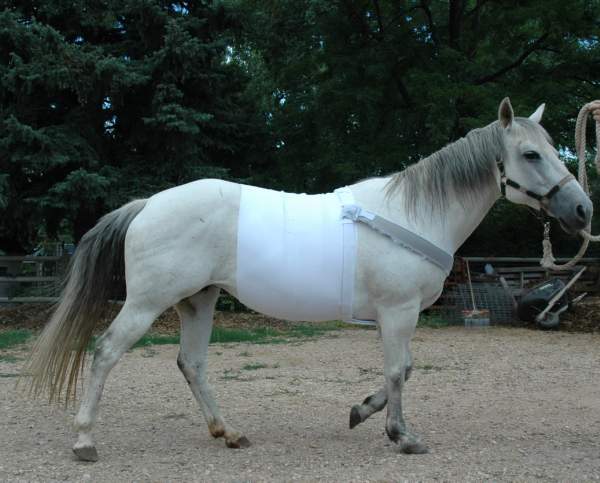
|
Horseadvice.com
is The Horseman's Advisor
Helping Thousands of Equestrians, Farriers, and Veterinarians Every Day
All rights reserved, © 1997 -
is The Horseman's Advisor
Helping Thousands of Equestrians, Farriers, and Veterinarians Every Day
All rights reserved, © 1997 -
