Site Menu:
| This is an archived Horseadvice.com Discussion. The parent article and menus are available on the navigation menu below: |
| HorseAdvice.com » Diseases of Horses » Skin Diseases, Wounds, and Swellings » Bumps / Nodules / Warts / Tumors » Squamous Cell Carcinoma » |
| Discussion on Black hole in mouth with "cauliflower" growing out? | |
| Author | Message |
| New Member: lmh1965 |
Posted on Tuesday, Jun 10, 2008 - 10:11 pm: My 22yo gelding has some odd growths in his mouth.In two places, one behind each of the two outermost incisors, he has a black hole with a cauliflower looking growth coming out. If he were to close his mouth, he has a growth that looks like an ulcer or scar tissue where the holes would touch his tongue. He has had the tongue issue for over a year-it almost looked like scarring from contact with his canines. Two weeks ago and equine dentist thought it was scarring as well until she looked inside and found the cauliflower growth in his mouth. It is not something you would easily see without really going in to look! She has sent tissue samples to be tested and we are awaiting results. He is a Cushing's horse so the initial thought was an oral infection from the Cushing's The odd part is the symmetry of the growths and the adjoining tongue (or the tongue caused the hole in the roof behind the teeth-no idea which came first, but the roof 'abscess/growth looks more daunting). She thought perhaps some kind of cancer-but this again seems odd because of the symmetry. While waiting on results I thought I would see, Dr O, if you have any thoughts. |
| Member: paul303 |
Posted on Tuesday, Jun 10, 2008 - 11:30 pm: Oh, my. When you say "dark hole", is it an actual hole, or a darkening of the tissue? And when you say cauliflower, is it pedunculated? Is it a soft or hard growth, and can you move it?Hope you'll let us know the results. Good luck! |
| Moderator: DrO |
Posted on Wednesday, Jun 11, 2008 - 6:30 am: Hello Leah,Both cancer and some types of infection, particularly some of the chronic fungi might have such a shape (ulceration associated with a cauliflower growth) as you describe so we will have to wait for histopath. Also chronic inflammatory changes often take on a warty look. If truly black, the color is a bit odd as the tissue in the mouth of horses is rarely pigmented that far back and this suggests melanoma to me but it will require hisotpath to settle this. DrO |
| New Member: lmh1965 |
Posted on Wednesday, Jun 11, 2008 - 6:38 am: OK...the report says the following:Eroded squamous plaques with bacteria and chronic purulent inflammation The dentist/DVM that was here is consulting a specialist at the local animal hospital, UGA so I should know more after that. I really don't understand what it means at this moment, but it sounds like a combination of things? |
| Moderator: DrO |
Posted on Thursday, Jun 12, 2008 - 6:08 am: Hmmmm it finds inflammation and that is not surprising and it finds bacteria which you always find in the mouth: are there any indications the bacteria are pathogenic or incidental? Are cultures running?DrO |
| New Member: lmh1965 |
Posted on Thursday, Jun 12, 2008 - 7:45 pm: I still have no new news...To my knowledge no cultures are running-but that would have been a good idea.I am still waiting on the consult from the university specialist so hopefully will hear soon. I do have photos though! 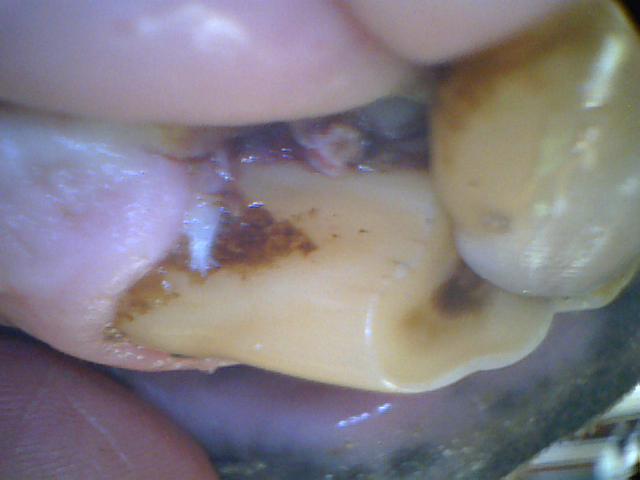 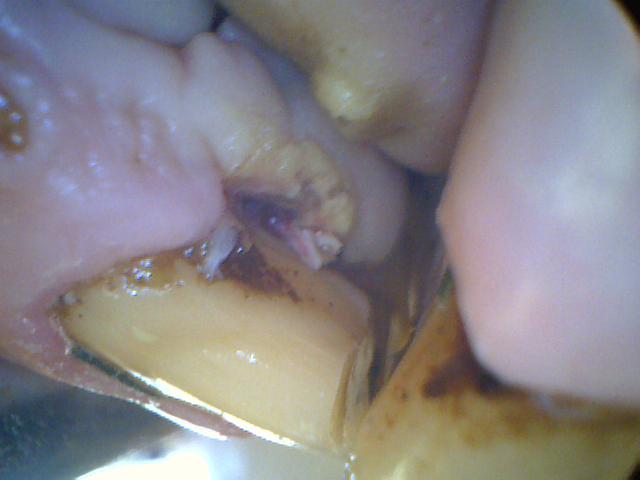 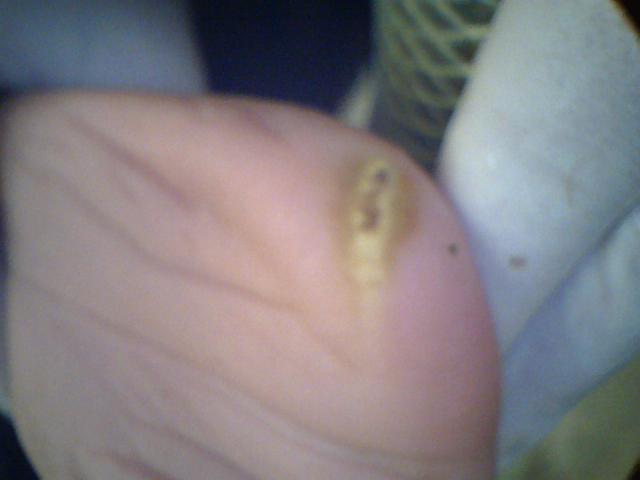 The middle one is the best-you can see the cauli-hole and the tongue scar/ulcer on the same photo. |
| Moderator: DrO |
Posted on Friday, Jun 13, 2008 - 6:39 am: Ulceration with infection and necrosis Leah. How about a three time daily application of a 50/50 mixture of peroxide with chlorhexidine using a syringe to squirt the effected areas? Of course if there is cancer at the bottom it will not fix that but until someone demonstrates it that would be my first choice of treatment. Any history of foxtail exposure?DrO |
| New Member: lmh1965 |
Posted on Friday, Jun 13, 2008 - 7:05 am: Thanks Dr O! That is very helpful to do SOMETHING that won't be harmful and possibly helpful until we know more.I don't know of any foxtail exposure. I am in Georgia so it is possible? Thank you again and I will post any updates. |
| Member: scooter |
Posted on Friday, Jun 13, 2008 - 7:17 am: Hi Leah along with foxtail, my old girl loves thistles, soon as she starts eating them she gets sores similar to your boys and starts quidding. I have to lock her off the pasture until I get the thistles killed. They didn't seem to bother her other than the quidding. I had the vet look at it and he said to lock her off the pasture and make sure hay was thistle/foxtail free, give bute for some reason and her mouth was fine in a couple weeks. Dr.O.'s suggestion sounds great, wish my vet would have thought of that.Hope it is something as simple...Good Luck |
| New Member: lmh1965 |
Posted on Friday, Jun 13, 2008 - 7:33 pm: Diane-now THAT is something I know about (thistle). I was just thinking, after Dr O's foxtail suggestion, that i needed to go on a thistle hunt-sure enough there are a few plants.So starting this weekend, Operation Thistle Removal is underway. |
| Moderator: DrO |
Posted on Saturday, Jun 14, 2008 - 8:32 am: Foxtails are very common in the SE USA but it is too early for seedheads in the pasture they would have to be in the hay. To see what they look like see, Diseases of Horses » Colic, Diarrhea, GI Tract » Mouth, Esophagus, and Liver » Disorders of the Mouth and Teeth.DrO |
Horseadvice.com
is The Horseman's Advisor
Helping Thousands of Equestrians, Farriers, and Veterinarians Every Day
All rights reserved, © 1997 -
is The Horseman's Advisor
Helping Thousands of Equestrians, Farriers, and Veterinarians Every Day
All rights reserved, © 1997 -
